













- ホーム
- Blogs
- Simulation Technology
- Understanding 10K Ohm Resistor: 10K Ohm Resistor Color Code
Understanding 10K Ohm Resistor: 10K Ohm Resistor Color Code
How to identify 10K ohm resistor color code? We often encounter this problem when designing and repairing power supply circuit boards. 10K ohm resistors are divided into 4 band, 5 band and even 6 band, which sounds very complicated, below we will answer these questions in detail, explore what is a 10K ohm resistor and analyze how the color code is composed and identify it.
What is a 10K ohm resistor?
A 10K ohm resistor is a passive component, one of the three major passive devices, with a resistance value of 10,000 ohms (Ω), often abbreviated as “10K”. Resistors are used on electronic circuit boards to limit the flow of current, divide voltage, dissipate energy, and form time delays with capacitors. Its resistance value depends on temperature, material, length, and cross-sectional area. When a current of 1 amp is passed through a 10K ohm resistor, a voltage drop of 10 volts is produced. In addition, 10K Ohm Resistors are widely used in various electronic devices and circuits, such as analogue circuits, digital circuits, and filters, and are indispensable components in electronics.
10k Ohm Resistor Color Code
The colour code of a 10K Ohm Resistor usually consists of four colour bands, which are used to visually represent its resistance value and error range.
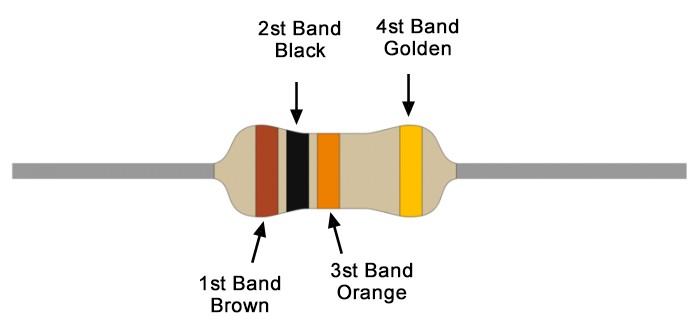
The colour code sequence for 10K ohm resistors is:
1st Band of Color Code: Brown
2nd Band of Color Code: Black
3rd Band of Color Code: Orange
4th Band of Color Code: Gold
When identifying the color code of 10K ohm resistors, you need to find the first band brown from the left first to avoid starting from the wrong reverse.
10K Ohm Resistors Power
The power of a 10K ohm resistor refers to the maximum power that the resistor can withstand under normal operating conditions. The amount of power depends on the size of the resistor, material, heat dissipation conditions, and other factors.
The power of common 10K ohm resistors are 1/8 watt, 1/4 watt, 1/2 watt, 1 watt, 2 watt and so on. Of these, 1/4 watt and 1/2 watt resistors are more common, while 1 watt and 2 watt resistors are typically used in applications that need to withstand higher power.
When choosing resistor specifications, the power of the resistor is not as high as possible, but rather the proper power needs to be chosen for the specific application. If the power of the resistor is too high, not only will it waste energy, but it may also lead to safety issues such as overheating, damage or even cause fire. Therefore, when choosing a resistor, you need to choose the right power according to the actual demand and circuit conditions.
10k ohm resistor color code 4 band
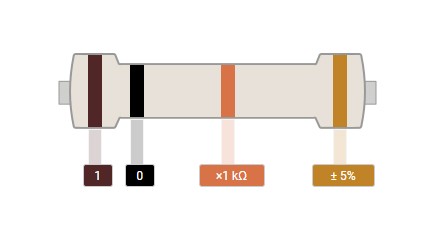
4 Band 10K Ohm Resistor Color Code Calculation Table
| Number of band | Colour | Function | Value |
| 1 | Brown | The first digit | 1 |
| 2 | Black | Second digit | 0 |
| 3 | Orange | Multiplier | 1,000 |
| 4 | Gold/Silver | Tolerance | Gold represents ± 5% Silver represents ± 10% |
| Calculation | 10K ohm |
The color code algorithm for 10K ohm resistors follows the international standard in the electronics industry, the EIA/IEC color coding system. This system uses the first two color bands for numbers, the third color band for multipliers, and the fourth color band for tolerances. For a 10K ohm resistor, the color code algorithm is as follows:
1st Band of Color Code: brown represents the number 1.
2nd Band of Color Code: black for the number 0.
3rd Band of Color Code: multiplier, orange represents the multiplier 1,000 (i.e., to the third power of 10).
4th Band of Color Code: tolerance, gold or silver is usually used to represent the tolerance, gold for ±5% and silver for ±10%.
So the color code for a 10K ohm resistor is:
Brown (1)
Black (0)
Orange (multiply by 1,000)
Gold or Silver (tolerance)
This means that the resistance value is 10 (1+0) times 1,000, which is 10,000 ohms, or 10K ohms. Tolerance bands indicate the range of resistance values above and below the nominal value. For example, if a 10K resistor has a tolerance of ±5%, its actual resistance value should be between 9.5K ohms and 10.5K ohms.
10k ohm resistor color code 5 band
In a 5-band resistor, the first 4 band indicate the effective number and multiplier, and the 5th band indicates the error level. By reading the colors of these bands, we can calculate the resistance value of the resistor.
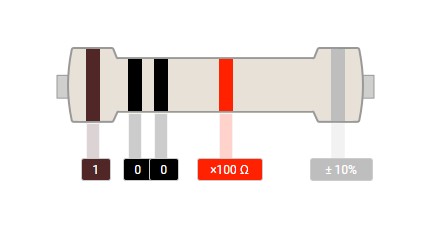
Color Codes for 5 Band 10K Ohm Resistors
| Number of band | Colour | Function | Value |
| 1 | Brown | The first number | 1 |
| 2 | Black | Second digit | 0 |
| 3 | Black | Third digit | 0 |
| 4 | Red | Multiplier | ×100 |
| 5 | Gold/Silver | Tolerance | Gold represents ± 5% Silver represents ± 10% |
| Calculation | 10KΩ |
In a 5 band resistor, the first 4 bands indicate the effective number and multiplier and the 5th band indicates the error level. By reading the color of these bands, we can calculate the resistance value of the resistor.
The color code for a 5-band 10K ohm resistor is usually “Brown-Black-Orange-Gold” or sometimes “Brown-Black-Black-Red-Gold”, depending on the manufacturer and the accuracy of the resistor. It depends on the manufacturer and the accuracy required of the resistor.
1st Band of Color Code (Brown): Indicates the number 1, which is the first valid digit of the resistance value.
2nd Band of Color Code (Black): Indicates the number 0, which is the second valid digit of the resistance value.
3rd Band of Color Code (Black): Indicates the number 0, which is the third valid digit of the resistance value.
4th Band of Color Code (Red): Multiplier, represents x 100, the previous three digits multiplied by 100, i.e.: 100 x 100Ω = 10,000 ohms = 10K ohms
5th Band of Color Code: Tolerance, gold or silver color is usually used to indicate the tolerance, gold represents ±5%, silver represents ±10%.
Calculating Resistance Value
Based on the above color code, we can calculate the resistance value of 5 Band 10K Ohm Resistors:
A 10K ohm resistor with 5 bands “Brown-Black-Black-Red-Silver” has a resistance value of 100 × 100 = 10,000 ohms with a tolerance of ± 10%.
10k ohm resistor color code 6 band
For 10K Ohm 6-Band resistors, the color code usually follows the following rules:
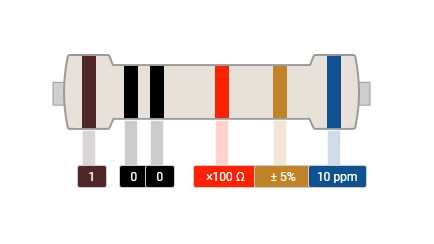
Valid Numbers 1, 2, 3: These color band represent the first three valid numbers of the resistor value. In 10K ohm resistors, these numbers are usually “100”. According to the color band coding table, brown represents 1 and black represents 0. Therefore, the colors of these three bands are brown, black, and black in that order.
Multiplier (×100): This color band indicates that the resistance value needs to be multiplied by 100 ohms. In a 10K ohm resistor, red represents 100 ohms, so this color band is red.
Tolerance: This color band indicates the allowable deviation range of the resistance value. Common tolerances are ±1%, ±2%,±5%, and ±10%. In most standard resistors, the tolerance is ±5%, and the corresponding color band color is gold. Therefore, this color band is usually gold.
Temperature Coefficient: This color band indicates how much the resistance value varies with temperature. Different resistor materials and processes will have different temperature coefficients. In 6-band resistors, this color band is optional and is used to indicate the stable performance of the resistor. If the resistor does not have special temperature requirements, this color band may not be used. For resistors that need to indicate the temperature coefficient, it can be selected based on specific requirements. For example, blue color represents 10ppm, a lower temperature coefficient value.
Temperature Coefficient Table
In a color band resistor, the 6th band is used to indicate the temperature coefficient of the resistor. The temperature coefficient characterizes the change in resistance value with temperature. However, not all color band resistors have a 6th band, which usually depends on the accuracy and purpose of the resistor. Below is a simplified temperature coefficient table listing the possible colors and the corresponding temperature coefficients (PPM/°C, i.e., how many parts per million change per degree Celsius)
| Colour | Temperature coefficient (ppm/° C) |
| black | 0 |
| brown | 100 |
| red | 50 |
| orange | 15 |
| yellow | 25 |
| green | 50 |
| blue | 10 |
| Purple | 5 |
This table is based on common industry standards and practices, but not all manufacturers adhere strictly to these color codes. In practice, it is necessary to refer to the technical specifications or data sheets provided by the resistor manufacturer to determine the exact temperature coefficient.
In addition, if the resistor does not have a band 6, it may not have a specific temperature coefficient marking, or that information may be provided in the resistor's product specification or data sheet.
It is also important to note that the temperature coefficient can be either positive or negative, determined by the type of resistor color-coded material. In the table above, we have assumed a positive temperature coefficient, i.e., the resistance value increases with increasing temperature. However, some resistive color coding materials may have a negative temperature coefficient, meaning that the resistance value decreases with increasing temperature.
Pull-Up and Pull-Down 10K Ohm Resistors
Pull-up and pull-down 10K ohm resistors are commonly used components in circuit layout design to ensure stability and certainty of signals during transmission. The moderate resistance value of 10K ohm resistors provides a good balance between not consuming excessive current and sufficient to provide a stable signal level for the circuit board.
Function of Pull-Up/Pull-Down Resistors
Pull-up and pull-down resistors are mainly used for the following purposes:
Stabilizing the signal level: preventing the input from dangling and ensuring that the input maintains a defined level state when there is no signal to drive it.
Enhance driving capability: In circuit design, pull-up resistors can provide extra current to enhance the driving capability of the circuit.
Reduce Noise Interference: A pull-up or pull-down resistor can be used in a circuit design to
Reduce noise interference: Through pull-up or pull-down resistors, noise on the signal line can be reduced to improve the circuit's anti-interference capability.
Protect circuits: In some circuit boards, pull-up/pull-down resistors can be used as protection elements to prevent circuits from being damaged by static electricity or abnormal voltage.
Application Scenarios for 10K Ohm Resistors
Microcontroller I/O ports: In the input ports of microcontrollers, pull-up 10K ohm resistors are used to ensure that the ports are kept high when no signal is present
The
Open-drain or open-collector outputs: In transistor circuits with open-drain or open-collector outputs, a pull-up 10K ohm resistor is used to pull the level high and ensure that the output signal has a clear high state.
Voltage divider for analogue signals: In analogue circuits, 10K ohm resistors can be used in voltage divider circuits to provide the required reference voltage.
Matching of CMOS circuits: In the interface between TTL and CMOS circuits, 10K ohm resistors can be used for level matching to ensure proper signal transmission.
How to Choose Pull-Up/Pull-Down 10K Ohm Resistors
The following factors need to be considered when selecting a pull-up/down 10K ohm resistor:
Power Consumption and Driving Ability: the larger the resistor value, the lower the power consumption, but the weaker the driving ability. 10K ohm resistors are usually a compromise choice, providing enough driving ability without consuming too much current
Signal Speed: In high-speed working boards, the signal speed can be very high.
Signal Speed: In high-speed operating circuit boards, a resistor value that is too large may cause the signal edge to slow down. 10K ohm resistors are usually suitable for not-too-high signal frequencies.
Signal speed
The noisy environment of the circuit: In a noisy environment, it may be necessary to use a lower-value resistor to provide more drive capability against external interference.
Supply Voltage: The value of the pull-up/down 10K ohm resistor should be matched to the supply voltage to ensure that the correct level is provided in all cases.
How to Make a 10K Ohm Color Band Resistor
Making a 10K ohm color band resistor is difficult for individuals in a home environment because it requires precise measuring tools and materials. However, I can provide a simplified guide to how resistors are made in the industry:
1.Selecting materials: first, determine the material of the resistor, such as carbon film, metal film, or wire-wound.
2.Determine size: Calculate the dimensions of the resistor based on the desired resistance value, power rating and dimensional requirements.
3.Manufacture the resistor body:
For carbon film resistors, it is necessary to coat a ceramic rod with a carbon film and notch the carbon film to determine the resistance value.
For metal film resistors, the resistance value is determined by depositing a metal film on the ceramic rod and notching the slots.
4.Coating: Coating a layer of protective paint or other protective material around the resistor body.
5.Connecting Leads: Connect the resistor body to leads or terminals.
6.Marking Color Band: According to the standard color band code, apply the corresponding color band to indicate the resistance value and tolerance.
7.Testing: Use precision instruments to test the resistance and power ratings of the resistors to ensure they meet specifications.
8.Packaging: Package the tested resistors and prepare them for sale.
Make simple wire-wound resistors for the home environment:
Selection of wire: Select wire with appropriate resistivity.
Determine Length and Diameter: Calculate the length and diameter of the wire needed to get a resistance value of 10K ohms.
Winding: Wrap the wire around the insulating rod, making sure the winding is tight and even.
Fixing: Use insulating material to fix the ends of the wire.
Apply Color Band: Apply the corresponding color band according to the calculated resistance value.
Please note that the accuracy and reliability of homemade resistors cannot be compared to industrially manufactured resistors.
How to Solder 10K Resistors
The following is how to assemble and use the 10K ohm resistor in the circuit board.
Solder steps
Determine the location: Determine the exact location of the 10K ohm resistor in the circuit diagram or PCB layout.
Select Resistor: Select the 10K resistor that meets the circuit requirements, and pay attention to its package type (e.g. 0603, 0805, etc.).
Solder or insert:
For through-hole resistors, insert the pins of the resistor into the corresponding holes of the PCB and fix them by soldering.
For surface mount resistors (SMD), place the resistors on the specified pads of the PCB and solder by reflow or hot air gun.
Precautions for use
Check the color band: Confirm the resistance value and tolerance of the resistor. 10K ohm resistors are usually coded with brown-black-orange-gold color band.
Soldering Technique: Make sure the soldering is firm and without short circuits, especially for SMD resistors; pay attention to the soldering temperature and time.
Testing: After soldering, use a multimeter to check the resistance value of the resistor to make sure it meets the 10K ohm requirement.
Application Examples
Pull-up/down resistors: Use 10K ohm resistors on the I/O ports of microcontrollers to ensure that the ports maintain a defined level state when there is no signal.
Voltage Divider: Used in conjunction with other resistors to provide a stable reference voltage for operational amplifiers or sensors.
Timing Circuit: works with capacitors in RC circuits to provide timing control.
Troubleshooting
Check soldering: Bad soldering may cause poor contact with the resistor; check if the soldering point is smooth and free of cracks.
Measure Resistance: Use a multimeter to measure the resistance value; if it deviates too much from the nominal value, the resistor may need to be replaced.
Check the circuit: Make sure the resistor is properly connected to the circuit and the ends are connected to the correct nodes.
Safety measures
Anti-static: Take anti-static measures, such as wearing an anti-static bracelet, when operating the SMD resistor.
Correct Placement: Ensure that the resistor is placed correctly to prevent circuit failures caused by incorrect placement.
Environmental Adaptation
Temperature Consideration: In a high-temperature environment, select a resistor that is resistant to high temperatures.
Moisture Sensitivity: For moisture-sensitive applications, select moisture-resistant resistor materials.
The above steps and precautions will ensure that the 10K ohm resistor is properly assembled and used in the circuit board, thus ensuring the stability and reliability of the circuit.
Conclusion
10K ohm resistors play a vital role in power circuit boards, and their moderate resistance value makes them ideal for a wide range of applications. By understanding the basic concepts of resistors, the features and applications of 10K ohm resistors, and how to identify it by the 10K ohm resistor color code, we can better use this resistive component. When selecting and using it, we also need to consider the error range and resistance value to ensure stable operation of the power board.
Related articles
What is a 1K ohm resistor? 1K resistor code
The principle, symbol and error of resistance
Basic knowledge, functions, parameters, and types of capacitors
FAQs
Articles you may also like
SMD Resistor Size Chart
What is a 1K ohm resistor? 1K resistor code
Stepper motor drive based on ULN2003, refer to ULN2003 Datasheet and Pinout
Differential op amp and instrumentation amplifier applications