













The working principle, key parameters, and selection of TVS
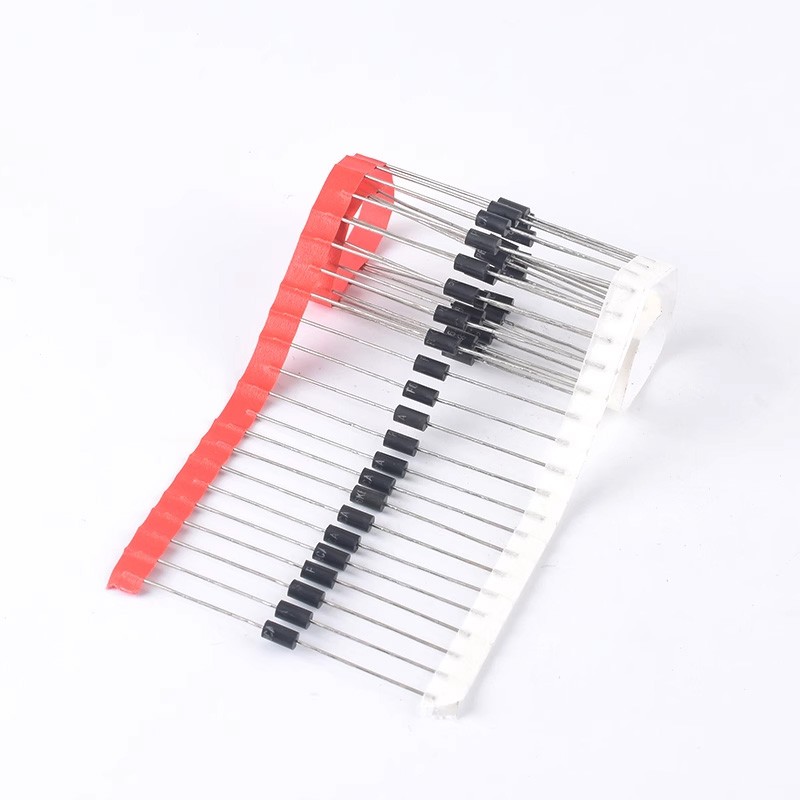
TVS (Transient Voltage Suppressors), also known as avalanche breakdown diodes, is an efficient circuit protection device that mainly protects the circuit from the impact of transient high voltage spikes (static electricity or lightning surges).
TVS Working principle
TVS is a device made using semiconductor technology to integrate a single PN junction or multiple PN junctions. Its electrical characteristics are determined by the PN junction area, doping concentration, and chip resistance. The ability to withstand sudden current is directly proportional to the PN junction area.
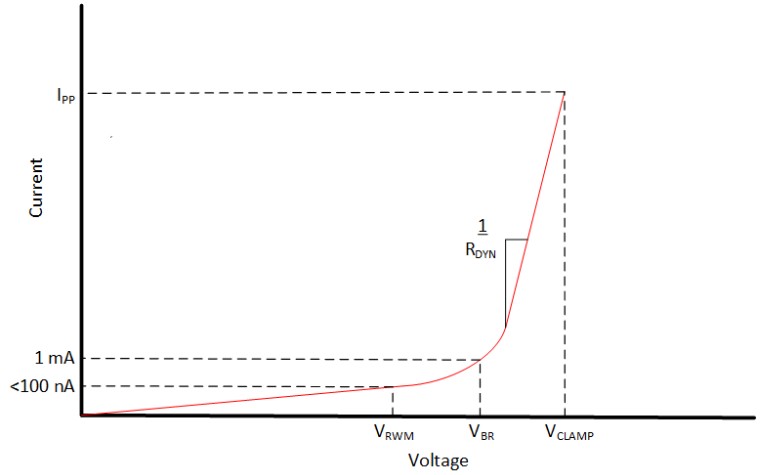
When the reverse voltage of TVS is less than the working voltage VRW M, TVS is in a high resistance state and can be considered as not conducting; When the reverse voltage of TVS is greater than the breakdown voltage VBR, the impedance of TVS begins to rapidly decrease, and the reverse voltage of TVS will remain almost unchanged.
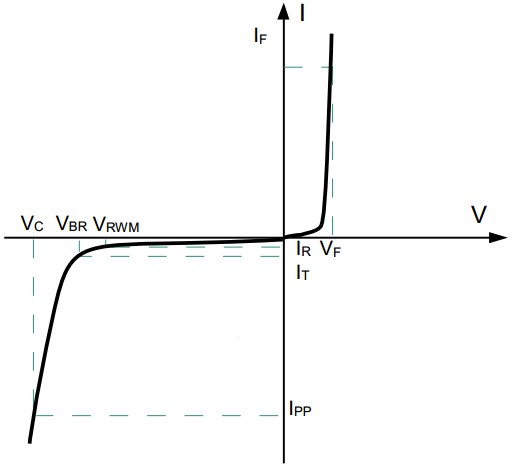
When TVS is subjected to reverse transient high voltage peak pulse impact, it changes from high impedance to low impedance at a speed of ps level, quickly absorbing most of the energy, and the clamping voltage increases from breakdown voltage to the maximum clamping voltage VC. As the pulse current decreases exponentially, the clamping voltage gradually decreases and returns to its original state, effectively protecting electronic circuit components from various forms of pulse impact.
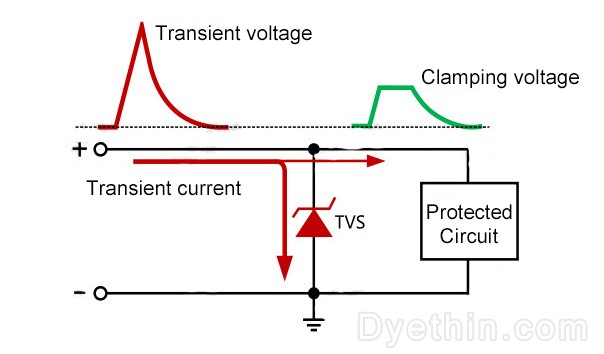
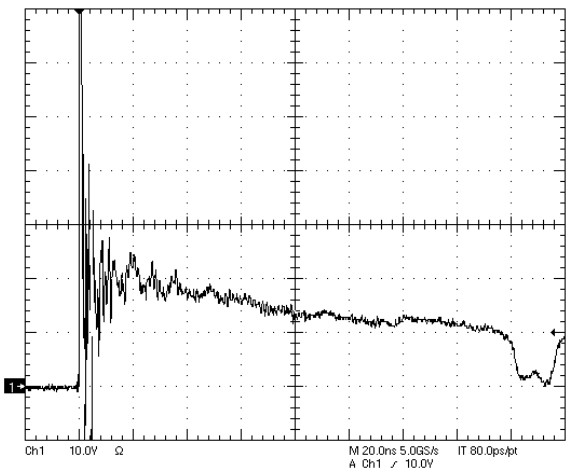
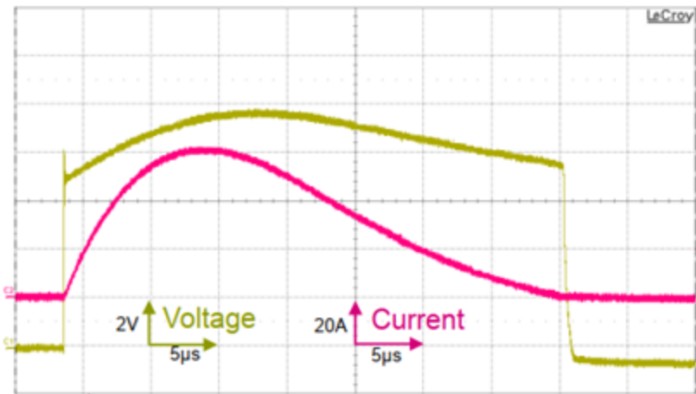
Due to the differences in energy, peak current, waveform, and duration of static electricity and surges, the voltage waveform of TVS under static electricity and surge impacts is also different.
Voltage waveform of TVS under+8KV ESD impact
Voltage waveform of TVS under surge (8/20uS) with peak current IPP of 62A
TVS parameters
Maximum reverse working voltage VRW M
The maximum reverse working voltage is the voltage value at both ends of the TVS tube when the reverse working current of the TVS tube is IR (usually IR is 0.1uA~1uA). At this point, the TVS tube is in a non-conductive state, meaning that the maximum reverse working voltage is the highest voltage at which the TVS tube is non-conductive.
In order not to affect the normal operation of the circuit, the VRW M should not be lower than the normal working voltage of the protected device or circuit; From the perspective of leakage, especially in the design of ultra-low power products, the larger the difference in operating voltage between VRW M and the protected signal, the smaller the leakage current.
Leakage current IR
Leakage current refers to the maximum current flowing through TVS under maximum reverse operating voltage conditions. Generally speaking, IR is a small current below uA level, and at this time, TVS transistors only have very small power consumption.
When TVS is used in high impedance circuits, leakage current is an important parameter, for example, in ADC sampling circuits, leakage current may affect the sampling value of ADC.
Breakdown voltage VBR
The breakdown voltage is the voltage value at both ends of the TVS tube when the reverse working current of the TVS tube is IBR (generally IBR is 1mA~10mA). The breakdown voltage is a symbol of the conduction of TVS tubes. When the reverse voltage exceeds the breakdown voltage, the reverse current will sharply increase as the reverse voltage increases.
Usually, the breakdown voltage and maximum reverse operating voltage have the following formula:
VRWM=(0.8∼0.9)VBR
Maximum pulse peak current IPP
The maximum reverse pulse peak current refers to the maximum peak current that TVS is allowed to pass under the specified current pulse waveform (8/20uS or 10/1000uS) in accordance with IEC61000-4-5 or GB/T 17626.5 standards.
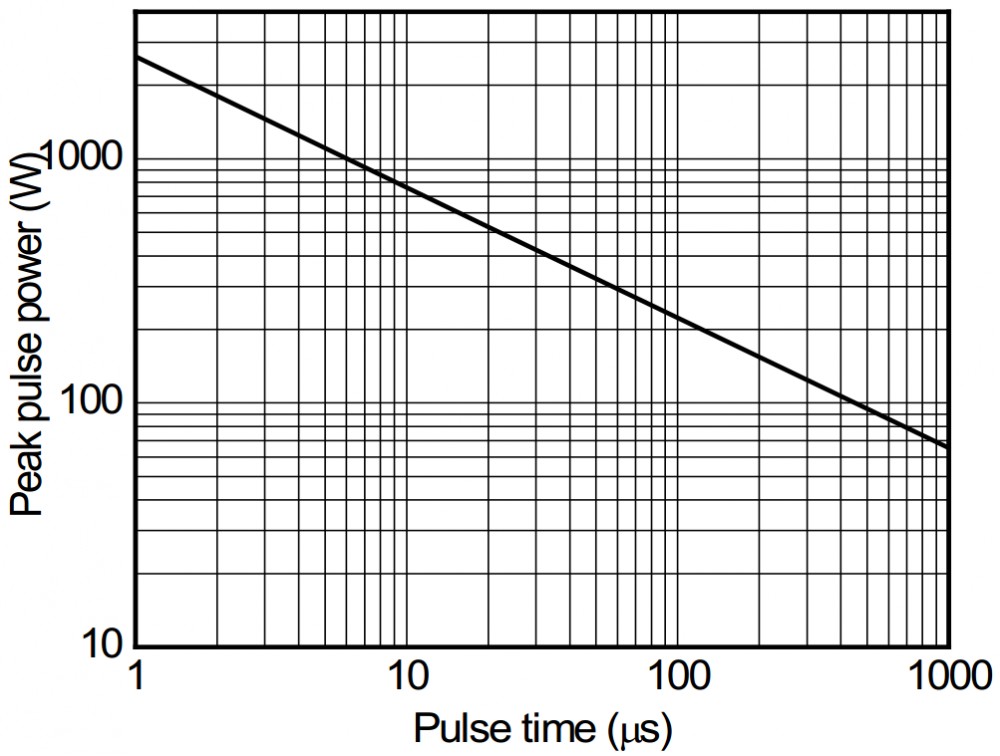
If only the peak current under 8/20uS pulses is marked in the data sheet, we can convert the peak pulse power time curve to obtain the peak current of 10/1000uS pulse waveform.
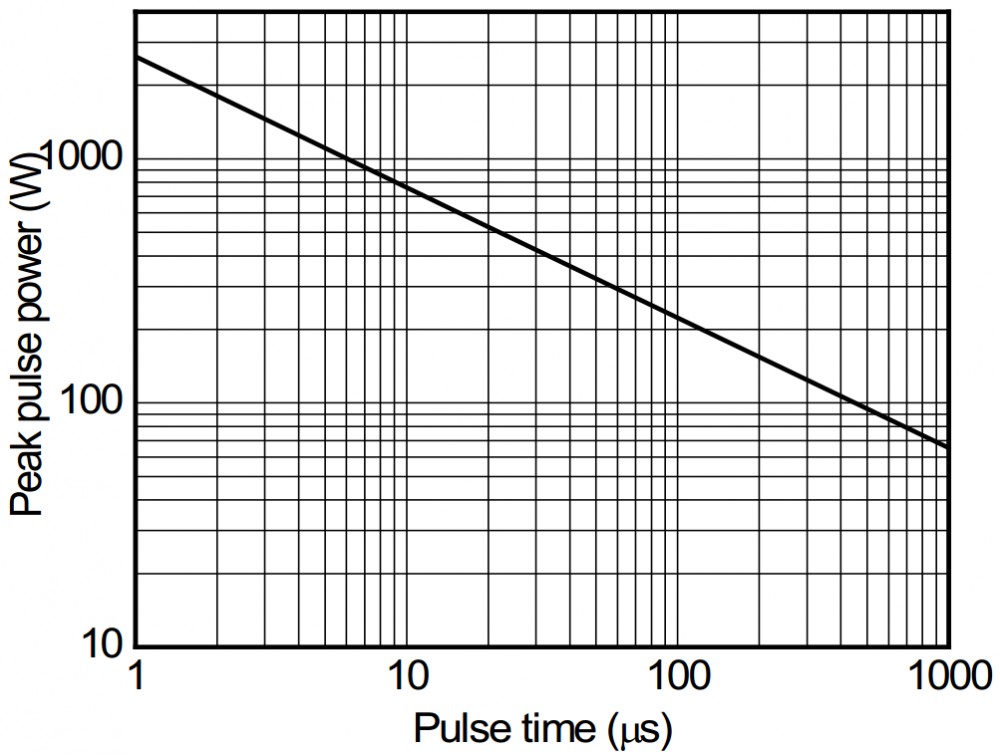
At 1000uS, the peak power is approximately 65W, and because TVS can withstand a fixed voltage without damaging itself, the peak power under 10/1000uS waveform is: 65W/15V=4.3A.
Note: The maximum clamping voltage of ESD 5651N is 15V.
For TVS without the above relationship diagram in the data sheet, it can be estimated based on the empirical values of conservative points:
The peak current measured by the same TVS under 8/20uS pulses will be 5 times that under 10/1000uS pulses.
Maximum clamping voltage VC (max)
The maximum clamping voltage refers to the voltage at which both ends of the TVS are clamped under the action of an 8/20uS pulse with a peak current of IPP, usually taken as the voltage value at 30ns. VC(max) should be less than the maximum transient safety voltage that the protected circuit in the later stage can withstand, otherwise the protected circuit in the later stage will be damaged.
The ratio of the maximum clamping voltage to the breakdown voltage is called the clamping coefficient, which is VC(max)/VBR. Generally, the clamping coefficient is around 1.3 .
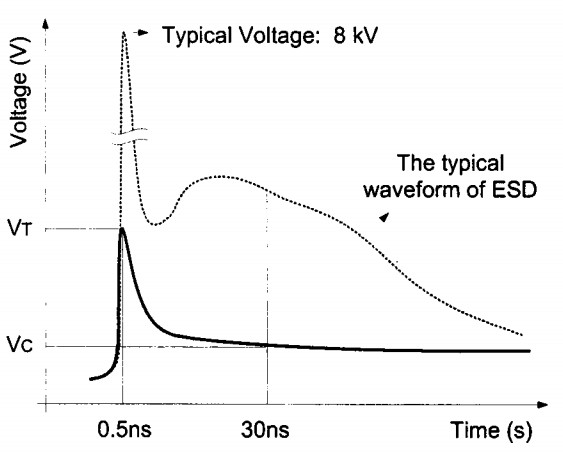
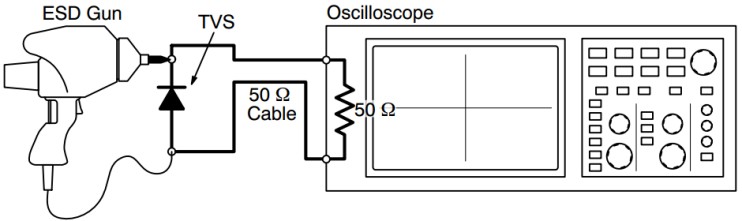
When applying ESD to a TVS, the voltage waveform at both ends of the TVS can be measured through the circuit shown in the figure below, thus clearly knowing the clamping voltage and reaction time of the TVS under the action of ESD.
Pulse peak power PPK
Pulse peak power refers to the maximum power value that TVS can withstand instantly under specified pulse conditions, reflecting the surge suppression ability of TVS. The PPK of TVS depends on the peak pulse current IPP and the maximum clamping voltage VC(max), but in addition, it is also related to the pulse waveform, pulse time, and ambient temperature.
So the formula for calculating the pulse peak power of the final TVS is:
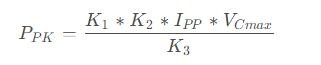
In the formula, K1 is the power coefficient, K2 is the temperature imaginary number, and K3 is the time coefficient.
The value of power coefficient K1 is shown in the table below, and the current wave of 8/20uS can be considered as a standard wave.
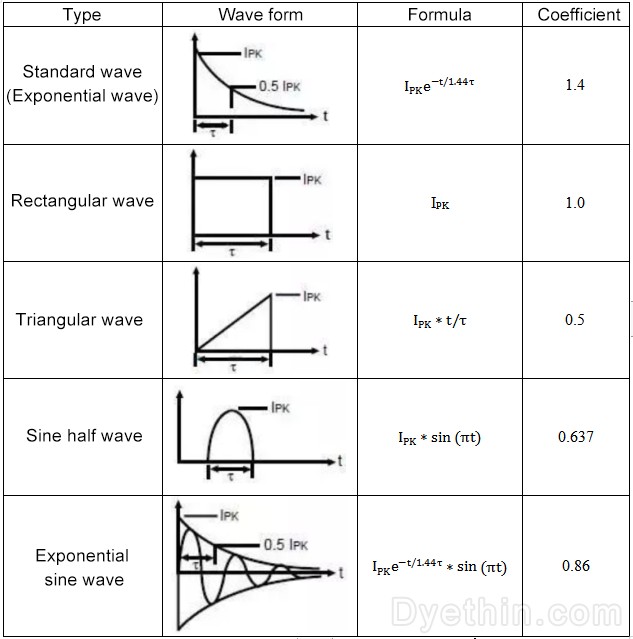
Table of Power Coefficients for Common Waveforms
The temperature coefficient K2 can be directly obtained from the power derating vs ambient temperature curve in the data sheet.
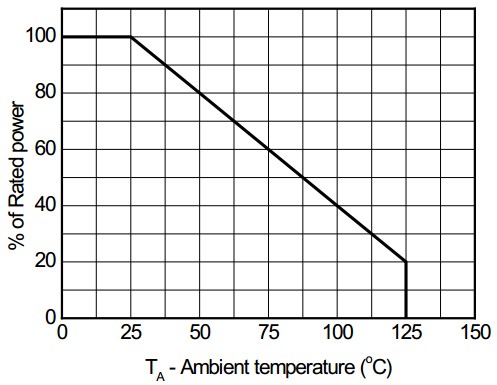
The time coefficient K3 can be directly converted proportionally based on the peak pulse power time curve.
Junction capacitance CPP
Junction capacitance refers to the parasitic capacitance of TVS, which is determined by the PN junction area and reverse voltage. The higher the power of the same series of TVS, the larger the junction area and parasitic capacitance; The junction capacitance of the same TVS decreases with the increase of reverse voltage and is minimized during breakdown.
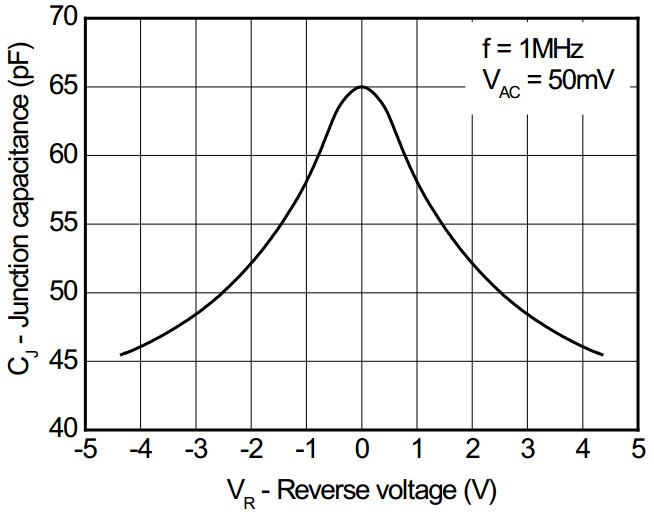
In addition, the junction capacitance can also affect the transmission quality of signals in the circuit. The larger the junction capacitance, the greater the impact on the signal. So for different signals, especially high-speed signals, it is necessary to choose appropriate junction capacitors to ensure normal communication. Table 2.2 shows the recommended values of junction capacitors in common interfaces by Texas Instruments (TI).
Table 2.2 Recommended Table for TVS Junction Capacitors in Common Interfaces
| Interface | Recommended value of ESD capacitance | TI Recommended Products |
| GPIO | <30pF | TPD1E10B06 |
| Push Button | <30pF | TPD1E10B06 |
| Audio | <10pF | TPD1E10B09 |
| USB 2.0 | <2.5pF | TPD1E05U06 |
| USB 3.0 | <0.5pF | TPD4E05U06 |
| USB 3.1 Gen2 | <0.3pF | ESD122 |
| HDMI 1.4 | <0.7pF | TPD4E05U06 |
| HDMI 2.0 | <0.5pF | TPD4E02B04 |
| Ethernet | <5pF | TPD4E1U06 |
| Antenna | <0.2pF | TPD1E01B04 |
| 4-20mA Loop | <80pF | TVS3300 |
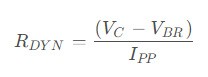
Dynamic resistance RDYN
Dynamic resistance is the current slope at two specified high current points on the V-I curve when the reverse voltage that causes breakdown is applied to TVS, namely:
TVS selection
Selecting the maximum reverse operating voltage
Under normal circuit operation, TVS should be in the cut-off state, that is, the VRWM of TVS should be greater than the highest working voltage of the protected circuit; However, if the working voltage VRWM of TVS is too large, it will cause the clamping voltage VC to be too large, exceeding the maximum transient withstand voltage of the circuit. So when choosing VRWM, it is necessary to comprehensively consider the working voltage of the protected circuit and the withstand capacity of the subsequent circuit:
VRWM=(1.1∼1.2)VCC
VCC is the highest operating voltage of the circuit.
For circuits that may be affected by leakage current, such as analog sampling and low-power circuits, VRWM should be chosen as large as possible to ensure that the leakage current of TVS under normal working voltage will not affect the circuit operation.
Selecting Clamping Voltage
The clamping voltage VC should be less than the maximum transient safety voltage that the subsequent protected circuit can withstand; Otherwise, when TVS clamp is applied to VC, it will cause damage to the circuit.
For surge tubes, the selection of clamping voltage VC can refer to the following formula:
VC=VC(max)=(1.2∼1.5)VCC
VC<VMAX
Among them, VMAX is the highest transient voltage that the circuit can withstand, indicating that the minimum withstand voltage of microelectronic devices is recommended to use 1.5 times the normal working voltage as the maximum residual voltage of their overvoltage protection devices.
For ESD tubes, the selection of clamping voltage VC can refer to the following formula:
VC=VC@ESD=(1.2∼1.5)VCC
VC<VMAX
In the formula, VMAX is the highest transient voltage that the circuit can withstand VC@ESD If the clamping voltage of the ESD tube subjected to the corresponding level of electrostatic contact discharge is not explicitly specified in the data sheet, the clamping voltage corresponding to the electrostatic level can also be found through the transmission line pulse (TLP) response curve, because the TLP curve has similar characteristics to the IEC61000-4-2 waveform.
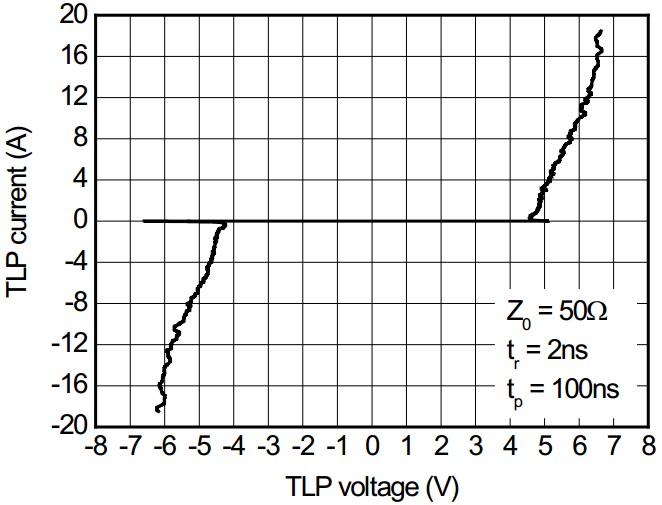
The corresponding relationship between TLP current and electrostatic level is shown in Table 4.1.
Table 4.1 Corresponding Table of ESD Level and TLP Test Current
| ESD level | IEC61000-4-2 waveform | Current (TLP curve) |
| 1 | Contact: 2KV Air: 2KV | 4A |
| 2 | Contact: 4KV Air: 4KV | 8A |
| 3 | Contact: 6KV Air: 8KV | 12A |
| 4 | Contact: 8KV Contact: 15KV | 16A |
Selecting Rated Transient Power
When selecting ESD tubes, the anti-static ability is usually directly stated in the data sheet, so there is basically no need to consider the rated transient power; However, for surge tubes, rated transient power is a very important parameter.
In theory, the higher the rated transient power of TVS, the more impact energy and frequency it can withstand; But the higher the power, the larger the packaging, and the higher the cost; So the rated transient power of TVS only needs to meet the testing requirements: greater than the maximum transient surge power that may occur in the circuit.
The maximum transient surge power in a circuit is usually selected based on the product's usage environment (refer to Appendix A of GB/T 17626.5) or user-defined surge levels. Assuming that the maximum test current in the actual circuit is IPP, then IPP can be estimated as:
IPP=UPP/Ri
Among them, UPP is the test voltage, which is the surge level; Ri is the test internal resistance, usually 2 Ω for differential mode testing of power lines, 12 Ω for common mode testing of power lines, and 42 Ω for communication lines.
After calculating the peak pulse current using the above equation, the maximum transient surge power in the circuit can be calculated using the following equation.
PPK=IPP∗VC(max)
So the rated transient power of the surge tube is slightly greater than the maximum transient surge power calculated above.
As shown in equation (2), the rated transient power of the surge tube is also related to the operating temperature of the equipment, so the selection needs to be based on the temperature derating curve; In addition, a certain proportion (30%~50%) of margin can be reserved in actual use.
The pulse peak power calculated according to the formula cannot be repeatedly applied to TVS in an extremely short time, but in practical applications, surges usually occur repeatedly. So, even though the energy of a single pulse is much smaller than the pulse energy that a TVS device can withstand, if repeatedly applied, these individual pulse energies accumulate and in some cases exceed the pulse energy that a TVS device can withstand. Therefore, circuit design must carefully consider and select TVS devices at this point, so that the accumulation of repeatedly applied pulse energy within the specified interval time does not exceed the pulse energy rating of TVS devices.
Selection of junction capacitance
In the protection of high-speed signals, if the junction capacitance of TVS is too large, it will affect the normal communication of the signal. Therefore, it is crucial to choose a suitable junction capacitance. For common signal interface junction capacitance selection, please refer to Table 2.2.
Sometimes, in order to obtain a larger PPPM, the junction area of TVS will increase, leading to an increase in parasitic capacitance; At this point, the parasitic capacitance of TVS can be reduced through the series parallel design of TVS
Example
The DC working voltage of the entire machine is 12V, and the impedance of the surge source is 50M Ω. The interference waveform is square wave, TP=1mS, and the maximum peak current is 50A.
1. First, select the maximum reverse working voltage VRWM=13V from the working voltage of 12V.
2. Select the maximum clamping voltage VC (max)=1.5 * VRWM=19.5V from the maximum reverse working voltage, take VC(max)=18V
3. Calculate the square wave pulse power from the clamping voltage VC and the maximum peak current IP: PPP=VC * IP=18 * 50=900W;
4. Convert square wave pulse power to TP=1mS, peak power of exponential wave, conversion coefficient K1=1.4, PPP=900 ÷ 1.4=643W;
5. Considering the temperature factor (K2=0.7 at 62.5 ℃), the peak pulse power is PPP=643 ÷ 0.7=924W, so PPP=1000W is taken;
In summary, the selected TVS parameters are: VRWM=13V, VC(max)=18V, PPP= 1000W@10 /1000uS;
Articles you may also like
Design of High Current H-Bridge Motor Drive Circuit

Understanding NAND Gate: The Universal Logic Gate in Digital Circuits
Gas Discharge Tube Symbols, Characteristics and Structure

What is ESD and how to layout the ESD protection circuit PCB