














The working principle and usage method of TTL circuit
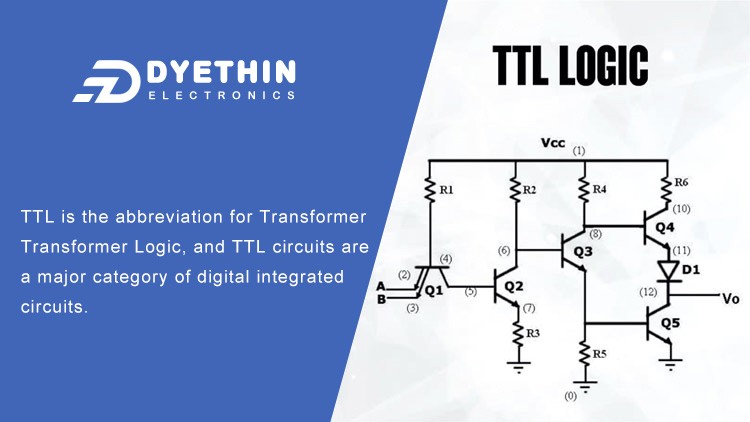
What does the term TTL circuit mean?
TTL is an integrated circuit that provides switching capabilities by employing bipolar transistors to conduct logic operations. The most essential characteristic of a TTL device is that, when unconnected, the gate's input is logic high.
Using this technique, integrated chips comprising logic gates, bipolar transistors, resistors, and diodes are designed and manufactured. Due to the use of transistors instead of diodes, TTL devices solve the capacitive loading issues and speed issues that occur in DTL, resulting in improved noise immunity and capacitive loading characteristics. With a propagation latency of 10ns and a power consumption of 10mW.
TTL level of logic
The majority of our systems utilise 3.3V or 5V TTL levels. The acronym TTL stands for Transistor-Transistor Logic. Bipolar transistor-based logic switching and maintenance circuits.
As with any logic family, understanding the threshold voltage level is essential. The following are examples of 5V TTL standards:
V OH – The minimal output voltage level provided by a TTL device for a high signal.
V IH -- Minimum input voltage considered to be excessive.
V OL -- The utmost output voltage provided by the device for a low signal.
V IL - The utmost input voltage still considered to be low.
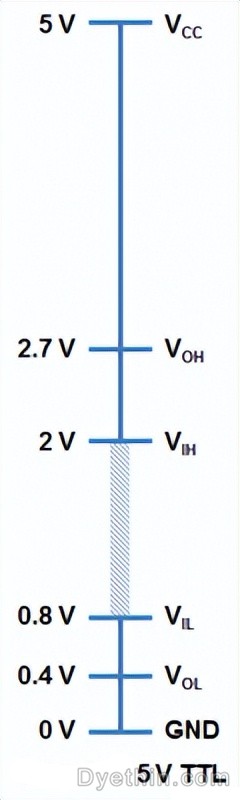
The minimum output high voltage (VOH) is 2.7V, as depicted in the figure above. This requires a minimum output voltage of 2.7V to power high-level devices. The minimum input high voltage (V IH) is 2 V, which means that any voltage above 2 V will be interpreted as a logic 1 (high) by the TTL device.
It should also be noted that there is a noise margin buffer of 0.7V between the output of one device and the input of the other.
Similarly, the utmost output low voltage (V OL) is 0.4 V, and a device emitting logic 0 will be below this threshold. The utmost input low voltage (V IL) is 0.8 V, which indicates that input signals below 0.8 V are read as logic 0s.
If the voltage is between 0.8 V and 2 V, what happens? This voltage range is indeterminate and produces an invalid state, also known as floating. If the device's output pin "floats" in this range, you cannot predict the signal's behaviour; it may oscillate between high and low.
How does the TTL circuit function?
The positive NAND gate function is depicted in the circuit diagram of a standard TTL logic gate shown below. In some instances, this standard TTL logic circuit is similar to diode-transistor logic (DTL) circuits.
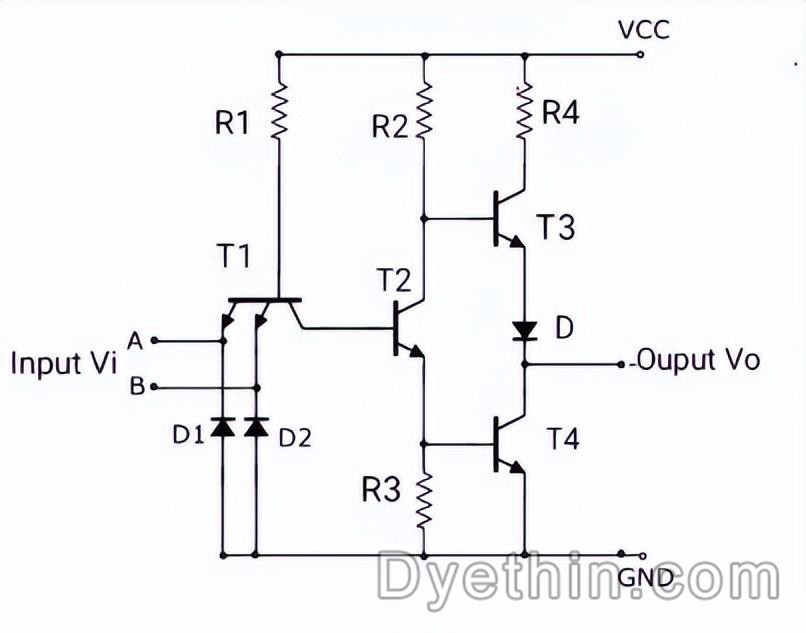
TTL circuit with two NAND inputs
As shown in the figure, T1 is an input transistor, which offers a switching time advantage. The phase divider is the transistor T2, and the totem pole output is provided by the transistors T3 and T4. This TTL circuit has an extremely low input impedance, a high fan-out, enhanced noise immunity, and the ability to drive a high capacitance.
When inputs A and B are both high, the transistors T2 and T3 are activated and function as a common-emitter amplifier. Transistor T4 and the emitter diode are forward biassed, and negligible current is flowing. The output is low, which corresponds to logic 0.
When both inputs are low, diodes D1 and D2 are forward biassed. Due to the 5V supply voltage VCC, current travels through diodes D1 and D2 and the resistor R1. The supply voltage in R1 decreases, causing the transistor T2 to turn off because it lacks sufficient voltage to turn on. Therefore, since transistor T2 is switched off, transistor T4 is also turned off. The transistor T3 is active as an emitter follower and is on (high). The output is high, which corresponds to a logic 1 value.
Due to the low input, the diode is forward biassed when either input A or B is low. The entire procedure is identical to the one described above. In consequence, the output is high (logic 1).
How to utilise TTL circuit
There are several distinct forms of TTL:
Normal TTL circuit
Rapid TTL wiring
TTL Schottky circuit
Powerful TTL Circuit
low electrical consumption TTL wiring
Superior TTL Schottky circuit
Here are some tips regarding the TTL circuit:
1. TTL standard circuit
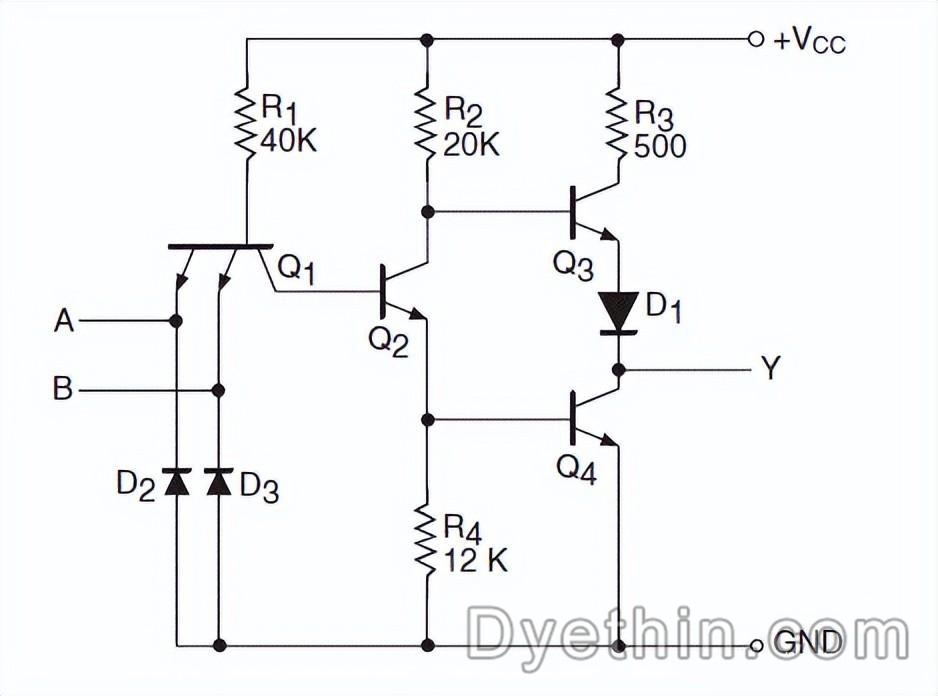
The structure and characteristics of a standard TTL NAND gate are depicted in the diagram below. Its NAND gate has four inputs and two outputs. Four 5400/740 circuits exist. The operation of this TTL circuit type is as follows.
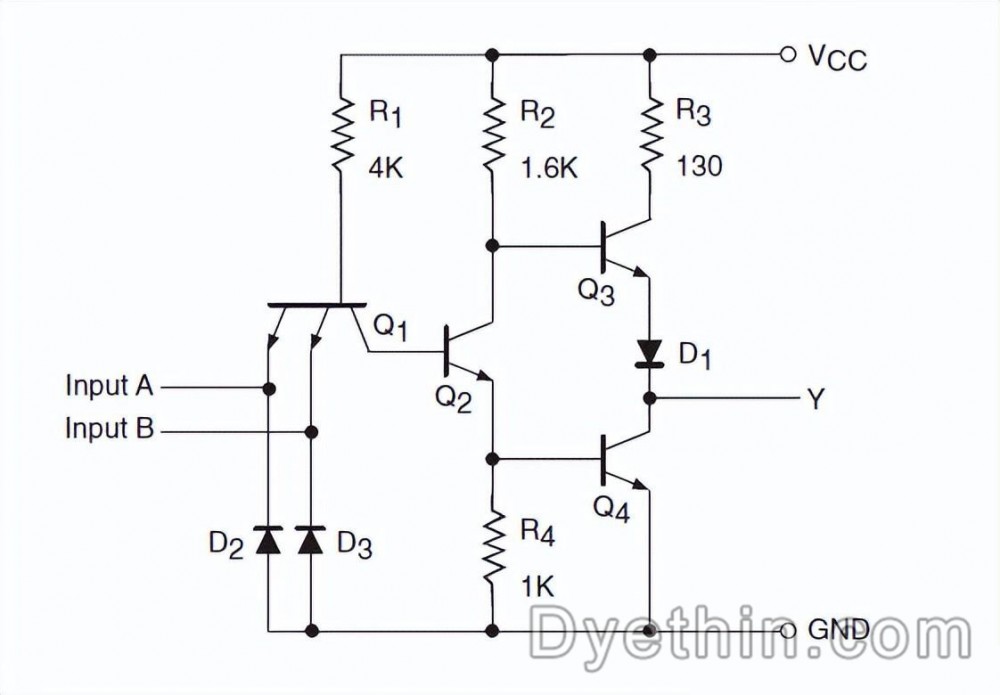
Standard TTL NAND gate
Q1 shown in the diagram is a dual emitter NPN transistor, this type of NAND gate is similar to two transistors with their base and emitter terminals connected together. Diodes named D2 and D3 are used to limit the input voltage which is negative in nature.
2. TTL circuit with a low power draw
Low power TTL circuitry accomplishes low power dissipation and power consumption. Despite the slower rate at which operations are completed. Above is a low-power TTL constructed with AND gates. This application employs a 74L00 or 54L00 NAND gate; the structure of this form of TTL is nearly identical to that of standard TTL, with the resistance value being higher. For this increased resistance value, the circuit's power dissipation is decreased.
Low power consumption TTL circuit
3.High Power TTL Circuit
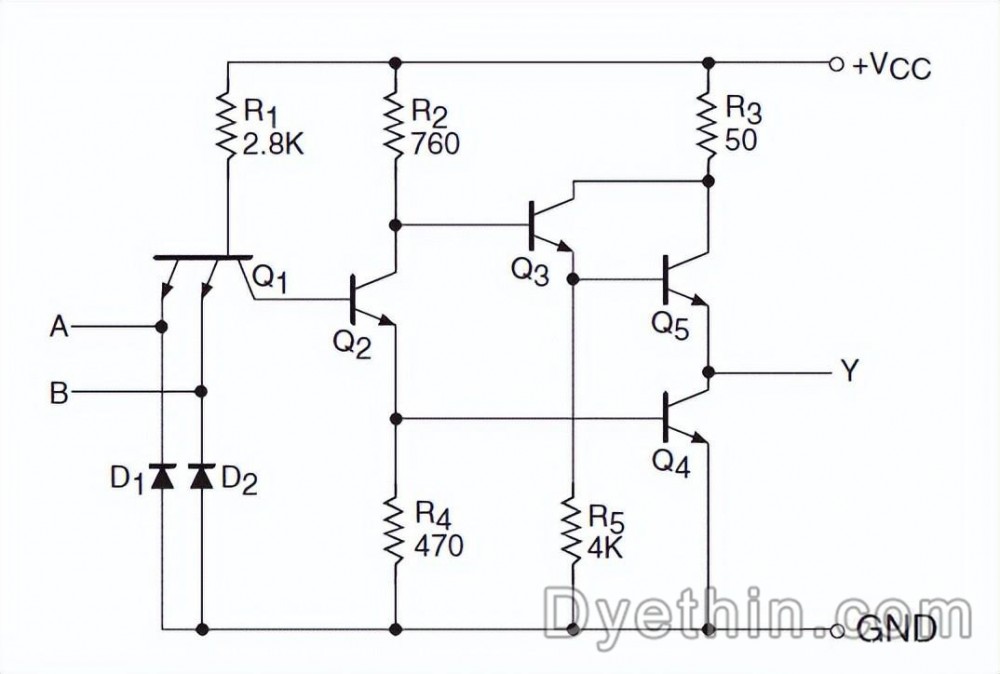
High-power TTL, unlike low-power TTL, is a faster version of conventional TTL. This form of TTL operates more quickly than previously described. It consumes more energy than the previously discussed TTLs. Below is a diagram of a high voltage TTL NAND gate. NAND gates are 74H00 or 54H00 varieties with two inputs. Very similar to conventional TTL with the exception that the Q3 transistor and D1 diode have been replaced by Q3, Q5, and R5. This form of TTL operates faster and consumes more energy.
High Power TTL Circuit
4. TTL Schottky circuit
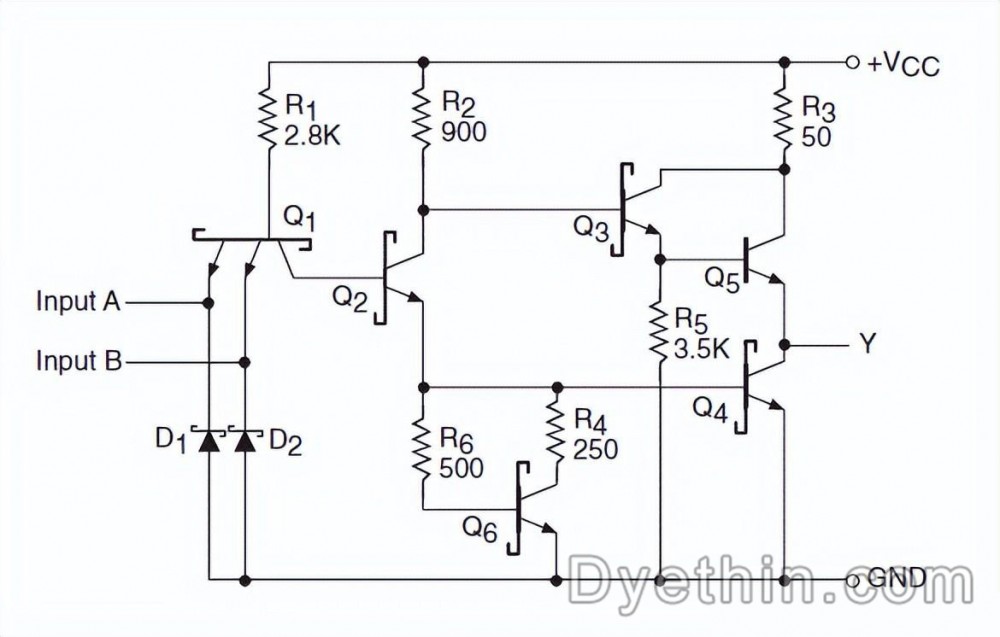
A Schottky TTL circuit is used to reduce the duration of the operation. This TTL type offers double the pace of high-power TTL. Both TTLs have the same power consumption; there is no additional power consumption. This diagram depicts a fundamental NAND-based Schottky TTL circuit.
The circuit diagram is very similar to that of the high power TTL, with the exception of the Q transistor. This form of TTL employs a bipolar Schottky transistor whose base and collector are connected by a Schottky diode.
TTL Schottky circuit
Correct diagram of TTL circuit cabling
Here, from the TTL circuit's input and output:
The input
Standard TTL circuit with 2 inputs
Standard TTL circuit with 3 inputs
TTL output totem pole
TTL totem pole output
TTL open collector output
TTL tri-state gate output
1. Standard 2-input TTL circuit
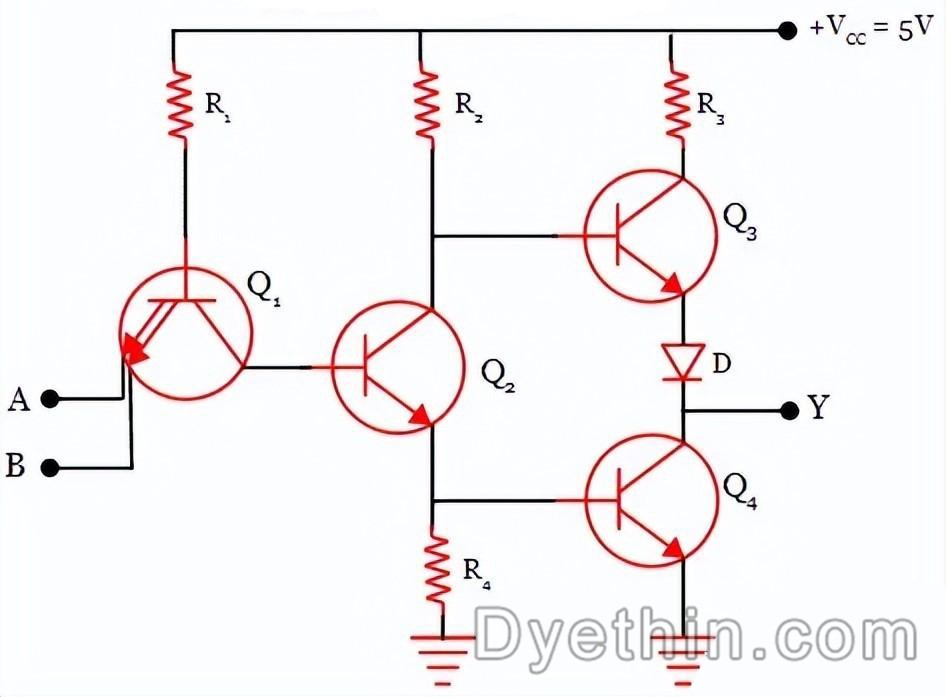
The figure below is a schematic of a 2-input TTL NAND gate. It contains four transistors labelled Q1, Q2, Q3, and Q4. On the emitter side, Q1 transistor has two inputs. Q 3 and Q 4 transistors comprise the output terminal, also known as the totem pole output.
Standard TTL circuit with 2 inputs
A 2-input TTL NAND gate circuit may appear intricate. As shown in the figure below, we can simplify the operation of a 2-input NPN transistor by contemplating its diode equivalent.
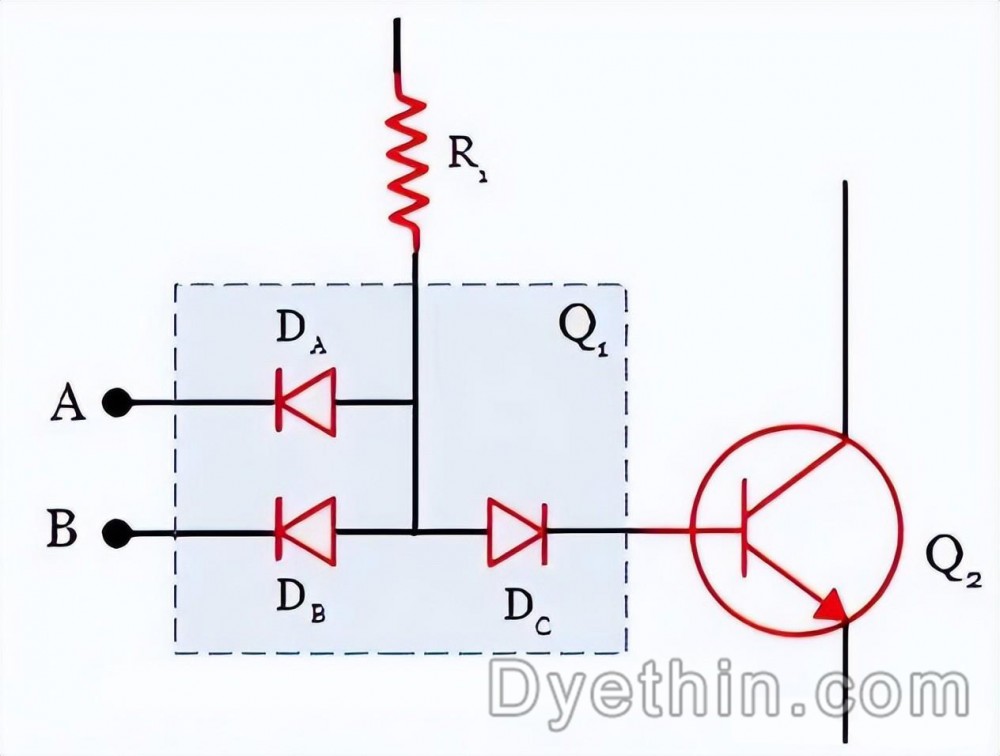
Standard TTL circuit with 2 inputs
Diodes DA and DB represent the 2-input emitter junction of transistor Q1 in the figure. Diode DC represents the junction between the collector and base of transistor Q2.
When both A and B inputs are low, both diodes will be forward biassed. Consequently, the current resulting from the supply voltage +V CC = 5 V will travel to ground via R 1 and the two diodes DA and DB.
The voltage drop across resistor R1 is insufficient to activate transistor Q2. With Q2 enabled, the transistor Q4 will also be disabled. However, the Q3 transistor is drawn high. Since Q3 is an emitter follower, the terminal's output is also high, or logic 1.
When either input (A or B) is low, the forward bias will be applied to the diode with the low input. The output will be high if the same operation as previously described occurs.
When both inputs A and B are high, the emitter-base junction of both diodes will be reverse biassed. Forward biassed diode DC at the collector-base junction. It will activate the Q2 transistor. As Q2 becomes active, Q4 will also become active.
Since both output transistors will be active, the terminal output will have a low level, also known as a logic 0.
2.Standard 3-input TTL NAND logic gate
The diagram below depicts a standard TTL NAND gate with three inputs. This is nearly identical to the 2-input TTL NAND gate, with the exception that the input transistor Q1 has three emitters instead of two. The operation is identical to that of a 2-input TTL NAND gate.
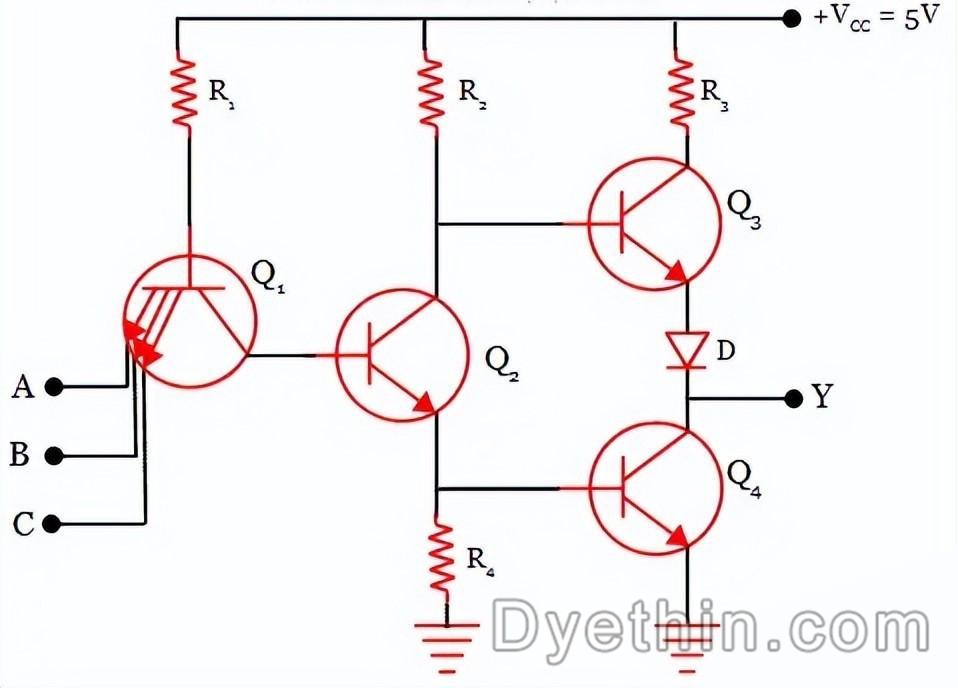
Standard TTL NAND gate with three inputs
3.TTL output totem pole circuit
The shaded area in the circuit diagram below represents the totem pole output. TTL totem pole output structure consists of transistors Q 3 and Q 4, diode D, and current-limiting resistor R 3.
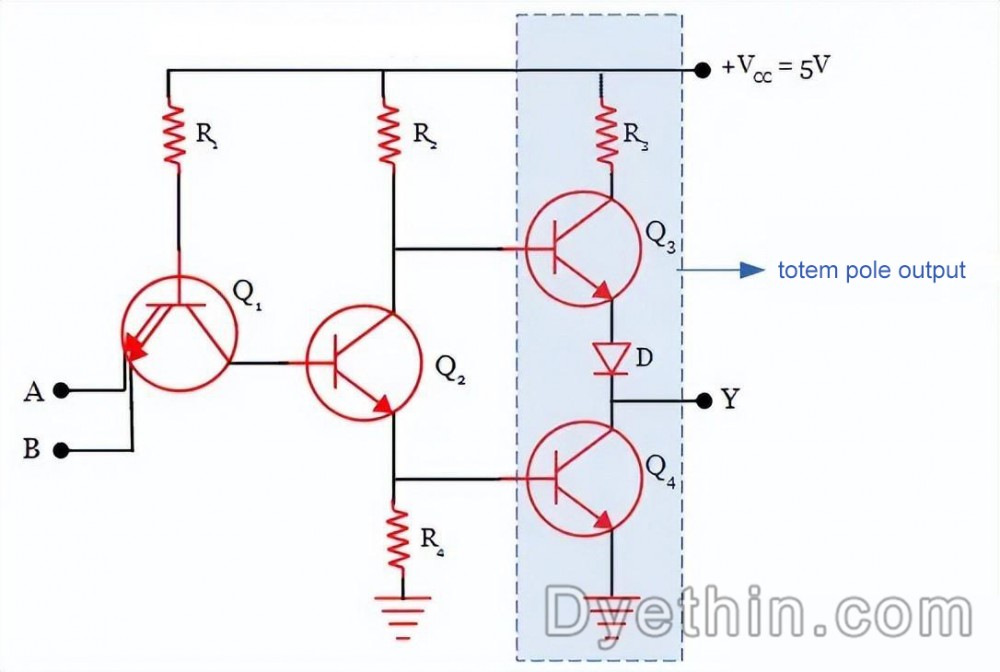
The TTL standard output circuit has the following characteristics and benefits:
1. Due to the low latency, they run at a fairly high speed compared to DTL
2. Low noise immunity (0.4V)
3. Average propagation delay per gate is 10 nanoseconds (ns)
4. The average power consumption is 10mW
5. It has a maximum fan-out of 10, which means one output can drive another 10 TTL inputs
6. The interface to other digital circuits is easy.
7. Compared with diodes, the multi-emitter transistors used in them occupy relatively less space
8. The price of this series is relatively cheap, and there is a large supply in the market
9. The application is simple and easy
10. Totem pole transistors provide very low output impedance in the binary 1 (high) state
11. TTL devices are compatible (that is, the output of one TTL device can be provided as input to another TTL device. In this case, the first device is called the driver, and the second is called the load)
4. TTL output open collector circuit
Figure below depicts the open collector output configuration for TTL logic. In this configuration, the Q3 transistor and pull-up resistor are removed. As shown, an external pull-up resistor is used instead to assure proper operation.
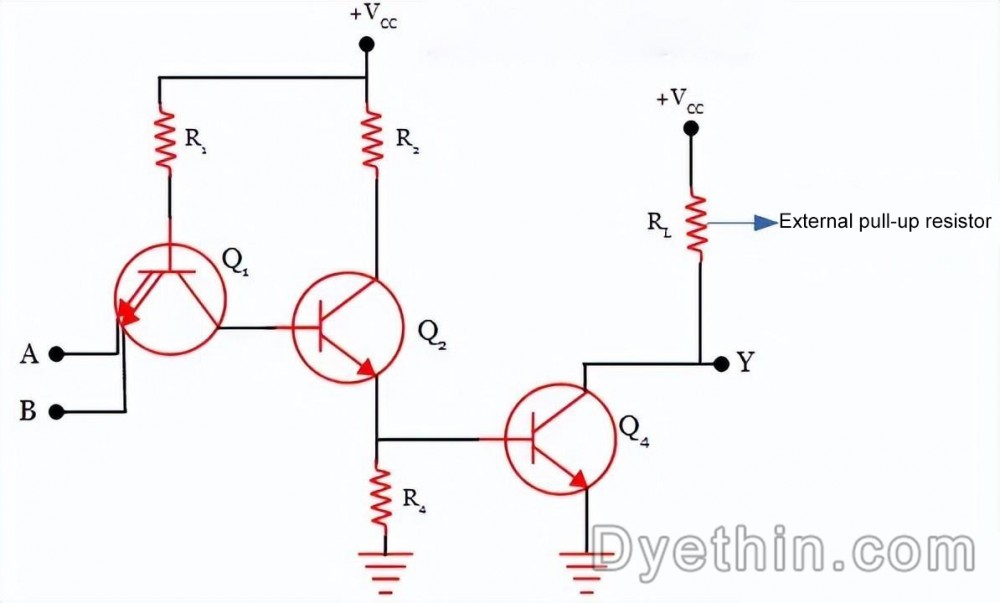
TTL open collector output
The output is taken from the open collector terminal of Q4. When transistor Q4 is off, the output Y will be high and when Q4 is on, the output will be low.
5.TTL tri-state output gate circuit
When the transistor is operated in this output configuration, a high impedance is achieved. The three output impedance states are high, low, and high.
Tri-state logic circuits take advantage of the totem-pole arrangement's high-speed operation while permitting the outputs to be wired-ANDed (connected together). The Hi-Z state occurs when both transistors in the totem-pole configuration are off, resulting in a high output impedance to ground and VCC. In other terms, the output is a floating or open terminal, which is neither low nor high. In actuality, the output terminal has a high resistance of several M or more with regard to ground and V CC.
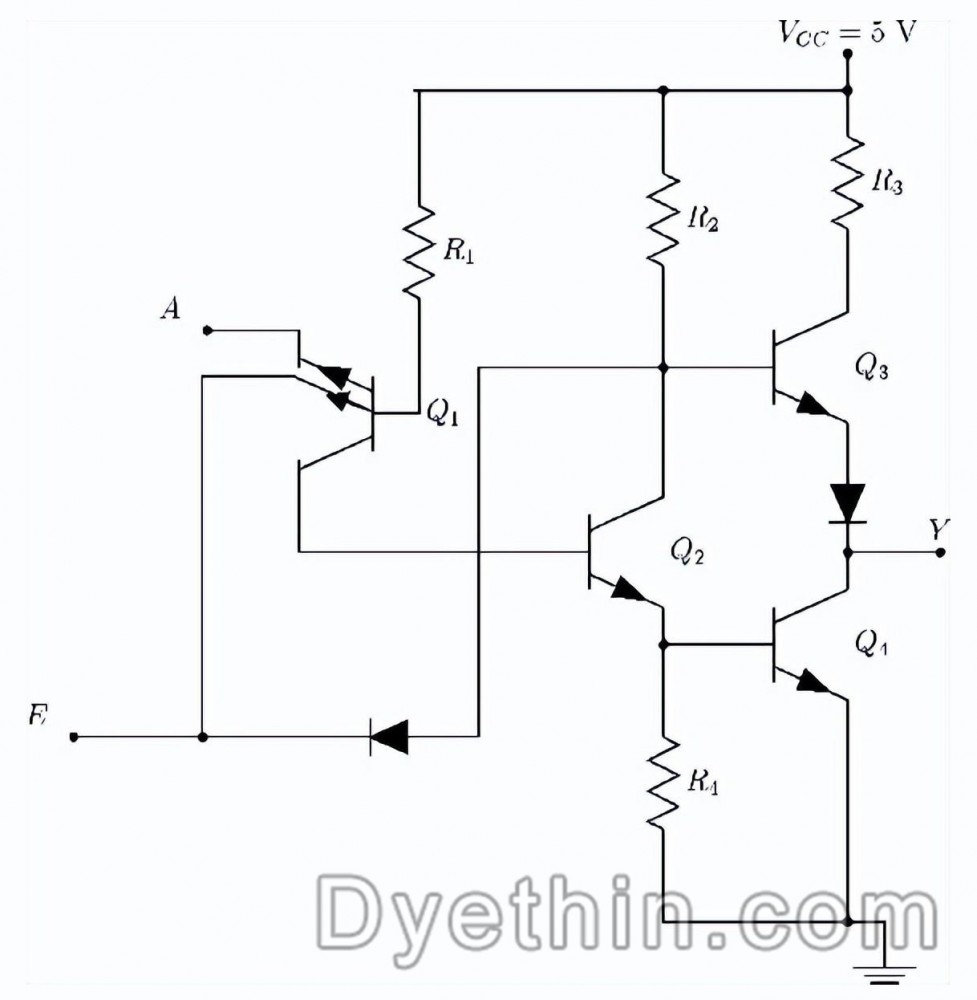
TTL tri-state gate output circuit
The circuit of a tri-state inverter with two inputs is depicted in the diagram above: A is the normal logic input and F is the enable input capable of generating a Hi-Z state.
Regardless of the state of logic input A, the circuit enters its state of high impedance when F = 0. A low at F forward biases the emitter-base junction of transistor Q1 and shunts the current through resistor R1 from transistor Q2, thereby shutting off Q2 and transistor Q4, which in turn turns off transistor Q4. The low at E also forward biases diode D2 to shunt current away from the base of transistor Q3, thereby turning off Q3. The output is essentially an open circuit because both totem-pole transistors are off.
This is evident from the accompanying table of facts: When F = 1, the circuit functions as a conventional inverter because a high input at F has no influence on transistor Q1 or diode D2. In this enabled state, the output is merely the logic input inverted.
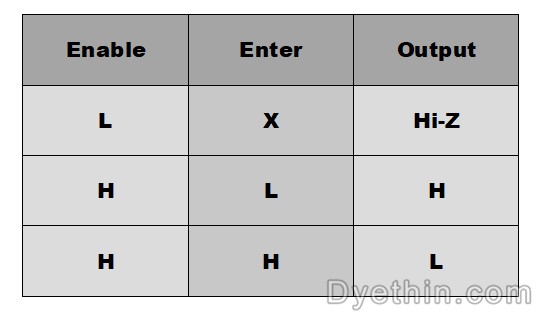
TTL tri-state gate output circuit truth table
TTL tri-state gate output circuit advantages:
In comparison to DTL and RTL logic devices, high-speed operation with a propagation delay of approximately 10 milliseconds is quicker.
Lower energy consumption than DTL and RTL.
economically priced.
Better spread out.
Noise and dependable performance.
TTL Characteristics
Fan-in and fan-out, power consumption, noise margin, and propagation latency define TTL.
Fan-in and Fan-out: The number of inputs and outputs connected to the gate without influencing the voltage or overall performance. The TTL fanout Noise Margin: This is the permitted noise voltage at the input, which should not influence the output. The noise margin for TTL is 0.4 V.
Refers to the time it takes for a circuit to go from receiving an input to producing an output.
Consumption of Energy: Necessary for the device.
Contrast between TTL and other logic families
Here is a contrast between TTL and other logic families:
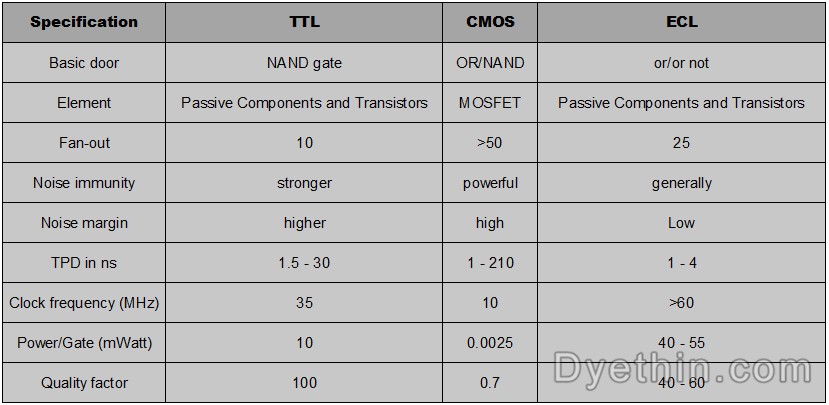
TTL in comparison to Other Logic Families

Articles you may also like
Simple and Useful Ultrasonic Transmitter and Receiver Circuit

How to design an overvoltage protection circuit?

Automotive taillight control circuit design
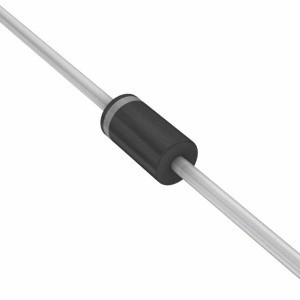
Interpret the 1N4007 Datasheet to understand what Schottky diode are

-
-

-
-
-
-
-
-
-
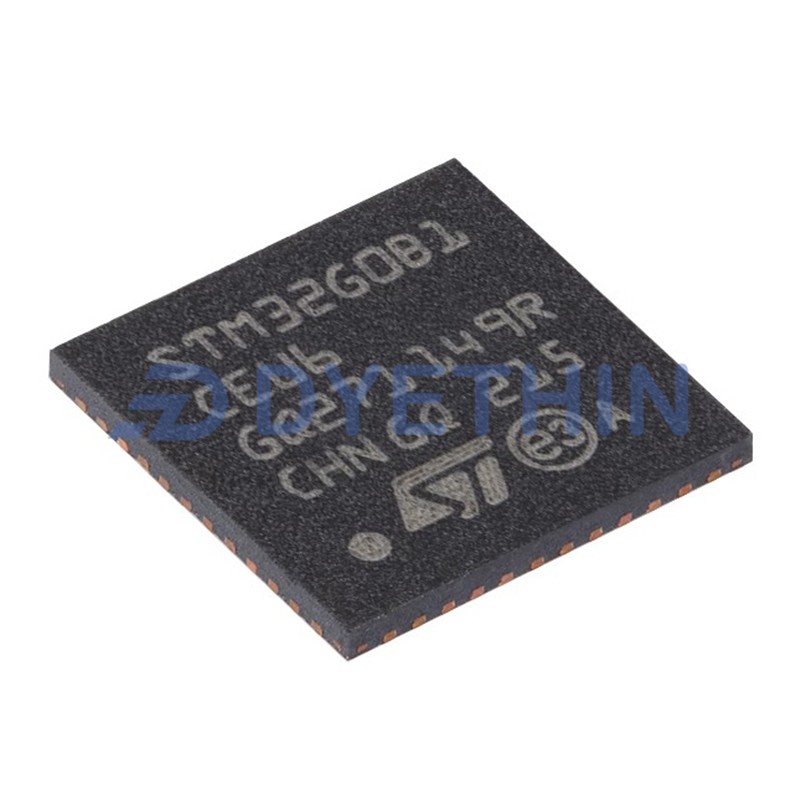
stmicroelectronics
ARM® Cortex®-M0+ STM32G0 Microcontroller IC 32-Bit Single-Core 64MHz 512KB (512K x 8) FLASH 48-UFQFPN (7x7)