













- Startseite
- Blogs
- Projects
- Simple and Useful Ultrasonic Transmitter and Receiver Circuit
Simple and Useful Ultrasonic Transmitter and Receiver Circuit
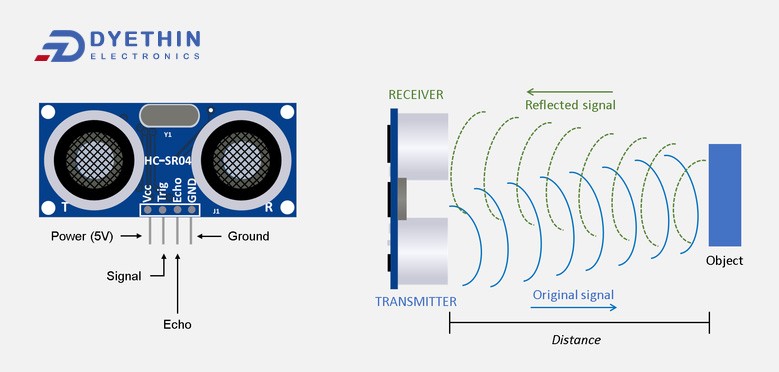
How an Ultrasonic Sensor works
Ultrasonic transmitter and receiver circuits are often used in everyday hardware design.This article discusses six extremely useful yet simple ultrasonic transmitter and receiver circuit projects that can be used in a variety of critical applications, including ultrasonic remote controls, burglar alarms, electronic door locks, and listening to ultrasonic waves that are normally inaudible to the human ear.
Numerous commercial ultrasound devices operate at predetermined frequencies and employ transducers that climax or resonate at predetermined frequencies. Due to their limited bandwidth and high cost, the majority of these sensors are impractical for hobby and do-it-yourself applications.
In reality, this is not a problem, as almost any piezoelectric speaker can be used as both a transmitter output device and a receiver sensor for ultrasonic transducers.
While piezoelectric speakers cannot match the efficacy of specialised industrial transducers, they are ideal for use in a hobby or as a fun project. The component used in the circuit described below is a 33/4" piezo tweeter, which is widely available online.
The most elementary ultrasonic generator
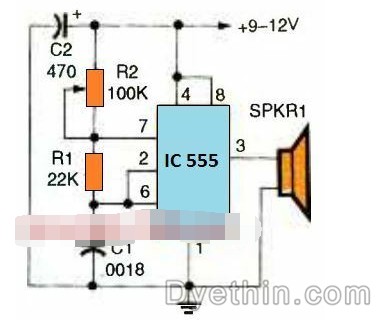

Diagram 1 This basic ultrasonic generator allows for rapid construction.
Our first circuit, depicted above, was an ultrasonic generator using the well-known 555 IC timer in an astable multivibrator circuit with an adjustable frequency. The design generates a square wave signal that, when combined with R2, can be tuned from 12 kHz to over 50 kHz.
This frequency range is readily adjustable by adjusting the value of capacitor C1; a smaller value will result in a larger range, and a larger value will result in a smaller range.
Ultrasonic generator with a 50% duty cycle that is preset
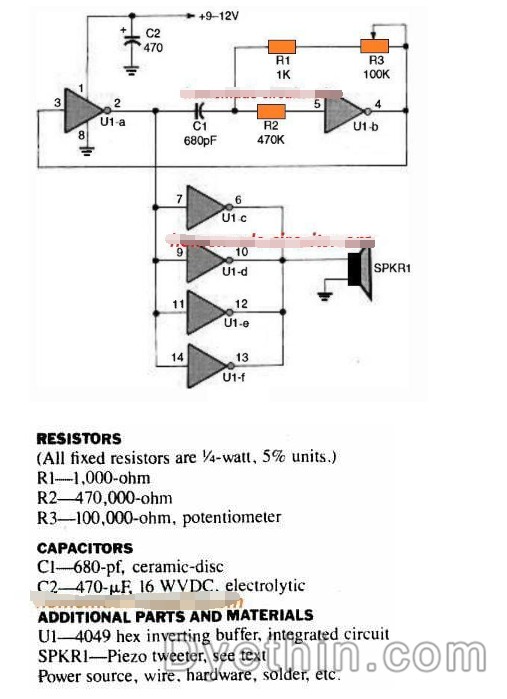
The following sonotrode, as depicted in the image above. As shown in Figure 2, a 4049 CMOS inverting buffer IC with six buffer gates is used separately.
Several buffers U1a and U1b are connected to an astable oscillator circuit with a 50% duty cycle square wave output and variable frequency.
The remaining four buffers are connected in parallel in order to improve the output of the piezoceramic element. This improved ultrasonic generator has a comparable frequency range to the previous IC 555 model. Nonetheless, the primary benefit of this design is its precise 50% duty cycle across the complete frequency spectrum.
Thus, the frequency range can be expanded by decreasing C1's value, and the frequency can be decreased by increasing C1's value. Together, the 100k potentiometer and R3 resistor set the output frequency.
PLL Ultrasonic Generator

As shown in Figure 3, an LM567 Phase Locked Loop (PLL) IC is used to generate the ultrasonic frequency. This circuit has numerous advantages over the previous two ultrasonic designs.
First, the internal oscillator of IC LM567 was designed to operate in the extremely broad frequency spectrum between 1 Hz and 500 kHz. The output waveform of the generator (pin 5) is symmetrical over its entire operating range.
This generator has a higher output than the other two because its output impedance is very close to that of the piezo tweeter (SPKR1).
Using potentiometer R10, the output of the circuit can be adjusted from approximately 100 kHz to over 5 kHz. To maintain the output distance of the LM567, transistor Q1 is connected as a standard collector circuit and powers the output amplifier circuit created by transistors Q2 and Q3. By detaching pin 7 of the IC and connecting the switch key in series, the circuit can be converted into an ultrasonic continuous transmitter.
In this instance, you'll need an ultrasonic receiver to listen for the signal; we'll discuss one in the following circuit.
Receiving ultrasonic circuit
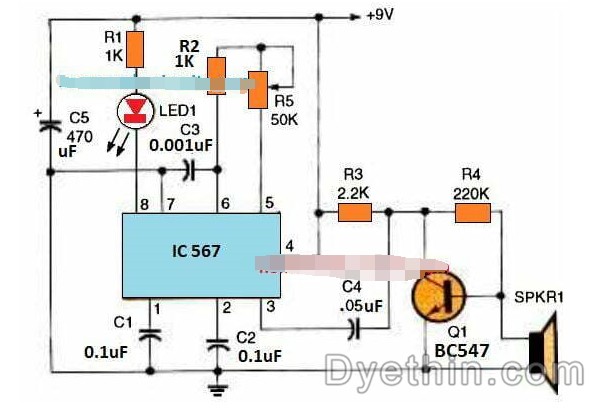
The IC LM567 ultrasonic receiver is compatible with the LM567 ultrasonic transmitter for optimal results.
The image displayed above depicts the ultrasonic receiver circuit employing a LM567 PLL IC with frequency adjustment. The frequency range of the tunable oscillator circuit of the integrated circuit is identical to the frequency range of the generator circuit. An LED on pin 8 of the detector IC provides a rapid indication of a detected signal.
The function of transistor Q1 is to amplify and transmit the ultrasonic signal detected by the piezoelectric device.
How to assess
Turn on the IC LM567 ultrasonic generator circuit and move the transmitter piezo across the area to test the ultrasonic functionality. Start with the lowest volume level and gradually adjust the R5 until nothing can be heard from the speakers. This should fix the output frequency of the circuit between 16 and 20 kHz, dependent on the sensitivity of your ear to high frequencies.
Open the ultrasonic receiver circuit and position the piezo transducer approximately 12 inches away from the generator speaker, but in the same direction as the target. Adjust the receiver via resistor R5, beginning at the minimal frequency point (corresponding to the maximum resistance range of the potentiometer) and gradually increasing the frequency until the LED on the receiver just illuminates.
If the receiver is not responding to the signal emitted by the transmitter, align the receiver's piezo with the generator's speaker precisely and consistently. Once the receiver detects a signal and the LED illuminates, move the Tx/Rx piezos a minimum of 10 feet away and begin pruning again.
Once you've determined that everything is operating properly, you can test the LED response on the receiver using the telegraph key affixed to the transmitter (pin 7 is optional).
The LED must respond by flashing in a dot-dash pattern when the telegraph key is pressed. This ultrasonic generator/receiver kit can also be used as a rudimentary sensor for a burglar alarm.
Connect a relay to pin 8 of the LM567 receiver and the positive battery terminal. Place the Tx and Rx piezos approximately one foot apart, aimed in the same direction, but clear of nearby objects.
If a person approaches a pair of speakers and comes near to the front of the pair, the ultrasonic frequencies will reflect back, causing the receiver's relay to open. The relay's output contacts can be used to activate an alarm or siren device.
Receiving circuit with high ultrasonic sensitivity
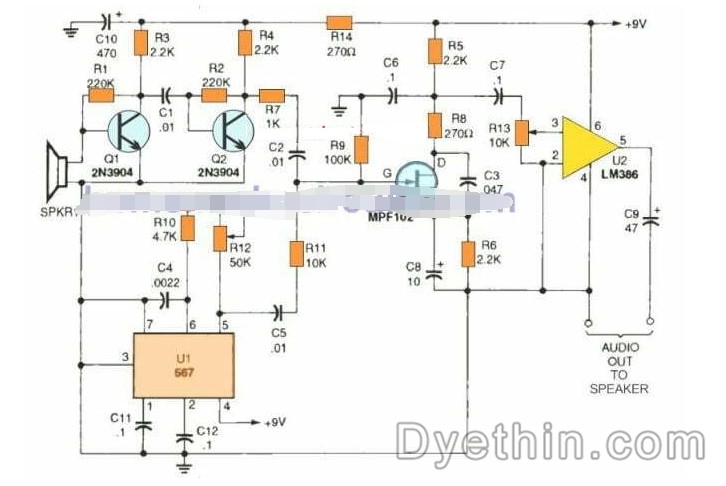
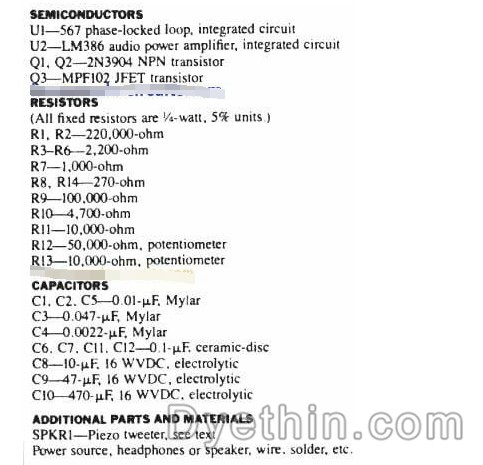
The final ultrasonic receiver circuit design is a highly sensitive ultrasonic receiver that can readily detect nearly all ultrasonic frequency signals. You can listen to insects, bat communications, engines, etc.; this concept can also be used in conjunction with the ultrasonic generator described in the previous section to develop a high-quality ultrasonic system.
The design employs the direct conversion method. The ultrasonic signal picked up by the piezoelectric speaker is amplified by transistors Q1 and Q2. The collector output of Q2 is then used to operate the JFET (Q3) input, and the JFET inputs are connected as a product detector circuit.
In this design, the PLL (U1) stage is analogous to a heterodyne oscillator that additionally supplies the input of the JFET detector circuit. Sum and difference frequencies are produced by combining the frequency of the heterodyne oscillator with the frequency of the incoming ultrasonic signal.
The C3, R8, and C6 component networks filter out high frequency components. The remaining low frequency output is admitted via the audio amplifier's LM386 input. The circuit's audio output can be connected to speakers or headphones.
An additional ultrasonic receiver circuit for detecting sounds above 20 kHz
Our ears have a frequency detection range that scarcely exceeds 13 kHz. Ultrasonic detectors are designed to circumvent this limitation by altering the frequency of high-frequency sounds, such as dog whistles, scarcely audible gas leaks, bat beeps and several artificial ultrasonic sounds, such as the light tapping of a newspaper.
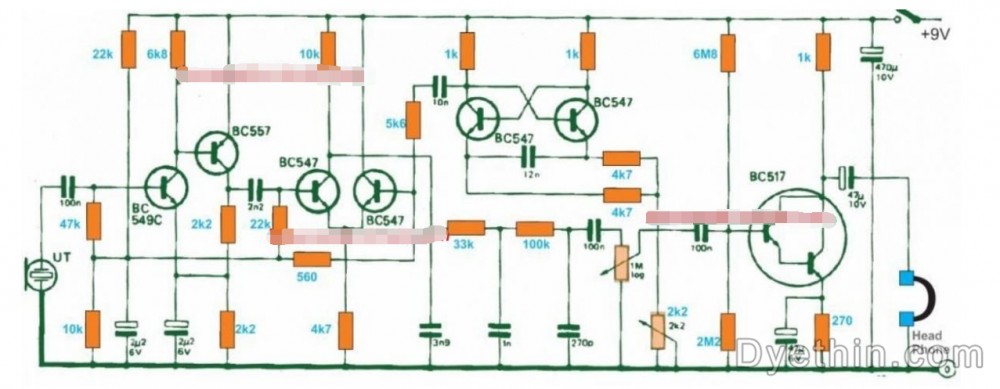
The "ultrasound" detected by the input transducer is amplified before being sent to the product detector. Include an astable multivibrator, as BFO stability is presumably not very practical. In addition to the required signal differentiation, the circuit generates the BFO signal as well as the summing frequency, which is terminated by a low-pass filter with a fixed 4 kHz cutoff frequency.
The signal generated here is amplified once more to power a pair of headphones. The circuit requires approximately 8mA, so it can be readily powered by a 9V dry battery.
Articles you may also like

The working principle and usage method of TTL circuit

How to design an overvoltage protection circuit?

Automotive taillight control circuit design
Interpret the 1N4007 Datasheet to understand what Schottky diode are