













Understanding NAND Gate: The Universal Logic Gate in Digital Circuits
The NAND gate (NOT AND gate) is one of the most essential logic gates in digital electronics. It performs a logical AND operation followed by a NOT operation, meaning it produces a low output (0) only when both inputs are high (1); otherwise, the output is high (1). This simple yet powerful function makes NAND gates a cornerstone of digital circuit design.
In modern computing and electronics, NAND gates are widely used due to their universality—they can be combined to create any other logic gate, including AND, OR, and NOT. This versatility makes them a fundamental building block in microprocessors, memory storage, and digital communication systems.
By understanding NAND gates, engineers and enthusiasts can better grasp Boolean algebra, circuit design, and how digital systems process information. In the following sections, we will explore NAND gate truth tables, circuit applications, and why this logic gate is considered universal in computational logic.
NAND Gate Truth Table and Logic Representation
The NAND gate (NOT AND gate) is a fundamental component of digital electronics, and understanding its truth table and logic representation is essential for circuit design. A truth table illustrates how a logic gate responds to different input combinations, making it easier to predict its behavior in a circuit.
| Input A | Input B | Output (A • B)' |
| 0 | 0 | 1 |
| 0 | 1 | 1 |
| 1 | 0 | 1 |
| 1 | 1 | 0 |
The Boolean algebra expression for a NAND gate is:
where "●" represents the AND operation, and the apostrophe (') indicates the NOT operation. This means the output is the inverse of the AND gate’s output.
Logic Representation
The symbol for a NAND gate consists of an AND gate with a small circle (inversion bubble) at the output, indicating negation. In digital circuit diagrams, this symbol is used to design more complex logical expressions.
Understanding the NAND gate’s truth table and logic representation is crucial in combinational logic, as it helps in designing circuits that perform essential computing functions. In the next sections, we will explore how NAND gates can be used to construct other logic gates and their role in digital electronics.
Why NAND Gate is a Universal Gate?
The NAND gate is known as a universal gate because it can be used to construct all basic logic gates, including AND, OR, and NOT gates. This property makes it one of the most powerful and widely used logic gates in digital circuit design.
What is a Universal Gate?
A universal gate is a type of logic gate that can be combined in different ways to replicate the functionality of any other fundamental logic gate. NAND and NOR are the only two universal gates in digital electronics, but NAND is more commonly used due to its efficiency in circuit design.
Building Basic Logic Gates Using NAND
NOT Gate Using NAND
A NAND gate with both inputs tied together acts as a NOT gate.
Expression: Y=(A⋅A)′=A′
AND Gate Using NAND
By inverting the output of a NAND gate using another NAND (acting as NOT), an AND gate is formed.
Expression: Y=(A⋅B)′′=A⋅B
OR Gate Using NAND
By applying De Morgan’s Theorem, an OR gate can be built using NAND gates.
Expression: Y=(A′⋅B′)′=A+B
Why is This Important?
The universality of the NAND gate simplifies circuit design, reducing the number of different components required in digital systems. This leads to cost-effective and efficient integrated circuit (IC) designs, widely used in computing, memory storage, and microprocessors.
Applications of NAND Gate in Digital Circuits
The NAND gate is one of the most versatile and widely used logic gates in digital electronics. Due to its ability to form any other basic gate, it plays a crucial role in various electronic systems, from microprocessors to memory storage. Let’s explore some of the most important applications of NAND gates in digital circuits.
1. Memory Units (SR Latch and Flip-Flops)
One of the most significant applications of NAND gates is in memory storage elements, such as SR (Set-Reset) latches and flip-flops. These components are the foundation of RAM (Random Access Memory), registers, and cache memory in computers.
SR Latch using NAND gates: Two cross-connected NAND gates create a bistable circuit, storing a single bit of data.
Flip-Flops: NAND gates are used in designing D, JK, and T flip-flops, which help in storing and processing sequential data in microprocessors.
2. Arithmetic Logic Units (ALUs)
The Arithmetic Logic Unit (ALU) is a key part of a CPU (Central Processing Unit), responsible for performing arithmetic and logical operations. Since NAND gates can be used to construct AND, OR, and XOR gates, they play a vital role in designing ALUs.
Half and Full Adders: NAND gates help in constructing binary addition circuits, essential for arithmetic operations in processors.
Multiplexers and Demultiplexers: NAND-based logic is used in data selection and distribution, crucial in signal processing and communication systems.
3. Combinational Logic Design
NAND gates are widely used in combinational logic circuits, where outputs depend only on the current input states.
Boolean Function Implementation: Any Boolean expression can be implemented using only NAND gates, reducing circuit complexity.
Logic Minimization: NAND gates are preferred in minimized logic circuits, as they reduce the number of components required.
4. Role in Integrated Circuits (ICs)
Most integrated circuits (ICs) rely on NAND gates because of their efficiency in designing low-power and high-speed digital logic circuits. NAND-based ICs are used in embedded systems, communication devices, and control units.
Why NAND Gates Dominate Digital Logic?
Universality: They can replicate any logic function.
Cost-Effective: Reduces the need for multiple types of logic gates.
Fast Switching Speed: Makes them ideal for high-speed digital systems.
Advantages of Using NAND Gate
The NAND gate is one of the most widely used logic gates in digital electronics, primarily due to its versatility, cost-effectiveness, and efficiency in circuit design. As a universal gate, it simplifies circuit implementation, reducing the number of components needed while enhancing performance. Below, we explore the key advantages that make NAND gates a preferred choice in digital logic design and integrated circuits (ICs).
1. Universality and Logic Optimization
One of the most significant advantages of the NAND gate is its universal nature, meaning it can be used to build any other basic logic gate (AND, OR, NOT). This eliminates the need for multiple gate types, simplifying circuit design and optimization.
Engineers can reduce hardware complexity by designing entire circuits using only NAND gates.
NAND-based circuits often require fewer transistors, making them more power-efficient.
2. Cost-Effectiveness in Manufacturing
Since NAND gates can replace multiple logic gates in a circuit, they help lower production costs in digital electronics manufacturing.
Fewer components mean reduced PCB size, making the design more compact.
Using NAND gates exclusively simplifies fabrication, reducing material costs.
Many integrated circuits (ICs) are designed primarily with NAND gates due to their economic benefits.
3. High Reliability and Robust Performance
NAND gates offer high-speed switching and low power dissipation, making them reliable for various applications in digital computing.
Fast response time improves performance in microprocessors, memory units, and embedded systems.
Less heat generation compared to complex gate combinations ensures better thermal management in electronic devices.
Stable performance across different environmental conditions makes NAND gates suitable for industrial applications.
4. Simplification in Digital Circuit Design
The ability of NAND gates to implement any Boolean function simplifies digital circuit design.
Logic functions can be minimized, leading to fewer gate delays and better system efficiency.
Combinational and sequential circuits, including flip-flops, registers, and memory storage, often rely on NAND-based designs.
5. Essential for Modern Integrated Circuits (ICs)
Due to their flexibility, NAND gates are heavily utilized in integrated circuit (IC) design, particularly in:
Microprocessors and microcontrollers (forming ALUs, control units).
Memory chips (NAND Flash memory, used in SSDs and USB drives).
Communication systems (signal processing and data transmission circuits).
Why Engineers Prefer NAND Over Other Logic Gates?
✔ Efficient and cost-effective circuit design
✔ High-speed operation with minimal delay
✔ Reduced transistor count for optimized performance
✔ Widely available and easy to integrate into ICs
Comparing NAND Gate with Other Logic Gates
The NAND gate is a fundamental component of digital electronics, often preferred over other basic logic gates due to its versatility, efficiency, and universal applicability. While AND, OR, and NOR gates have their unique functions, NAND stands out because it can be used to construct all other logic gates. In this section, we will compare NAND with other key logic gates in terms of functionality, performance, power efficiency, and practical applications.
1. NAND Gate vs. AND Gate
| Aspect | NAND Gate | AND Gate |
| Boolean Expression | (A⋅B)′ | A⋅B |
| Output Behavior | Produces 0 only when both inputs are 1 | Produces 1 only when both inputs are 1 |
| Functionality | Involves an AND operation followed by a NOT operation | Purely performs an AND operation |
| Application | Used to construct any logic function due to universality | Used mainly in arithmetic and logical operations |
Why NAND is Better? Since a NAND gate can function as an AND gate by adding an extra NAND-based inverter, it provides more flexibility in circuit design.
2. NAND Gate vs. OR Gate
| Aspect | NAND Gate | OR Gate |
| Boolean Expression | (A′⋅B′)′ | A+B |
| Output Behavior | Produces 0 only when both inputs are 1 | Produces 1 when at least one input is 1 |
| Functionality | Universal gate, can simulate OR operation | Directly performs OR operation |
| Application | Used in memory storage, control circuits, and universal logic design | Common in signal processing and decision-making circuits |
Why NAND is Better? NAND gates can replace OR gates by applying De Morgan’s Theorem, which allows for simpler and more cost-effective circuit designs.
3. NAND Gate vs. NOR Gate
| Aspect | NAND Gate | NOR Gate |
| Boolean Expression | (A⋅B)′ | (A+B)′ |
| Universality | Yes (can form any logic function) | Yes (can form any logic function) |
| Output Behavior | Produces 0 only when both inputs are 1 | Produces 1 only when both inputs are 0 |
| Application | More commonly used in ICs and memory circuits | Used in digital logic control and basic computing |
Why NAND is More Common? While both NAND and NOR gates are universal gates, NAND is used more frequently due to its faster switching time and simpler implementation in transistor-based circuits.
4. Performance and Power Efficiency
NAND gates require fewer transistors compared to implementing separate AND, OR, and NOT gates, reducing overall circuit complexity and power consumption.
NAND-based circuits are faster than NOR-based designs, making them preferable for high-speed digital applications like microprocessors and memory storage.
5. Practical Applications and Industry Preference
| Gate Type | Common Use Cases |
| NAND Gate | Memory circuits, microprocessors, logic simplification |
| AND Gate | Arithmetic operations, decision-making logic |
| OR Gate | Signal processing, control systems |
| NOR Gate | Digital logic design, flip-flops |
Conclusion: The NAND gate surpasses other logic gates in terms of versatility, cost-effectiveness, and ease of integration into digital circuits.
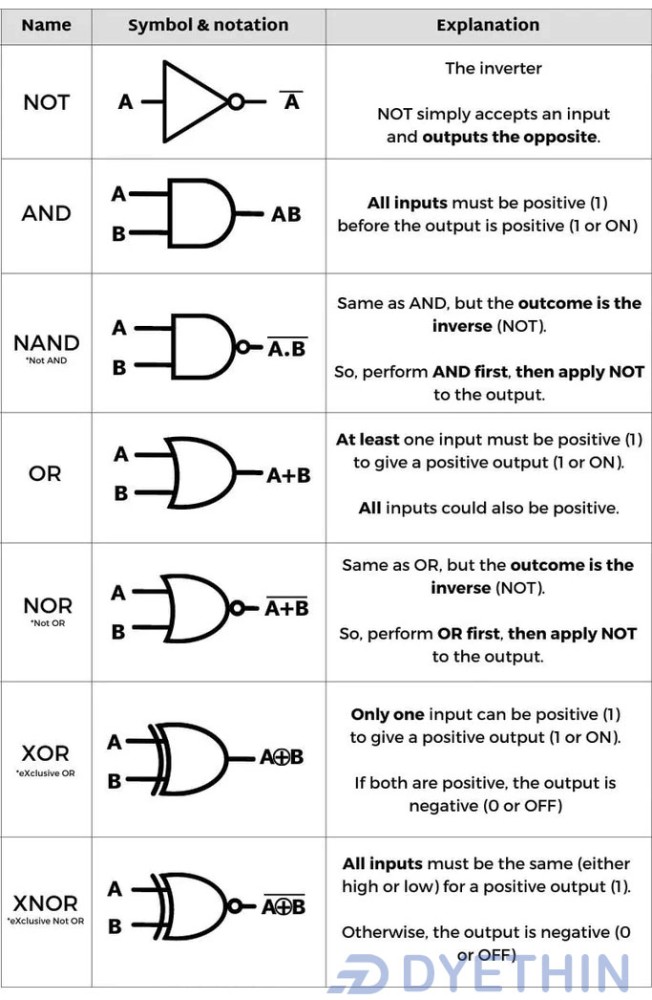
7 Basic Logic Gates
The seven basic logic gates are AND, OR, NOR, XOR, NOT, NAND, and XNOR.
In the following Gate cheat sheet, the terminals are noted as A or B or a combination of the two.
Future Trends and Advancements in NAND-Based Circuits
As digital technology advances, the NAND gate continues to play a crucial role in the evolution of semiconductor design, computing, and artificial intelligence. Due to its efficiency and versatility, researchers and engineers are leveraging NAND-based circuits to drive innovations in high-speed computing, AI processors, and next-generation quantum computing.
High-Speed Computing and Low-Power Design
Modern microprocessors and digital logic circuits are optimizing NAND-based architectures to improve processing speed and energy efficiency. With the increasing demand for faster data processing in mobile devices, cloud computing, and IoT (Internet of Things), NAND logic is being refined to reduce power consumption while maintaining performance.
AI Processors and Machine Learning Hardware
Artificial Intelligence (AI) and Machine Learning (ML) rely heavily on optimized logic circuits to process complex algorithms. NAND gates are being integrated into neuromorphic computing chips, where they mimic brain-like processing patterns, enhancing deep learning performance and efficiency.
NAND in Quantum Computing
While traditional NAND logic is essential in classical computing, researchers are exploring how NAND-like logic can be adapted to quantum circuits. This could revolutionize secure encryption, large-scale simulations, and computational problem-solving in ways that traditional computing cannot achieve.
As semiconductor technology continues to evolve, NAND-based circuits will remain at the forefront of next-generation computing, powering smarter, faster, and more efficient digital systems.
Conclusion
The NAND gate is one of the most fundamental and powerful components in digital electronics, serving as a universal gate that can construct any other logic function. Its widespread applications in memory units, microprocessors, and AI-driven systems highlight its critical role in modern technology.
Understanding NAND-based logic design is essential for anyone interested in electronics, computing, or engineering. Whether you're a student, an enthusiast, or a professional, exploring NAND gate applications can open doors to deeper insights into modern digital systems and beyond.
Related articles
SMD Resistor Size Chart
CR2025 Battery: Equivalent, Specifications and Replacements
Hall Effect Sensors & Switches
Understanding 10K Ohm Resistor: 10K Ohm Resistor Color Code
The Ultimate Guide to CR2016 vs CR2032 Batteries
FAQs
Articles you may also like
Design of High Current H-Bridge Motor Drive Circuit

The working principle, key parameters, and selection of TVS
Gas Discharge Tube Symbols, Characteristics and Structure

What is ESD and how to layout the ESD protection circuit PCB