














Intel Core i7 6700 vs i5 9500T
Introduction
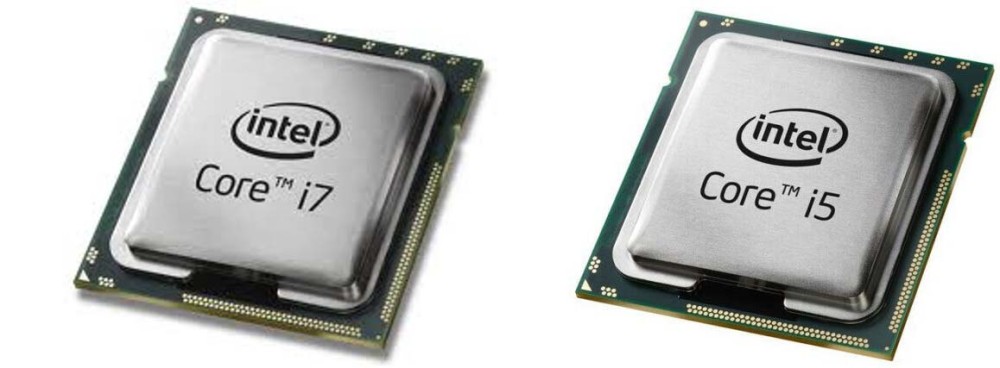
Choosing the right processor is crucial for building a powerful and efficient PC. Among mid-range CPUs, the Intel Core i7 6700 and Intel Core i5 9500T are often compared for their performance, power efficiency, and gaming capabilities. Both processors cater to different user needs, making it essential to understand their strengths and limitations before deciding which one suits you best.
The Intel Core i7 6700, part of Intel's 6th-generation Skylake lineup, is known for its impressive multitasking abilities and solid performance in demanding applications. On the other hand, the Intel Core i5 9500T, a 9th-generation CPU, offers improved power efficiency with a lower TDP, making it ideal for energy-conscious users.
In this article, we'll compare these two processors based on gaming performance, productivity tasks, and energy consumption, helping you make an informed decision based on your unique computing needs. Whether you’re a gamer, content creator, or casual user, this guide will provide the insights you need.
1. Key Specifications Comparison
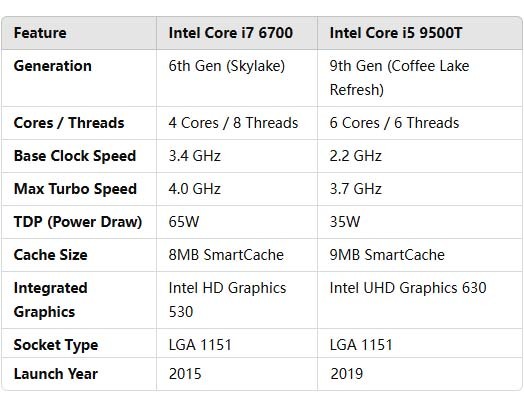
When comparing the Intel Core i7 6700 and the Intel Core i5 9500T, it's crucial to understand their technical specifications. Below is a detailed table that highlights the key differences:
Core and Thread Count Differences
The Intel Core i7 6700 features 4 cores and 8 threads, giving it an advantage in multitasking, especially for content creation and demanding workloads. Conversely, the i5 9500T offers 6 cores and 6 threads, which may provide better performance in single-threaded tasks but lacks Hyper-Threading for advanced multitasking.
Clock Speeds and Turbo Boost
The i7 6700 boasts a higher base clock speed (3.4 GHz) and can reach 4.0 GHz with Turbo Boost, ensuring solid performance for gaming and productivity. Meanwhile, the i5 9500T has a lower base clock (2.2 GHz) and peaks at 3.7 GHz, which is slower but optimized for power efficiency.
Power Efficiency and Thermal Performance
A key strength of the i5 9500T is its 35W TDP, making it a far more energy-efficient option compared to the i7 6700's 65W TDP. This reduced power consumption benefits compact builds, silent systems, and energy-conscious users. However, the i7 6700’s higher power draw allows it to deliver stronger performance in demanding applications.
In summary, the i7 6700 excels in multitasking and performance-heavy tasks, while the i5 9500T offers better energy efficiency and may suit low-power systems or HTPC setups. Choosing between these CPUs depends on your performance needs and power consumption priorities.
2. Gaming Performance
When evaluating the gaming capabilities of the Intel Core i7 6700 and Intel Core i5 9500T, it's essential to consider both frames per second (FPS) benchmarks in popular titles and their effectiveness in Minecraft server hosting.
FPS Benchmarks in Popular Games
The Intel Core i7 6700, a 6th-generation processor, features 4 cores and 8 threads with a base clock speed of 3.4 GHz, boosting up to 4.0 GHz. In contrast, the Intel Core i5 9500T, a 9th-generation CPU, offers 6 cores and 6 threads with a base clock of 2.2 GHz and a turbo boost up to 3.7 GHz. Despite the i5 9500T's newer architecture and additional cores, its lower clock speeds and absence of Hyper-Threading can influence gaming performance.
In single-threaded games like Counter-Strike: Global Offensive (CS:GO), the i7 6700's higher clock speeds and Hyper-Threading provide a slight advantage, delivering smoother gameplay and higher FPS. Conversely, in multi-threaded titles such as Battlefield V, the i5 9500T's additional cores offer improved performance, handling more simultaneous processes efficiently.
It's important to note that the i5 9500T is a low-power variant with a 35W TDP, which may result in reduced performance compared to its standard counterparts. This power efficiency can lead to lower FPS in demanding games, making the i7 6700 a more robust choice for high-performance gaming.
Real-World Performance for Minecraft Server Hosting
Minecraft server hosting relies heavily on CPU performance, particularly single-threaded capabilities, as the game engine processes most tasks on a single core. The i7 6700's higher single-core performance and Hyper-Threading enable it to manage multiple server tasks effectively, providing a stable environment for players.
Community feedback supports this assessment. Users have reported successful experiences hosting heavily modded Minecraft servers on the i7 6700, emphasizing the importance of adequate RAM allocation alongside CPU performance. One user noted, "The i7-6700 is fine. What is more important is the RAM; make sure to have at least 16 GB and use about 8 GB for Java.
The i5 9500T's lower clock speeds and lack of Hyper-Threading may limit its effectiveness in handling the intensive single-threaded demands of Minecraft servers, potentially leading to lag or reduced player capacity.
For gaming purposes, the Intel Core i7 6700 generally offers superior performance, particularly in single-threaded games and applications like Minecraft server hosting. While the Intel Core i5 9500T provides better energy efficiency, its reduced clock speeds and lack of Hyper-Threading can hinder gaming performance. Therefore, if gaming is a primary consideration, the i7 6700 may be the more suitable choice.
3. Productivity and Multitasking
When it comes to productivity tasks such as content creation, photo editing, and video rendering, both the Intel Core i7 6700 and Intel Core i5 9500T have distinct strengths and limitations. Understanding these differences is crucial for professionals seeking optimal performance in creative workflows.
Performance in Content Creation Tasks
The Intel Core i7 6700, with its 4 cores and 8 threads, is designed to handle demanding workloads efficiently. Applications like Adobe Premiere Pro, Photoshop, and Blender often rely on both multi-threaded and single-threaded performance. Thanks to its higher base clock speed of 3.4 GHz and Turbo Boost capability reaching 4.0 GHz, the i7 6700 offers solid performance in rendering, encoding, and multitasking.
In comparison, the Intel Core i5 9500T boasts 6 cores but lacks Hyper-Threading. While its additional cores provide better performance in multi-threaded tasks like batch image processing in Photoshop, its lower base clock speed of 2.2 GHz and maximum Turbo Boost of 3.7 GHz may result in slower rendering speeds in demanding video editing software.
Impact of Hyper-Threading on Performance
Hyper-Threading technology significantly enhances multitasking capabilities by allowing each core to handle two threads simultaneously. The Intel Core i7 6700’s support for Hyper-Threading improves its performance in heavily-threaded applications like Adobe After Effects and DaVinci Resolve, where multiple layers, effects, and transitions require robust CPU power.
In contrast, the Intel Core i5 9500T lacks Hyper-Threading, limiting its efficiency in complex multitasking scenarios. Users managing multiple applications simultaneously or handling large-scale video projects may find the i7 6700 to be the superior choice.
For content creators, designers, and multitaskers, the Intel Core i7 6700 generally provides better performance and responsiveness, while the Intel Core i5 9500T offers improved efficiency for lighter workloads and energy-conscious users.
4. Energy Efficiency and Cooling
When comparing the Intel Core i7 6700 and Intel Core i5 9500T, energy efficiency and cooling performance are key considerations. Understanding their power consumption and thermal requirements can help users optimize their PC builds for stability, longevity, and cost savings.
Power Consumption Comparison
The power draw of a CPU directly impacts system stability, heat generation, and overall energy costs. Here’s how the two processors compare:
✅ Intel Core i7 6700
TDP (Thermal Design Power): 65W
Higher power consumption due to its higher base clock (3.4 GHz) and Turbo Boost up to 4.0 GHz.
Best suited for performance-oriented systems, gaming rigs, and content creation setups.
May require better airflow management to maintain stable temperatures under load.
✅ Intel Core i5 9500T
TDP (Thermal Design Power): 35W
Optimized for energy efficiency, consuming roughly 40-50% less power than the i7 6700.
Ideal for compact PCs, HTPC setups, and low-power workstations.
Maintains lower heat output, reducing the need for aggressive cooling solutions.
Cooling Solutions for Each CPU
To maintain optimal temperatures and performance, choosing the right cooling solution is essential:
✅ Intel Core i7 6700
Recommended: Mid-range to high-performance air coolers or budget liquid coolers.
Popular choices include the Cooler Master Hyper 212 Black Edition or be quiet! Pure Rock 2 for efficient cooling during extended gaming or intensive workloads.
✅ Intel Core i5 9500T
Recommended: Standard stock coolers such as the Intel Laminar RM1 or small form factor coolers for mini-ITX builds.
The i5 9500T’s low heat output makes aftermarket cooling optional unless operating in hot environments.
For energy efficiency and lower heat generation, the Intel Core i5 9500T is the superior choice. However, users seeking higher performance should opt for the Intel Core i7 6700 with an appropriate cooling solution to ensure stable operation.
Conclusion
In the battle between the Intel Core i7 6700 and Intel Core i5 9500T, the right choice depends on your computing needs, performance expectations, and budget.
For gamers, the Intel Core i7 6700 emerges as the better choice due to its higher clock speeds and Hyper-Threading support. This combination ensures smoother gameplay in CPU-intensive titles and better stability for tasks like Minecraft server hosting.
For content creators, the i7 6700 again holds the advantage. Its 4 cores and 8 threads enhance multitasking, making it ideal for demanding applications such as Adobe Premiere Pro, Photoshop, and Blender. The improved thread handling significantly boosts performance in video rendering and content production.
For budget buyers or those prioritizing energy efficiency, the Intel Core i5 9500T is a smart pick. With its 35W TDP, it consumes less power while maintaining decent performance for casual gaming, web browsing, and light productivity tasks.
In short, if performance is your priority, the i7 6700 is the superior choice. However, for low-power setups or budget builds, the i5 9500T delivers efficient performance at a reduced power cost. Carefully weigh your needs to choose the ideal CPU for your setup.
Related articles
CR2025 Battery: Equivalent, Specifications and Replacements
CR1616 Battery Equivalent: Best Replacement Guide
MCP1700 Low Dropout Regulator: Features, Applications, and Comparison
P75NF75 Mosfet Datasheet, Pinout, Equivalent, Voltage, Circuit and Uses

FAQs
Articles you may also like

Xilinx Zynq Multiprocessor System-on-Chip (MPSoC)
What is the specific protocol of QSPI?

-
-
-
-
-
-
-
-
-
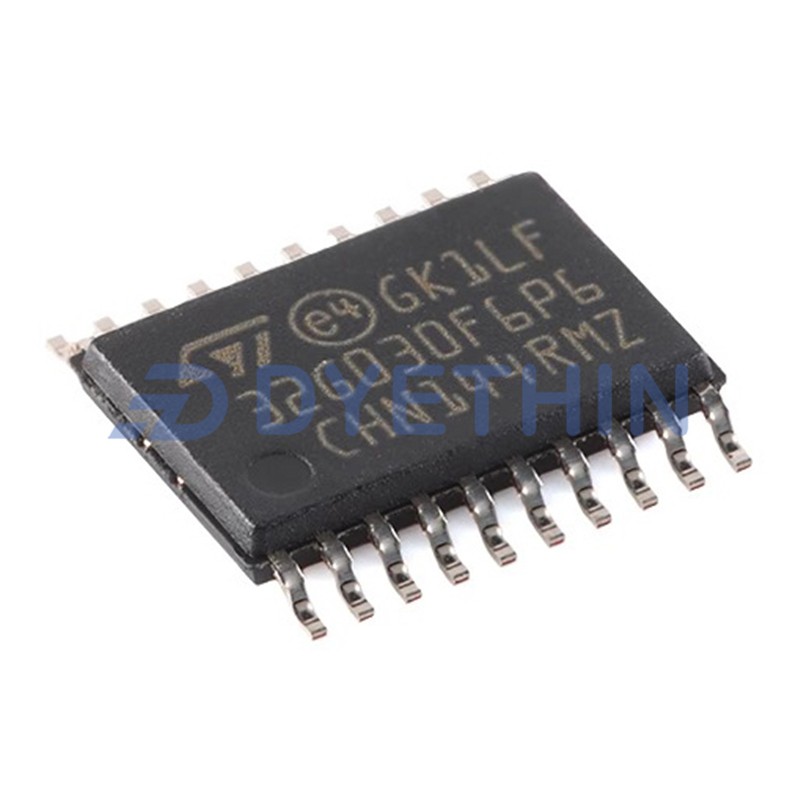
stmicroelectronics
ARM® Cortex®-M0+ STM32G0 Microcontroller IC 32-Bit Single-Core 64MHz 32KB (32K x 8) FLASH 20-TSSOP