













- Startseite
- Featured Products
- Microchip
- MCP2515 Series Product Analysis: CAN Controller Solution
MCP2515 Series Product Analysis: CAN Controller Solution
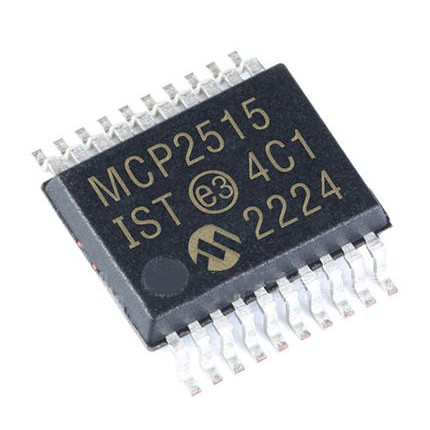
MCP2515 Introduction
MCP2515 is an independent CAN (Controller Area Network) controller produced by Microchip, which supports the CAN V2.0B technical specification and provides a communication rate of up to 1 Mb/s. It is widely used in embedded systems requiring CAN bus communication. MCP2515 transmits data to the central controller (such as the STM microcontroller) through the SPI interface, improving the reliability and efficiency of the data processing solution for electrical products.
MCP2515 Series Features
SPI interface: MCP2515 communicates with the main controller through the SPI interface and supports SPI clock frequencies up to 10MHz.
High-speed CAN: Supports communication rates up to 1 Mb/s, meeting high-speed data transmission requirements.
Multiple buffers: Provides 3 independent send buffers for sequential transmission of data.
Full compatibility: Fully compatible with CAN V2.0B technical specifications, supporting standard and extended data frames as well as remote frames.
Flexible configuration: Built-in two receiving buffers, six acceptance filter registers, and two acceptance mask registers, supporting flexible message filtering and storage.
Low-power design: Using low-power CMOS technology, the operating voltage range is 2.7V to 5.5V, and the standby current is as low as 1 μ A.
Wide temperature operation: Supports industrial grade (-40 ° C to+85 ° C) and expansion grade (-40 ° C to+125 ° C) temperature ranges.
MCP2515 series model details
The MCP2515 series includes multiple models to meet the needs of various development projects. Below are several mainstream models:
| Model | Package | Operation Temp | Describe |
| MCP2515-I/SO | 18-SOIC | -40°C ~ 85°C | IC CAN CONTROLLER W/SPI 18SOIC |
| MCP2515-E/SO | 18-SOIC | -40°C ~ 125°C | IC CAN CONTROLLER W/SPI 18SOIC |
| MCP2515-I/P | 18-DIP | -40°C ~ 85°C | IC CAN CONTROLLER W/SPI 18DIP |
| MCP2515-E/P | 18-DIP | -40°C ~ 125°C | IC CAN CONTROLLER W/SPI 18DIP |
| MCP2515-I/ST | 20-TSSOP | -40°C ~ 85°C | IC CAN CONTROLLER W/SPI 20TSSOP |
| MCP2515-E/ST | 20-TSSOP | -40°C ~ 125°C | IC CAN CONTROLLER W/SPI 20TSSOP |
| MCP2515-I/ML | 20-QFN | -40°C ~ 85°C | IC CAN CTLR SPI 2ND GEN 20QFN |
| MCP2515-E/ML | 20-QFN | -40°C ~ 125°C | IC CAN CTLR SPI 2ND GEN 20QFN |
Note: Products with OVAO after the model number are of automotive grade and comply with AEC-Q100 standards.
MCP2515 Technical Specifications
When selecting and developing products using MCP2515, the main considerations are the following specifications:
| Parameter | Explain |
| Working voltage range | 2.7V to 5.5V |
| CAN bus speed | Up to 1 Mbps |
| Working temperature range | -40 ° C to+125 ° C |
| SPI clock frequency | Up to 10 MHz |
| Packaging type | SOIC、TSSOP、DIP |
| Number of receiving filters | 6 |
| Number of receiving masks | 2 |
MCP2515 Working principle
MCP2515 is an independent CAN controller that uses the SIP interface to transmit data to the microcontroller and is responsible for processing all instructions on the CAN bus, such as sending, receiving, and filtering instructions. The microcontroller sends instructions and data to MC2515 through the SPI interface and receives data uploaded from the CAN bus from MC2515.
MCP2515 Applications
Automotive Electronics: In the intelligent automotive solution, MCP2515 is mainly used for managing and controlling data exchange between various sensors and ECU (Electronic Control Unit) in the automotive network. Its high-speed transmission characteristics meet the requirements of the automotive CAN bus system.
Industrial automation: providing reliable communication solutions in applications such as robots, PLCs, sensor networks, etc.
Smart Home: In the smart home system, interconnection and intercommunication between various smart devices are achieved to enhance home intelligence.
MCP2515 Typical case
Interfacing MCP2515 CAN Module with Arduino
Use CAN protocol to transmit DHT11 sensor data within a certain distance. Controller Area Network, also known as CAN-BUS, is a common industrial bus due to its long travel distance, moderate communication speed, and high reliability.
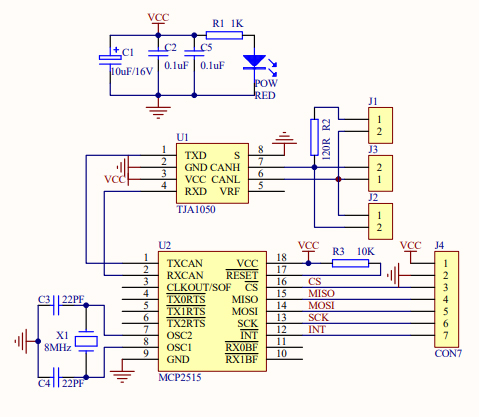
MCP2515 CAN module circuit schematic
In order to transmit and receive data at very high speeds, standard automotive communication protocols are required. Standard communication protocols such as UART, SPI, and I2C are not reliable for this system. Therefore, we need a car communication protocol like CAN protocol to achieve high-speed and one-time transmission of thousands of data.
This case study uses a Microchip MCP2515 CAN bus module and Arduino board's CAN bus communication protocol. Using a pair of CAN bus modules MCP2515, we will send DHT11 sensor data within a distance of a few centimeters. Typically, the communication speed range of CAN is 50 Kbps to 1 Mbps, with a distance range of 40 meters at 1 Mbps to 1000 meters at 50 kbps.MCP2515 CAN bus module is connected to Arduino to understand the CAN bus protocol.
How do you choose the appropriate MCP2515 model?
The selection of a suitable MCP2515 model should be based on the following considerations:
Working temperature range: Whether high temperature or cold resistance is required, choose the appropriate level, industrial grade, or expansion grade.
Space limitations: Consider whether the packaging type is suitable for the size of the PCB circuit board and the assembly space.
Data rate: Does the maximum CAN bus speed of 1 Mbps meet the project requirements?
MCP2515 Development Tools and Support
Microchip provides rich development tools and technical support for MCP2515, including MPLAB IDE, sample code library, and development board, to help developers quickly get started and implement functional verification.
MCP2515 Datasheet
Conclusion
MCP2515 series, as a star product of Microchip Technology, occupies an essential position in CAN communication with its excellent performance and wide application range. With the continuous development of industrial automation and automotive electronics technology, the MCP2515 series will continue to play an important role and support innovative development in various industries. In the future, we look forward to Microchip launching more innovative products to meet the constantly changing market demands.
FAQs
Articles you may also like
AT24C02 pinout and datasheet, as well as application cases
MCP1700 Low Dropout Regulator: Features, Applications, and Comparison
MIC2287-34YML-TR Features, Pinout and Datasheet