













- Startseite
- Blogs
- Intelligent control
- PIC microcontroller technology and application foresight
PIC microcontroller technology and application foresight
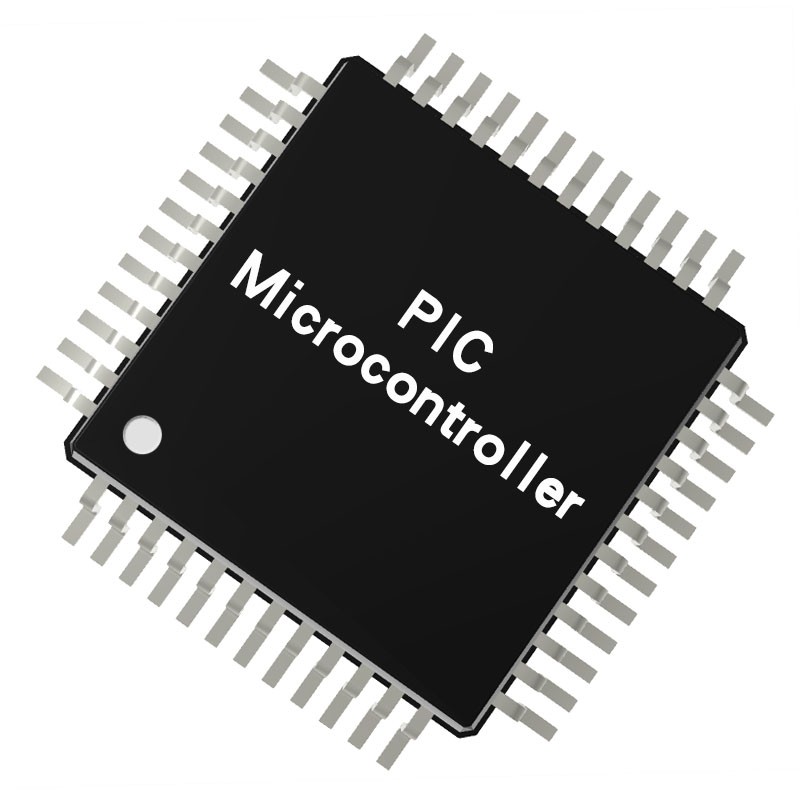
In embedded system development, PIC microcontroller has become the first choice of many engineers and developers due to its cost-effective and wide range of application areas. So, what is PIC microcontroller? How is it different from other microcontrollers? In this article, we will be from the basics to advanced applications, a full analysis of the technical characteristics and practical use of PIC microcontroller, to provide readers with a clear learning path.
PIC microcontroller (Peripheral Interface Controller) is a series of microcontrollers developed by Microchip. Since its introduction in the 1980s, PIC microcontrollers have gradually occupied an important position in the development of embedded systems by virtue of their simple architecture and flexibility.
Architecture of PIC Microcontroller
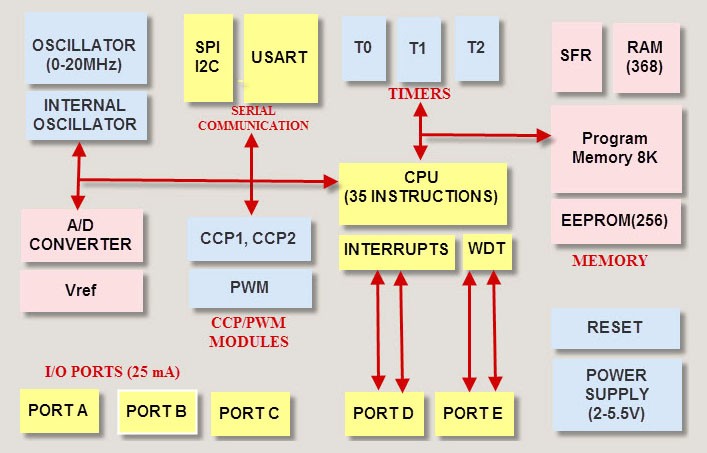
Architecture of PIC Microcontroller picture
PIC microcontrollers utilize the Harvard architecture, which greatly improves processing efficiency by separating program and data memories compared to the traditional von Neumann architecture. In addition, PIC microcontrollers are usually based on the Reduced Instruction Set (RISC), which supports only a small number of instructions, making it easier and more efficient to program.
Features of the Harvard Architecture
Separate data and instruction buses: Enables parallel operation and improves operation speed.
Simple instruction set: each instruction can be executed in a single clock cycle, reducing power consumption.
Difference between RISC and CISC
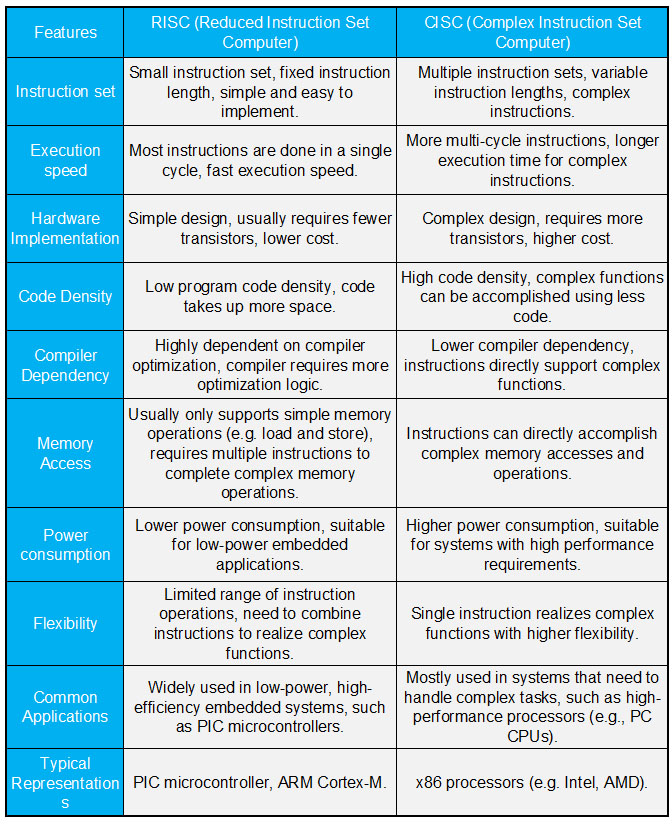
Comparison Chart of RISC and CISC Differences
PIC microcontrollers are generally based on the RISC architecture, which is characterized by simplicity, high efficiency, and low power consumption, and is well suited for control and low-cost applications in the embedded domain, while the CISC architecture is more suitable for high-performance computing and complex task processing.
Common PIC Microcontroller Families
Microchip categorizes PIC microcontrollers into several families based on different application requirements. Below are a few common series and their features:
PIC10/12 series
| Part Number | Description |
| PIC10F200 | 6-bit instruction set, 4 I/O pins, 256 bytes of program memory for small embedded applications. |
| PIC10F222 | 8-bit instruction set, 512 bytes program memory, supports analog comparator, low power consumption. |
| PIC12F508 | 8-bit microcontroller, 1.5KB program memory, no AD module, suitable for basic logic control. |
| PIC12F675 | With ADC module, 10-bit resolution, 1KB program memory, suitable for sensor applications. |
| PIC12F683 | Supports PWM and capture functions, 3.5KB program memory, suitable for simple motor control and timing tasks. |
These low-end series microcontrollers feature ultra-low power consumption and miniaturization, and are commonly used for projects with low resource requirements, such as simple sensors and LED drivers.
PIC16 Series
| Part Number | Description |
| PIC16F84A | 8-bit microcontroller, 1KB program memory, 68 bytes RAM, supports EEPROM storage. |
| PIC16F877A | Supports AD module, 40 I/O pins, 14KB program memory, widely used in industrial control and automotive fields. |
| PIC16F628A | Built-in comparator, 2KB program memory, suitable for small and medium-sized applications and timing control. |
| PIC16F886 | https://www.dyethin.com/productcategory/integrated-circuits-ics-430/memory-497Powerful with 10-bit ADC module, 14KB program memory, 256-byte EEPROM. |
| PIC16F1503 | High-performance 8-bit microcontroller, 4KB program memory, supports low-power mode for battery-powered devices. |
General-purpose PIC microcontrollers, widely used in scenarios such as home appliance control and IoT devices, balancing performance and price.
PIC18 Series
| Part Number | Description |
| PIC18F4520 | Advanced 8-bit MCU, 32KB program memory, support LCD driver, suitable for complex embedded systems. |
| PIC18F2550 | Supports USB communication, 24KB program memory, suitable for embedded devices that require USB functionality. |
| PIC18F46K22 | 64KB program memory, support 16-bit PWM, suitable for high performance applications. |
| PIC18F4550 | Supports USB 2.0 with ADC module, 32KB program memory, widely used for embedded development. |
| PIC18F45K50 | Supports Enhanced Instruction Set, 16KB program memory, both low power consumption and high performance, suitable for industrial applications. |
Designed for high-performance needs, providing larger storage capacity and higher operating speed, suitable for applications requiring complex operations, such as robot control and communication systems.
Working Principle of PIC Microcontroller
The core working principle of a PIC microcontroller revolves around the processing of data and instruction streams. Its clock system is responsible for coordinating the speed of operation, while the reset mechanism ensures system recovery in case of an error.
Data and Instruction Flow
The PIC microcontroller processes input data into usable output signals by means of registers, program counters, and instruction decoders working in tandem. The execution of each instruction relies on its clean pipeline structure, a design that greatly improves operational efficiency.
Clock system and reset mechanism
The PIC microcontroller has a built-in oscillator module that can be configured with different frequencies to suit a wide range of applications. At the same time, its reset mechanism ensures that the system can be quickly restored to its normal state after disturbance or accidental power failure.
Programming Languages and Development Tools for PIC Microcontrollers
For PIC microcontroller development, choosing the right programming language and tool chain is crucial.
Programming in C Language
C is the most common language used in PIC microcontroller development as it combines efficiency and readability.
Advantages of C language
Cross-platform support: C language is supported by most PIC series.
Rich library functions: speed up development.
The following is a simple C code example for controlling a blinking LED:
#include <xc.h
void main() {
TRISB = 0x00; // set PORTB as output
while (1) {
LATB = 0xFF; // turn on all LEDs
__delay_ms(500);
LATB = 0x00; // turn off all LEDs
__delay_ms(500);
}
}
Programming in Assembly Language
For scenarios where precise control of hardware resources is required, assembly language is still the preferred choice. Assembly language is based on the PIC instruction set and can directly manipulate hardware registers.
How to get source code onto a PIC microcontroller
1. Preparation
Before you start, you need to prepare the following tools and resources:
Compiler software: Commonly used development tools are the MPLAB X IDE and XC compiler provided by Microchip.
Source code files: Code files written in C or assembly language (usually .c or .asm files).
Programmer hardware: e.g. PICkit 3/4 or ICD 4, used to write the compiled code to the PIC microcontroller.
Target PIC microcontroller: Need to make sure it matches the model and resources of the source code.
Connection cable and board: Hardware environment for connecting the programmer to the PIC microcontroller.
2. Installation of Development Tools
Download and install the MPLAB X IDE and the corresponding XC compiler from the Microchip website.
MPLAB X IDE: Microchip official website
Select the appropriate compiler according to the PIC family used (e.g. XC8, XC16 or XC32).
3. Creating a Project
Open the MPLAB X IDE.
Click File > New Project and select Microchip Embedded > Standalone Project.
Select the target PIC microcontroller model (e.g. PIC16F877A).
Select the programmer (e.g. PICkit 4).
Select the compiler version (e.g. XC8).
Configure the project folder and name and click Finish when finished.
4. Writing or importing code
In the MPLAB project, create or import a source code file:
New Code File: Right-click the project and select New > C Source File to write source code.
Import existing code: Right-click the project and select Add Existing Items... to import existing .c code. to import an existing .c or .asm file.
Set the Configuration Bits according to the needs of the project:
Configure directly in the code or use MPLAB's Configuration Bits tool.
5. Compiling the code
Click the Build Main Project button (green hammer icon) in the toolbar.
After compilation, the resulting binary file (e.g. .hex) will be saved in the dist folder of the project directory.
6. Hardware connection
Connect the programmer (e.g. PICkit 3/4) to the computer via USB.
Use the programmer's interface to connect to the PIC microcontroller (usually the ICSP interface).
Make sure that the connections are correct, including VPP (programming voltage), VDD (power), GND (ground), PGD (data) and PGC (clock).
7. Writing the program
In the MPLAB X IDE, make sure the programmer is connected:
Click Window > Output > PICkit/ICD to check the connection status.
Click the Make and Program Device button (green arrow icon) to write the compiled .hex file to the PIC microcontroller.
Wait for the write to complete and check the output log to make sure there are no errors.
8. Test program
When the write is complete, disconnect the programmer.
Run the PIC microcontroller in the target board to verify that the program functions well and the operation is stable.
9.Notes on Burning Programs
Make sure that the programmer and target PIC microcontroller models match.
If program burning fails, check the hardware connections and compilation settings.
Configuration bits must match the actual hardware circuitry (e.g., clock source and reset settings).
Application areas of PIC microcontrollers
Home automation: PIC microcontroller is one of the important components to realize smart home. Through the use of PIC microcontroller, it can realize the automation control of home equipment, such as lights, curtains, air conditioning and so on. At the same time, PIC microcontroller can also be combined with sensors to realize the monitoring and control of environmental parameters such as temperature, humidity and air pressure. The realization of these functions not only improves the comfort and safety of the home, but also saves energy and labor costs.
Medical equipment: PIC microcontroller also has a wide range of applications in medical equipment, such as blood pressure monitors, ECG recorders, drug management and so on. Its high performance, low power consumption and easy programmability enable medical equipment to operate more accurately and efficiently, providing strong support for the development of the medical field.
Automotive electronics: In the field of automotive electronics, PIC microcontrollers are widely used in engine control systems, tire pressure monitoring systems, car audio systems and so on. Its reliability and stability enable automotive electronic systems to run more safely and reliably, improving driving comfort and safety.
Industrial automation: PIC microcontrollers can also be used for various functions of industrial automation equipment, such as PLC (programmable logic controller), robots, sensors and so on. Its powerful computing capability and rich hardware modules enable industrial automation systems to accomplish various tasks more efficiently and accurately.
Other fields: In addition to the above fields, PIC microcontrollers are also widely used in communication, security, toys, low-power measurement and control applications and other fields. Its wide range of application fields and powerful functions make PIC microcontroller an indispensable part of modern electronic technology.
Advantages and Limitations of PIC Microcontrollers
PIC microcontroller occupies an important position in the market due to its unique technical features, but it also faces some limitations in its use.
The main technical advantages of PIC microcontroller
Low power consumption: the energy-efficient nature of PIC microcontrollers makes them ideal for battery-powered devices, especially in IoT and portable devices.
Simple instruction set: PIC microcontrollers based on RISC architecture have a simplified instruction set that is easy to learn and apply, so even beginners can get started quickly.
Powerful peripheral support: PIC microcontroller integrates rich peripheral modules, such as ADC, UART, PWM, etc., which reduces the need for additional hardware.
Complete development tools: Microchip provides comprehensive development tools, including MPLAB X IDE, XC compiler and PICKit debugger, which reduces the development difficulty.
Frequently Asked Questions and Challenges
Limited memory and processing power: Compared to high-end microcontrollers (such as the ARM Cortex-M series), PICs have weak memory and processing power, making them unsuitable for resource-intensive applications.
Packaging Complexity: Some PIC microcontrollers are packaged in complex packages with high soldering and layout requirements.
Programming complexity: Although C language is widely supported, for the realization of certain advanced functions, it still needs to be combined with assembly language, which increases the learning threshold.
Practical Case Studies of PIC Microcontrollers
The following two practical cases are used to further understand the application value of PIC microcontrollers in different fields.
Case 1: PIC-based intelligent temperature control system
In smart home, temperature control is an important function. By using PIC microcontroller, the following objectives can be realized:
Sensor reading: read the data from the temperature sensor using the built-in ADC module.
Data Processing: Control the relay according to the set temperature threshold to realize the automatic start and stop of heating or cooling equipment.
Low power operation: Utilizes the sleep mode of the PIC to reduce standby power consumption.
The following is a sample of the basic implementation code of the system:
#include <xc.h>
void main() {
ADCON0 = 0x01; // Configuring the ADC
while (1) {
int temp = Read_Temperature();
if (temp > THRESHOLD) {
Activate_Cooling();
} else {
Activate_Heating();
}
}
}
Case 2: Application of PIC microcontroller in robotics
In robot control, PIC microcontrollers can be used for motor driving, path planning and sensor data processing. For example, in a simple two-wheeled balancing robot, the PIC controls the motor speed via PWM signals and maintains balance using data from the gyroscope sensor.
The future development trend of PIC microcontroller
PIC microcontroller constantly adapts to the technology trend, and its future development direction is mainly focused on the following aspects:
Integration with AI
With the popularization of artificial intelligence, PIC microcontrollers are gradually integrating AI functions for edge computing and intelligent decision-making. For example, in the smart home, PIC can be combined with simple machine learning algorithms to achieve more accurate behavioral prediction.
Innovative applications in emerging fields
Internet of Things (IoT)
The low power consumption of PIC microcontrollers makes them highly desirable in the IoT, especially for wireless sensor networks and wearable devices.
Medical Electronics
In portable medical devices, PIC microcontrollers enable high-precision data acquisition and processing, supporting the popularization of medical technology.
Conclusion
With its simple and efficient architecture, rich peripheral support and low-power features, PIC microcontroller has become an important tool in the field of embedded development. Whether you are a beginner or an experienced developer, learning and mastering PIC microcontrollers can bring great value to technical projects. However, when selecting and applying PIC microcontrollers, developers need to consider their performance and limitations to ensure that they match their project needs.
Related articles
CR1616 Battery Equivalent: Best Replacement Guide
Understanding 10K Ohm Resistor: 10K Ohm Resistor Color Code
MAX485 is an RS 485/RS422 transceiver integrated circuit IC produced
P75NF75 Mosfet Datasheet, Pinout, Equivalent, Voltage, Circuit and Uses
FAQs
Articles you may also like

What is a waveform? What types of waveforms are there? And the characteristics of the waveform
Build an intelligent UPS power supply
Measurement of Air Ionic Conductivity with Double Darlington Tubes
CC2530 integrated circuit IC to design an intelligent agricultural control system