














PCB Stackup Design Tips
Single-sided PCB board and 2 layer PCB Stackup
4 layer pcb stackup
6 layer pcb stackup
8 layer pcb stackup
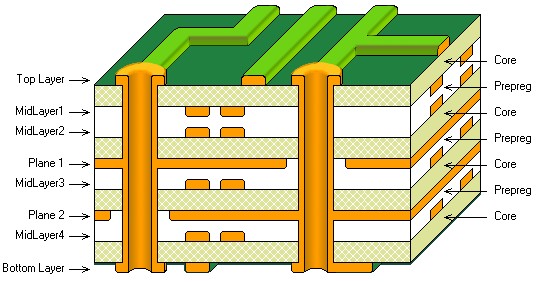
In general, PCB stackup design mainly follows two rules:
● Each routing layer must have an adjacent reference layer (power or ground layer);
● The adjacent main power layer and ground layer should be kept at a minimum distance to provide a large coupling capacitance;
Single-sided PCB board and 2 layer PCB Stackup
For two-layer boards, due to the small number of layers, there is no problem of stacking. Controlling EMI radiation is mainly considered from wiring and layout;
The electromagnetic compatibility problem of single-layer boards and double-layer boards is becoming more and more prominent. The main reason for this phenomenon is that the signal loop area is too large, which not only generates strong electromagnetic radiation, but also makes the circuit sensitive to external interference. To improve the electromagnetic compatibility of a line, the simplest way is to reduce the loop area of critical signals.
Key signals: From the perspective of electromagnetic compatibility, key signals mainly refer to signals that generate strong radiation and signals that are sensitive to the outside world. Signals that can produce strong radiation are generally periodic signals, such as low-order signals of clocks or addresses. Signals that are sensitive to interference are those analog signals that are low in level.
Single and double-layer boards are usually used in low-frequency analog designs below 10KHz:
1) Power supply traces on the same layer are routed in a radial manner and the total length of the lines is minimized;
2) When running power and ground wires, keep them close to each other; lay a ground wire next to the key signal line, and this ground wire should be as close to the signal line as possible. This forms a smaller loop area and reduces the sensitivity of differential mode radiation to external interference. When a ground wire is added next to the signal line, a loop with the smallest area is formed, and the signal current will definitely take this loop instead of other ground wire paths.
3) If it is a double-layer circuit board, you can run a ground wire along the signal line on the other side of the circuit board, immediately below the signal line, and make the line as wide as possible. The loop area thus formed is equal to the thickness of the circuit board multiplied by the length of the signal line.
4 layer pcb stackup
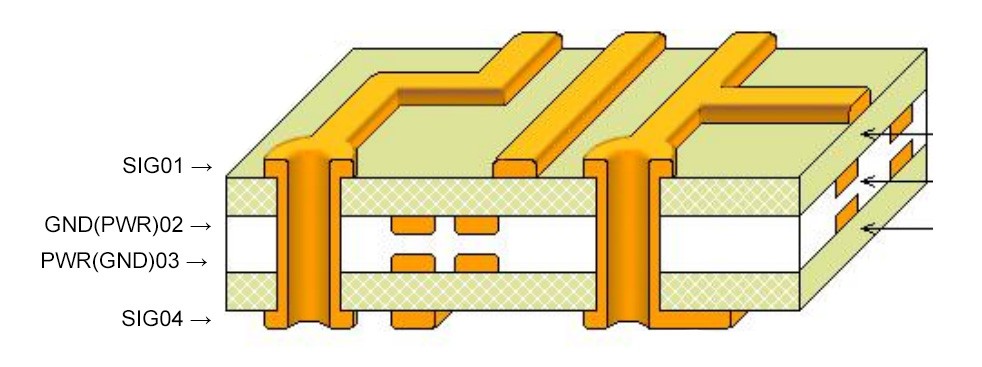
1) SIG-GND(PWR)-PWR (GND)-SIG;
2) GND-SIG(PWR)-SIG(PWR)-GND;
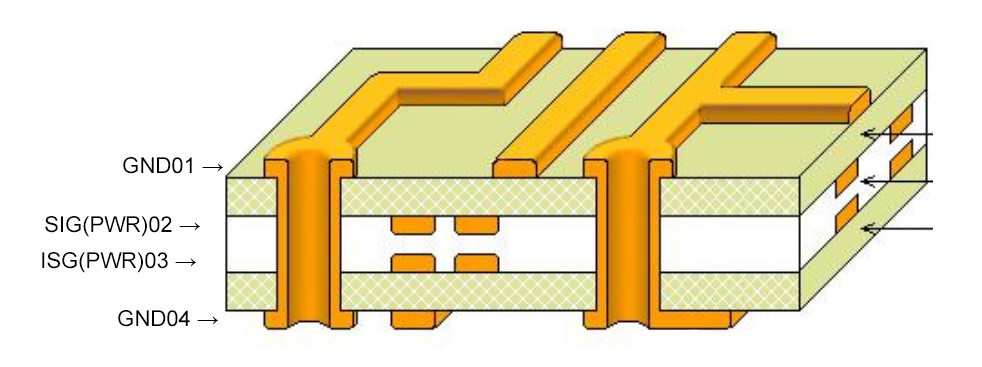
For the above two stack-up designs, the potential problem is with the traditional 1.6mm (62mil) board thickness. The spacing between layers will become very large, which is not only detrimental to impedance control, interlayer coupling and shielding; in particular, the spacing between power and ground layers is very large, which reduces the board capacitance and is not conducive to filtering noise.
For the first solution, it is usually used when there are many chips on the board. This solution can achieve better SI performance, but is not very good for EMI performance, which is mainly controlled through wiring and other details. Main note: The ground layer is placed in the connected layer of the signal layer with the densest signal, which is beneficial to absorbing and suppressing radiation; increasing the board area reflects the 20H rule.
For the second solution, it is usually used in situations where the chip density on the board is low enough and there is sufficient area around the chip (to place the required power copper layer). In this solution, the outer layers of the PCB are all ground layers, and the two middle layers are signal/power layers. The power supply on the signal layer is routed with wide traces, which can make the path impedance of the power current low and the impedance of the signal microstrip path also be low, and can also shield the inner layer signal radiation through the outer ground. From an EMI control perspective, this is the best 4-layer PCB structure available.
Main notes: The distance between the signal and power mixed layers in the middle two layers should be widened, and the wiring direction should be vertical to avoid crosstalk; control the board area appropriately to reflect the 20H rule; if you want to control the wiring impedance, the above plan should be very careful to route the wiring. Arranged under the power and grounding copper island. In addition, copper traces on power or ground planes should be interconnected as much as possible to ensure DC and low-frequency connectivity.
6 layer pcb stackup
For designs with higher chip density and higher clock frequency, a 6 layer pcb stackup design should be considered. The recommended stacking method is:
1. SIG-GND-SIG-PWR-GND-SIG;
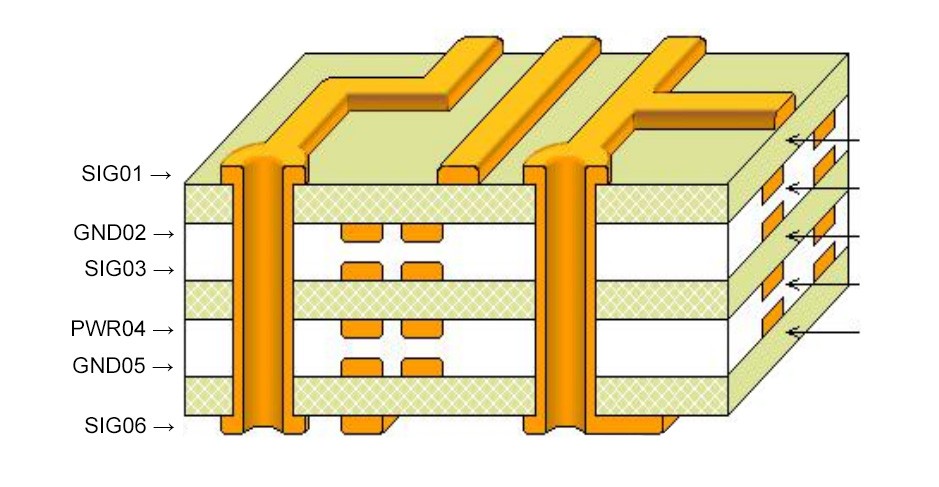
For this solution, this stacking solution can achieve better signal integrity. The signal layer is adjacent to the ground layer, the power layer and the ground layer are paired. The impedance of each wiring layer can be better controlled, and the two The strata are good at absorbing magnetic field lines. And when the power supply and ground layers are complete, it can provide a better return path for each signal layer.
2.GND-SIG-GND-PWR-SIG-GND;
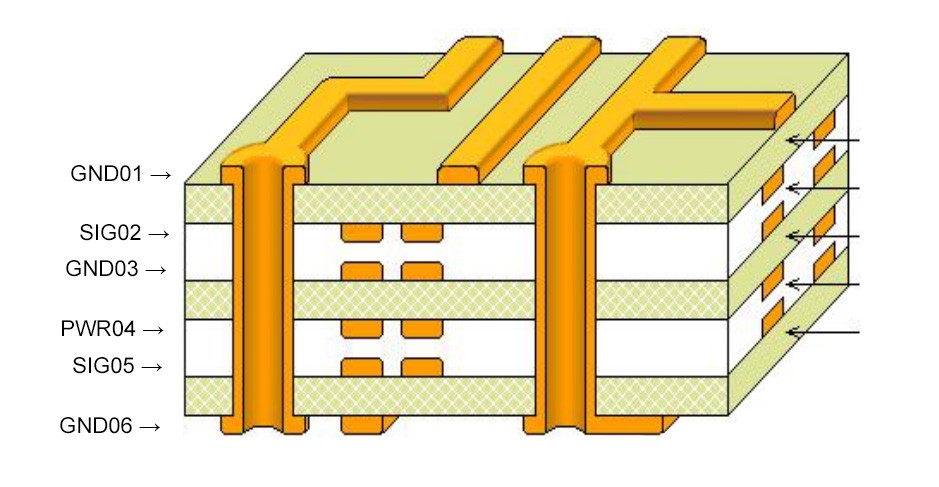
For this solution, this solution is only applicable when the device density is not very high. This stack has all the advantages of the above stack, and the ground planes on the top and bottom layers are relatively complete and can be used as a better shielding layer. to use. It should be noted that the power layer should be close to the layer that is not the main component surface, because the bottom plane will be more complete. Therefore, the EMI performance is better than the first solution.
Summary: For a six-layer board solution, the distance between the power layer and the ground layer should be minimized to obtain good power and ground coupling. However, with a board thickness of 62mil, although the layer spacing has been reduced, it is still not easy to control the distance between the main power supply and the ground layer very small. Comparing the first option and the second option, the cost of the second option is greatly increased. Therefore, we usually choose the first option when laminating. When designing, follow the 20H rule and mirror layer rule design
8 layer pcb stackup
1. This is not a good stacking method due to poor electromagnetic absorption capability and large power supply impedance. Its structure is as follows:
1.Signal 1 component surface, microstrip wiring layer
2.Signal 2 internal microstrip wiring layer, better wiring layer (X direction)
3.Ground
4.Signal 3 strip line routing layer, better routing layer (Y direction)
5.Signal 4 stripline routing layer
6.Power
7.Signal 5 internal microstrip wiring layer
8.Signal 6 microstrip wiring layer
2. It is a variant of the third stacking method. Due to the addition of a reference layer, it has better EMI performance and the characteristic impedance of each signal layer can be well controlled.
1.Signal 1 component surface, microstrip wiring layer, good wiring layer
2.Ground formation, better electromagnetic wave absorption ability
3.Signal 2 stripline routing layer, good routing layer
4.Power power layer, which forms excellent electromagnetic absorption with the ground layer below. 5.Ground layer
6.Signal 3 strip line routing layer, good routing layer
7.Power ground layer, with large power impedance
8.Signal 4 microstrip wiring layer, good wiring layer
3. The best stacking method, due to the use of multi-layer ground reference planes, it has very good geomagnetic absorption capabilities.
1.Signal 1 component surface, microstrip wiring layer, good wiring layer
2.Ground formation, better electromagnetic wave absorption ability
3.Signal 2 stripline routing layer, good routing layer
4.Power power layer, which forms excellent electromagnetic absorption with the ground layer below. 5.Ground layer
6.Signal 3 strip line routing layer, good routing layer
7.Ground formation, better electromagnetic wave absorption ability
8.Signal 4 microstrip wiring layer, good wiring layer
How to choose how many layers of boards to use in the design and what kind of stacking method to use depends on many factors such as the number of signal networks on the board, device density, PIN density, signal frequency, board size, etc. We must consider these factors comprehensively. For designs with more signal networks, higher device density, higher PIN density, and higher signal frequencies, multi-layer board designs should be used as much as possible. For good EMI performance it is best to ensure that each signal layer has its own reference layer.

Articles you may also like
Design of High Current H-Bridge Motor Drive Circuit
The working principle, key parameters, and selection of TVS

Understanding NAND Gate: The Universal Logic Gate in Digital Circuits

What is ESD and how to layout the ESD protection circuit PCB

-
-
-
-
-
-
-
-
-

nxp-usa-inc
ARM® Cortex®-M7 RT1060 Microcontroller IC 32-Bit Single-Core 528MHz External Program Memory BGA-196 (10x10)