














Gas Discharge Tube Symbols, Characteristics and Structure

Gas Discharge Tubes are a commonly used electronic component that plays a key role in high-voltage appliances, switchgear, and protection circuits. As the industry continues to modernize, the design and application of gas discharge tubes are constantly evolving and improving to meet the growing demand for power system protection. This article will examine the working principles, symbols and applications of gas discharge tubes and their importance in modern power systems.
What Is A Gas Discharge Tube?
A gas Discharge Tube (GDT) is an electronic device that utilizes gas to produce a discharge under the action of an electric field, commonly known as a lightning tube—composed of a sealed glass or ceramic shell filled with low-pressure gas, such as argon, neon or xenon. Both ends of the shell are equipped with electrodes; when the voltage is applied to the electrodes to reach the breakdown voltage of the gas, the gas will be suddenly ionized and conductive, forming a conductive channel, allowing the current to pass.
Gas Discharge Tube Symbol
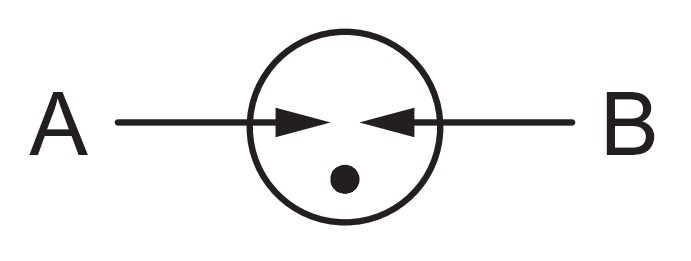
A capacitor-like figure with electrodes usually represents the circuit symbol for a gas discharge tube at each end to indicate the conduction path of the current and a gap in the middle portion to symbolize the presence of a gas. The symbol is shown below:
Gas Discharge Tube Symbol
Dieses Symbol zeigt an, dass sich zwischen den beiden Elektroden ein „Spalt“ befindet, der dem Gas in der Gasentladungsröhre entspricht, das bei Erreichen der Durchbruchspannung leitet.
Gas Discharge Tube Features
High voltage withstand capability: Withstand high overvoltage shocks and prevent transient overvoltage in the circuit.
High current withstand capability: Gas discharge tubes have great through-current energy, usually up to tens to hundreds of KA, which makes it capable of withstanding and releasing a large number of current shocks in a short period, suitable for lightning protection and surge protection.
Low capacitance: The parasitic capacitance of the gas discharge tube is very small, usually in the range of 1~5pF, which helps to reduce the noise interference in the circuit, suitable for use in high-frequency and radio frequency circuits, will not significantly affect the signal transmission.
Low leakage current: The insulation resistance of gas discharge tubes is extremely high, reaching thousands of megohms level, and there is almost no leakage current under normal operating voltage, so it will not cause power consumption to the circuit.
Bidirectional protection without polarity: Gas discharge tubes have the characteristic of no polarity, which can provide bidirectional protection against positive and negative voltages.
Slow response speed: The discharge delay of gas discharge tube is usually large (≥100ns), compared with other protection components such as TVS diodes, the response speed of gas discharge tube is slower, which is suitable for protecting larger and slower voltage shocks.
Long service life: Gas discharge tubes do not suffer from aging failure in the use process and have a long service life.
High ignition voltage: The ignition voltage of a gas discharge tube is usually high, which means that the tube may not discharge immediately when subjected to smaller overvoltage shocks.
Working Principle of Gas Discharge Tube
The operating principle of the gas discharge tube is based on the ionization of gases. It is filled with an inert gas and has two electrodes. When an overvoltage occurs in the circuit and the voltage exceeds the breakdown voltage of the gas discharge tube, the gas inside is strongly acted upon by the electric field and begins to ionize, forming a conductive plasma channel. At this time, the gas discharge tube from the high-resistance state into a low-resistance state quickly shunts the overvoltage to ground or other lines to protect sensitive electronic components from damage.
When the overvoltage disappears, the ionization state of the gas discharge tube stops, the gas returns to the insulating state, the resistance becomes high again, and the circuit returns to normal operation. The key to this process is its breakdown voltage and ability to return to a high resistance state, making it an effective overvoltage protection element.
Gas Discharge Tube Structure
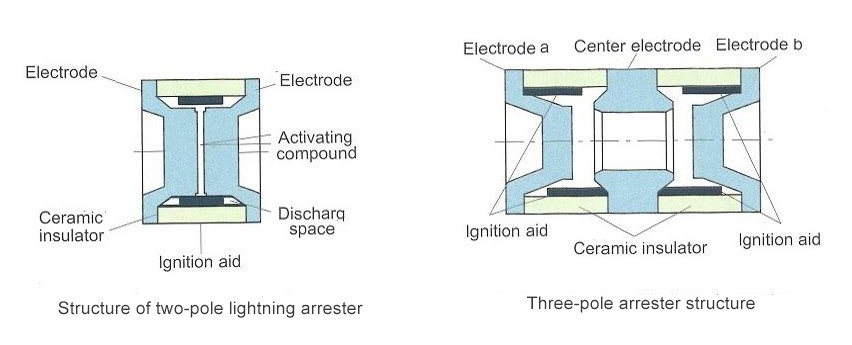
Gas discharge tube is composed of metal electrodes (commonly used pure iron electrode, nickel-chromium-cobalt alloy cap, etc.), conductive tape, electronic powder and rare gases (mainly neon, argon, two kinds of electrically stable inert gases), and the use of metalized ceramic insulated tube shell or glass tube shell for encapsulation of the gas discharge device, the gas separates the internal electrodes between the electrodes, the electrodes can be divided into two-pole and three-pole discharge tubes according to the number of electrodes.
Gas Discharge Tube Selection Considerations?
DC-Spark-over Voltage and Impulse Spark-over Voltage
When selecting the type, we should consider the difference between DC Spark-over Voltage and Impulse Spark-over Voltage. DC Spark-over Voltage should be selected concerning the working voltage of the circuit, and the DC Spark-over Voltage should be greater than the maximum working voltage of the line to be protected, or else it will affect the normal operation of the line. Pulse breakdown voltage to consider the surge test level, the general surge test waveform rise time for microseconds pulse waveforms, such as 8/20μs current waveforms and 10/700μs voltage waveforms, and the GDT pulse breakdown voltage measurement voltage rise rate of 1000V/μs for an order of magnitude, such as the use of 10/700μs of the waveform to test the 4000V, the pulse breakdown voltage of the GDT to be For example, if a 10/700μs waveform is used to test 4000V, the pulse breakdown voltage of the GDT should be less than 4000V so that the GDT can conduct during the test.
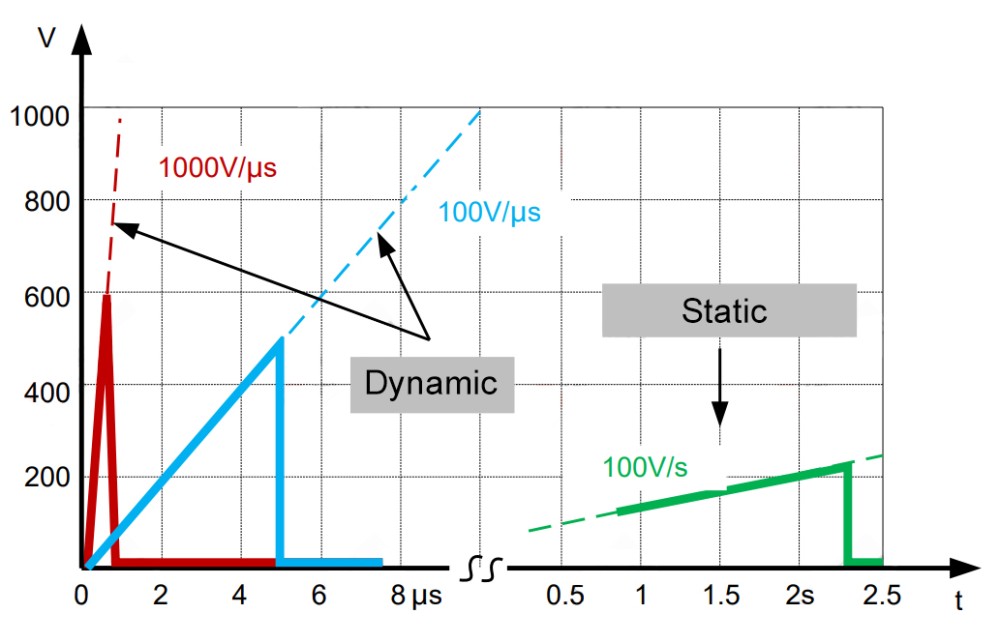
The above figure shows the on-state diagram of GDT under different voltage rise rates, from which it can be seen that the higher the voltage rise rate, the higher the breakdown voltage of GDT.
Inrush current capacity
According to the line to determine the maximum transient inrush current that the gas discharge tube can withstand, especially in the lightning strike or surge protection, the inrush current capacity should be large enough, usually choose the parts that can withstand a few thousand amperes to dozens of kiloamperes model.
Capacitors
In high-frequency or RF applications, gas discharge tubes with low capacitance should be selected to minimize the effect on the signal.
Response Speed
Select a gas discharge tube with a nanosecond response time to ensure a rapid response and circuit protection in the event of an overvoltage.
Package
Select the appropriate package form according to the layout of the circuit design. The size of the discharge tube package and the level of protection are directly proportional to the general package; the larger the device's ability to withstand shock current is, the higher the level of protection.
Proper Application Of Gas Discharge Tubes In Power Supply Circuits
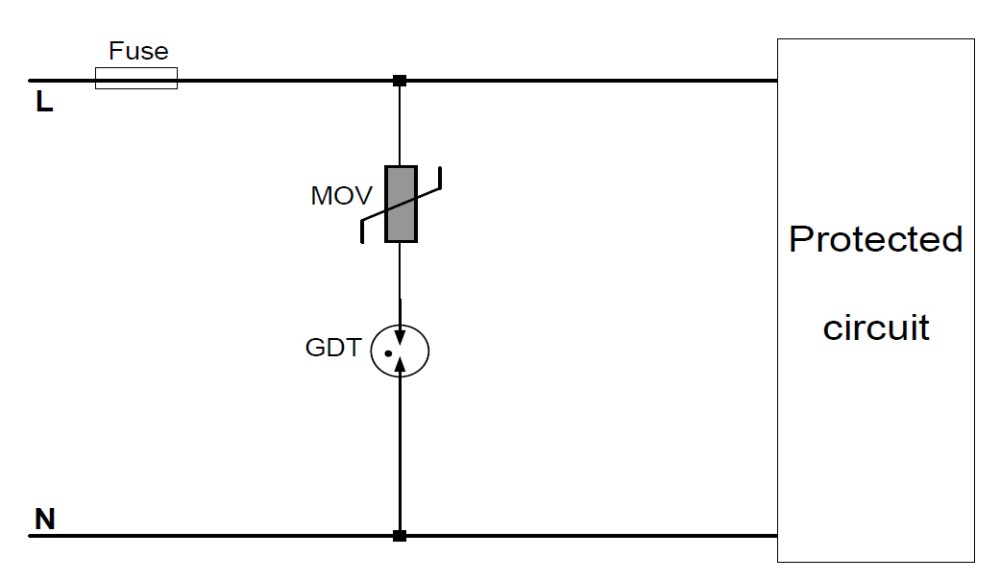
GDT in an Ungrounded Power Supply.
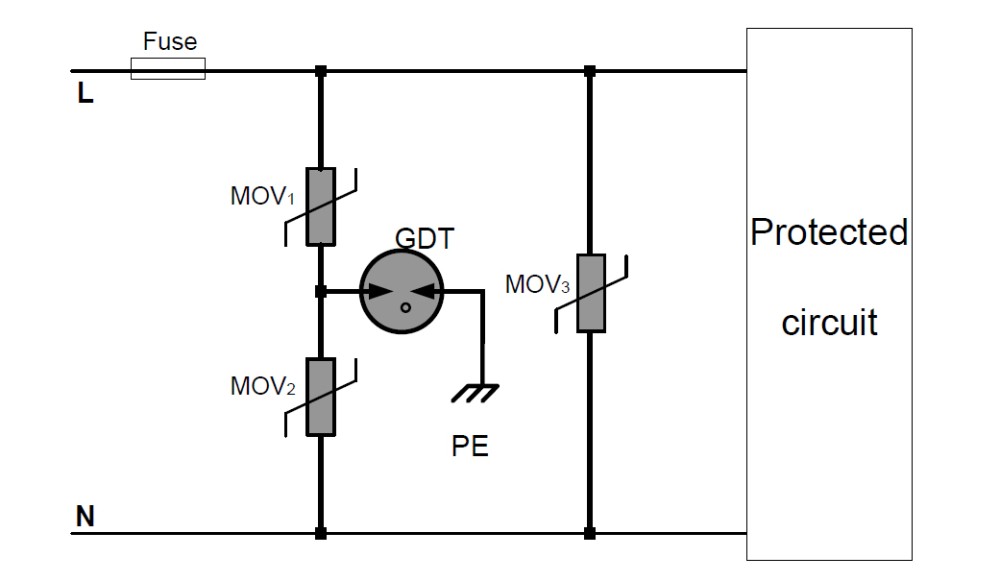
GDT in a Grounded Power Supply.
As shown in the two pictures above, in order to cope with the current continuation problem of GDTs, we need to connect an additional protection element (such as a varistor or transient suppression diode, etc.) in series with the circuit. This element should have the characteristic of disconnecting automatically after the overvoltage disappears to solve the problem of the current continuity of the discharge tube. In addition, given that the GDT has an insulation resistance value of up to 1GΩ or even more than 10GΩ, it can effectively stop the leakage current from the L/N line to the ground, thus enhancing the safety and reliability of electronic products.
Gas Discharge Tube Safety Certification Standards
The main international safety certification standards for gas discharge tubes are listed below:
IEC 61643-311: This standard covers the technical requirements and test methods for using gas discharge tubes as surge protection components to ensure their effectiveness in lightning strikes and surge protection.
UL 1449: The U.S. standard for surge protectors applies to equipment using gas discharge tubes. Gas discharge tubes complying with this standard can pass stringent surge and durability tests.
ITU-T K.12: This is a standard issued by the International Telecommunication Union, specifically for using gas discharge tubes in communication systems and requires efficient overvoltage protection.
RoHS: Gas discharge tubes must comply with this European Union standard, which ensures that hazardous substances, such as lead and mercury, are not used in their manufacturing process.
ISO 9001: Although this is a quality management system standard, many manufacturers of gas discharge tubes will be certified to ensure the reliability and consistency of their product production.
These standards cover the electrical characteristics, mechanical characteristics, safety performance and environmental requirements of gas discharge tubes to ensure product quality and reliability.

FAQs
Articles you may also like

Design of High Current H-Bridge Motor Drive Circuit

The working principle, key parameters, and selection of TVS

Understanding NAND Gate: The Universal Logic Gate in Digital Circuits

What is ESD and how to layout the ESD protection circuit PCB

-
-

-

-

-

-

-

-

-

intel-fpgas-altera