













- Home
- Blogs
- Semiconductor News
- Renesas Announces Blueprint for Next Generation Automotive Processors, Fully Embracing Platformization
Renesas Announces Blueprint for Next Generation Automotive Processors, Fully Embracing Platformization
At the end of 2023, there was an endless stream of press conferences from major car manufacturers, and we can see that electrification and electrification have become an absolutely unstoppable trend. As the cornerstone of automotive electronics, semiconductor companies are also undergoing unprecedented innovation to address these challenges. From autonomous driving to a kick style tailgate, any innovation cannot be achieved without the contribution of chips.
In order to further enhance the experience of developers and drivers, Renesas has recently released a roadmap for the next generation of automotive processor products, which has many noteworthy key points. Zhao Kun, Senior Manager of Renesas Automotive Electronics Technology Department, recently introduced some design details and ideas of Renesas's new generation of automotive SoC and MCU processors to the outside world at the Renesas booth of the Shanghai CIIE.
The new generation SoC and MCU fully embrace Arm
Zhao Kun stated that the fifth generation R-Car products will fully adopt the Arm architecture, not only SoC products, but also the new 32-bit MCU will use the Arm core.
Currently, Renesa offers many MCUs with its own core, including the 16 bit RL78 and 32 bit RH850, which have been widely used in the market. However, as the leader of the automotive MCU market, Renesa no longer adheres to its own land, but actively embraces the Arm core and continuously updates its own core to meet different customer needs through diversified products.
The reasons behind Renesas's shift towards platformization
Why shift to more combinations? Mainly because as the overall E/E (electronic/electrical) architecture of the car has completed the transition from discrete to domain control, it is currently transitioning to regional control.
Zhao Kun stated that while regional control brings benefits, it also brings many challenges. Firstly, the ECU covers more and more functions, resulting in increasingly complex designs; The second is that with the complexity of ECU, the development cycle and development costs are increasing exponentially. The third is the platform based development concept of the car factory, which also requires the ECU to be platform based, in order to cover more vehicle models and series.
Addressing pain points in regional control from multiple perspectives
Zhao Kun stated that the new generation processor platform of Renesa has three major characteristics to meet the challenges of future automotive electronic and electrical architecture.
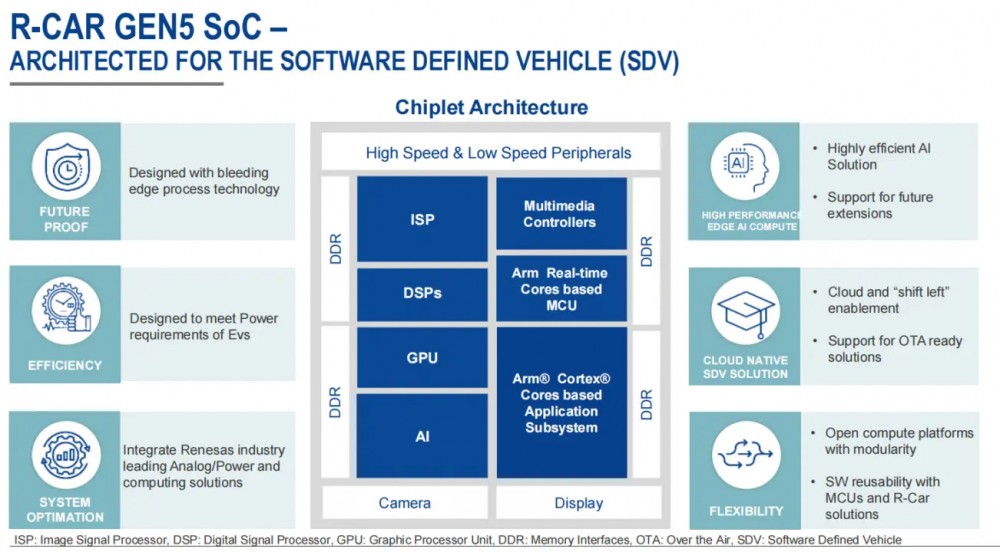
Firstly, the fifth generation SoC will adopt Chiplet technology to meet OEM's needs for customization, personalization, and greater and richer computing power for chip subsystems; Secondly, software reuse technology is used to reduce customers' repeated development cycles and costs; Thirdly, by providing virtual prototypes, customers can conduct simulations and simulations before the official launch of Renesas products. This left shift approach allows customers to develop and evaluate software and algorithms earlier, thereby reducing overall development time.
In terms of technology, Zhao Kun did not provide a detailed introduction, but only stated that the next generation SoC "will adopt the current industry-leading semiconductor technology for design, in order to achieve industry-leading performance and power consumption.
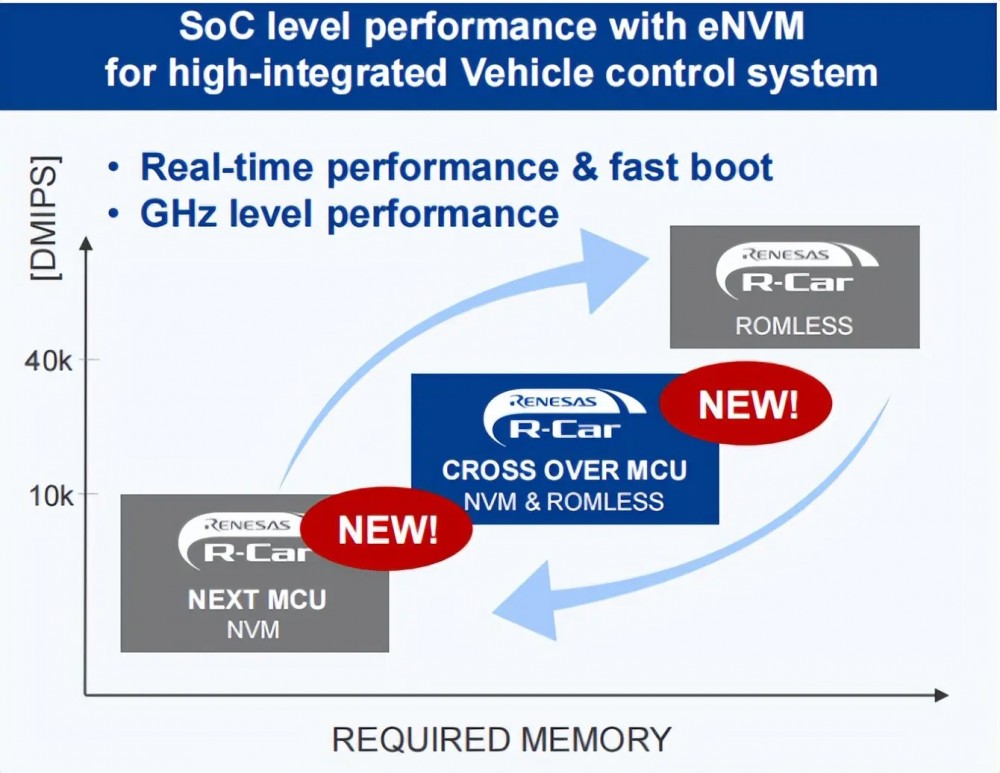
In the MCU platform, as car companies are increasingly segmented in terms of functional specifications, Renesas has also divided the next generation MCU into two major product lines, codenamed NEXT MCU and CROSS OVER MCU. Zhao Kun explained that in existing products, SoC and MCU are often two independent product lines, either high-performance and high computing power, or high real-time performance. However, in the new regional (domain) control architecture, many applications need to have both computational power and real-time performance in order to better interact with the cockpit or gateway domain. For this reason, the CROSS OVER series MCU has emerged, which can effectively fill the gap between MCU and SoC.
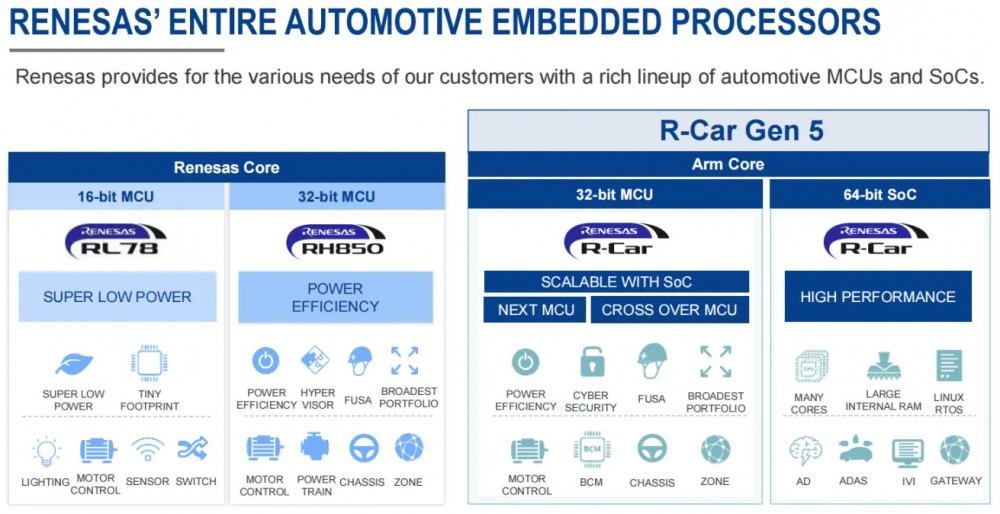
Combining the fifth generation processors and MCUs, as well as Renesas core products such as RH850 and RL78, Renesas provides the most diverse platform based products in the market to meet more market demands. Whether it is adding or upgrading, corresponding processors can be found at Renesas. In addition, Ruisa also provides a complete development kit, including the bottom layer, middle layer, and partner software and hardware matching, to form a complete industry support. It is worth mentioning that the fifth generation products have taken into account the specific needs of Chinese customers at the beginning of their design, such as incorporating Chinese elements in supporting national confidential standards.
Zhao Kun stated that the current automotive industry places great importance on cost reduction and efficiency improvement, which is also an important reason for Renesas's rapid deployment of the next generation processor platform. It is often difficult to significantly reduce prices on existing products, and Renesas places greater emphasis on achieving better cost-effectiveness and stronger competitiveness through innovative technologies and applications, "he said.
Summary
This is the first time that Renesas has publicly released the roadmap for the next generation of automotive processors and MCUs, and it is a globally unified release. Some specific details will only be disclosed after actual production in the future. However, through publicly available information, we can also see the evolution path of the next generation of automotive processors under a series of popular technological trends, including area control, software definition, and design left shift.
Articles you may also like
$3.8 billion! Wenye acquires Future Electronics
Due to suspected anti-competitive behavior of AI chips, it is reported that the European Union has launched an early investigation into Nvidia
The AI chip market will reach US$67 billion in 2024, and WIMI.US is increasing its efforts to develop efficient AI solutions.
Qualcomm lays off employees globally