













- Home
- Blogs
- Semiconductor
- Complete Guide to All Types of Transistors
Complete Guide to All Types of Transistors
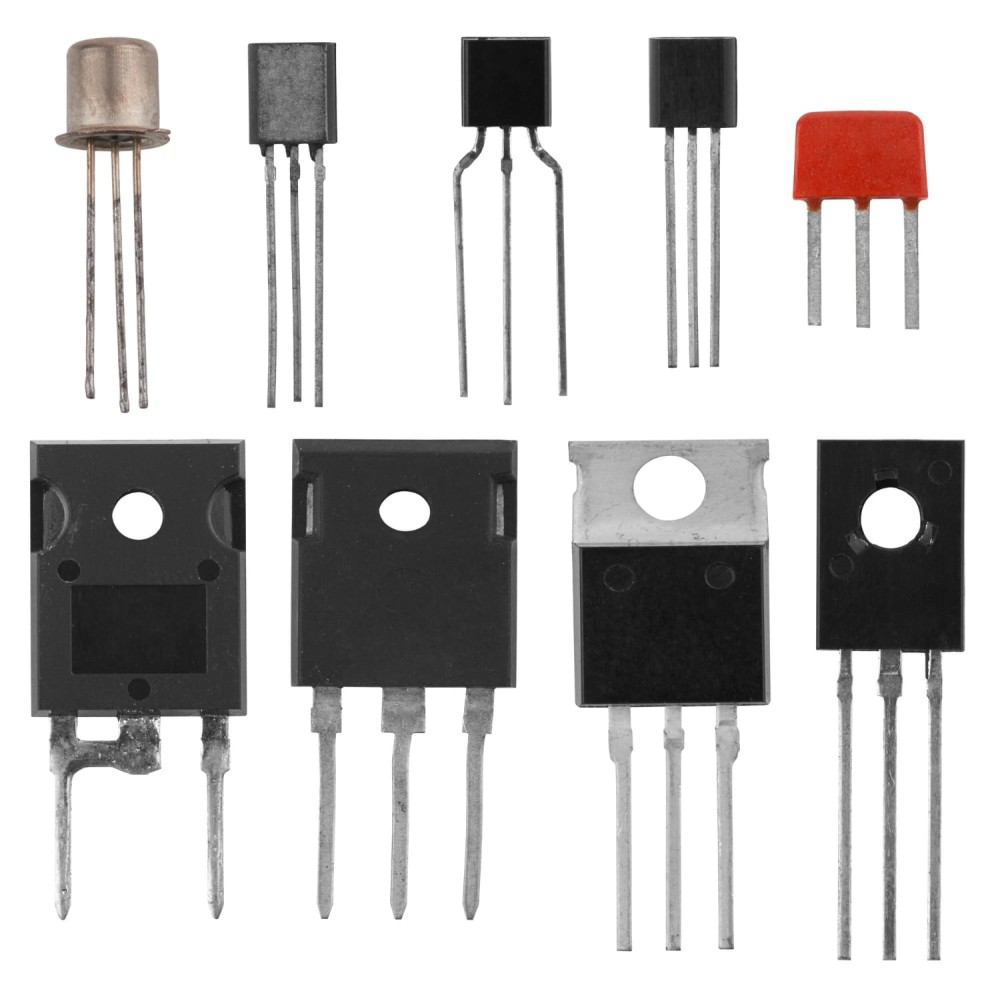
The main types of transistors fall into two families: bipolar (BJT) and field-effect (MOSFET, JFET), plus a hybrid that borrows from both: the IGBT. Each type controls electric current through a different mechanism, and that difference determines where it belongs in a circuit.
This guide covers every major transistor type you'll run into, from how each one works to where it fits and where it fails. We also look at specialty variants like Darlington pairs and phototransistors, along with the newer wide-bandgap devices (SiC, GaN) that are actively replacing silicon in high-power designs right now.
New to transistors entirely? Start with our guide on what a transistor is and how it works before diving into the individual types.
Key Takeaways
Every transistor sorts by one question: current-controlled (BJT) or voltage-controlled (MOSFET, JFET, IGBT).
MOSFETs dominate modern electronics because their gate draws zero current, enabling billions of them on a single chip.
Quick selection guide: BJT for linear amplification, JFET for lowest noise, MOSFET for fast switching, IGBT for high-voltage power above 200V.
SiC and GaN wide-bandgap devices are replacing silicon in EVs and solar inverters, with documented power loss reductions up to 79%.
When choosing a transistor, start with three numbers: your circuit's voltage, current, and switching frequency.
How Transistors Are Classified
Two questions sort every transistor into its category.
First: what controls the output current? Second: does it use one type of charge carrier, or two?
1. Bipolar transistors (BJTs) need current fed into their base terminal to switch on. They're called "bipolar" because both electrons and holes carry current through the device.
2. Field-effect transistors (MOSFETs and JFETs) take a different approach: a voltage applied to the gate terminal creates or removes a conductive channel. Only one carrier type moves through at a time, which is why engineers call them unipolar.
3. Then there's the IGBT. It doesn't fit neatly into either camp. Its input looks like a MOSFET (voltage-controlled gate, almost zero input current), but its output behaves like a BJT (high-current bipolar conduction). That combination is the whole point of the device.
| Family | Control Method | Main Types | Charge Carriers |
| Bipolar | Current at the base | NPN, PNP (BJT) | Electrons + holes |
| Field-Effect | Voltage at the gate | MOSFET, JFET | Electrons or holes (unipolar) |
| Hybrid | Voltage-controlled gate, bipolar output | IGBT | Both |
Beyond these three families, several specialty transistors build on the same principles. Darlington pairs, phototransistors, and unijunction transistors each modify the base architecture for a specific purpose.
We'll cover those after the four main types.
BJT (Bipolar Junction Transistor)
A BJT transistor controls current with current. Feed a small amount into the base terminal, and a much larger current flows between the collector and emitter. That amplification factor, called current gain (hFE), typically lands between 50 and 300 for general-purpose parts. Some specialized devices push into the thousands.
Three operating regions define what a BJT can do. In cutoff, both junctions are reverse-biased and no current flows: the transistor acts as an open switch. In saturation, both junctions are forward-biased and current passes freely: a closed switch. Between those two sits the active region, where output current tracks the input proportionally. That's where amplification happens.
NPN vs. PNP
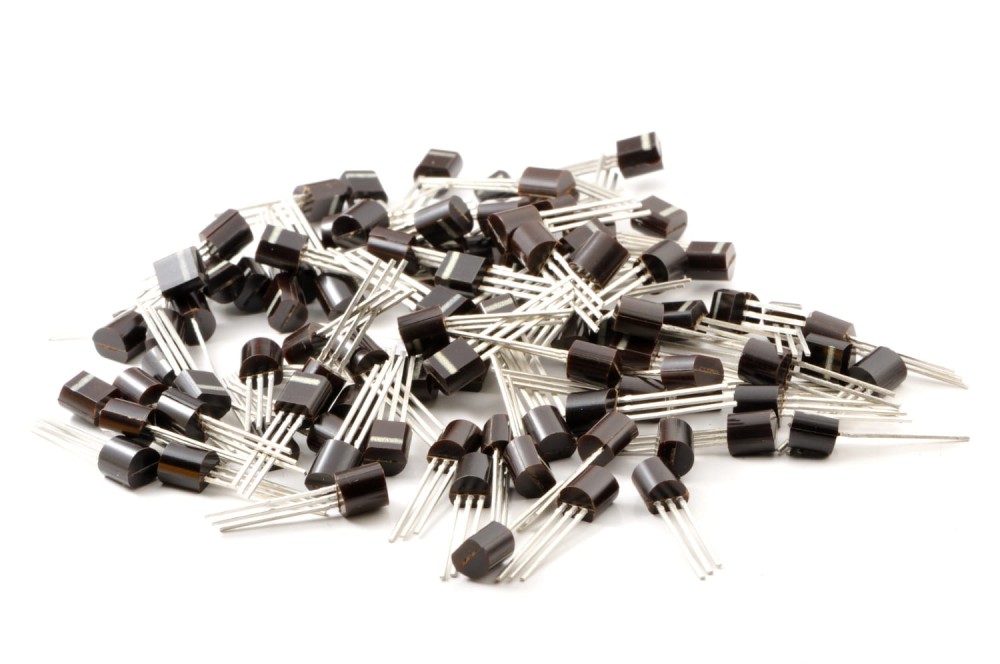
NPN transistors show up in most designs. Electrons serve as the majority carrier, and since electron mobility in silicon runs roughly 2 to 3× higher than hole mobility, NPN devices switch faster and deliver higher gain. Current flows from collector to emitter when the base is driven high, making NPN the go-to choice for low-side switching.
PNP transistors flip the polarity. Current flows from emitter to collector when the base is pulled below the emitter voltage. You'll find PNP devices in high-side switching, complementary push-pull audio output stages, and level-shifting circuits where an NPN alone can't do the job.
Common BJT Applications
Audio amplifiers still lean on BJTs for their linear behavior in the active region. Discrete switching circuits, sensor interfaces, LED drivers, and signal conditioning stages all rely on them daily. BJTs are also the building block inside Darlington pairs, which we cover later in this guide. For sourcing individual components, Dyethin carries single bipolar transistors across both NPN and PNP configurations.
MOSFET (Metal-Oxide-Semiconductor Field-Effect Transistor)
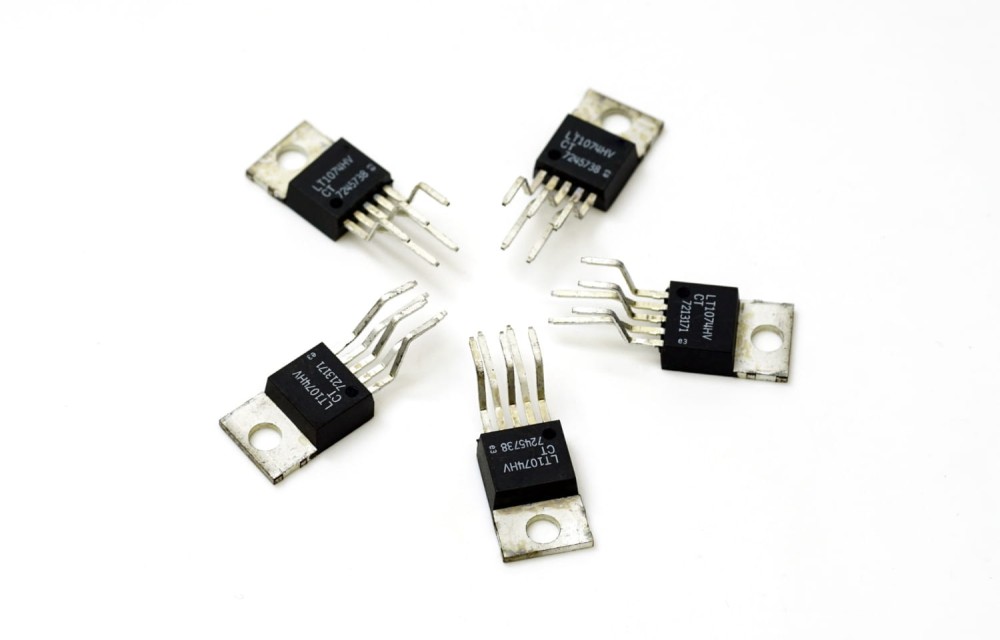
A MOSFET transistor switches current using voltage. Apply a voltage to the insulated gate terminal, and a conductive channel forms between the source and drain. Remove that voltage, and the channel vanishes. No current flows into the gate during steady-state operation because a thin oxide layer isolates it from the channel completely. Input impedance sits north of 10¹⁴ ohms.
That near-zero gate current is the reason MOSFETs replaced BJTs across most of digital and power electronics. Driving a MOSFET gate wastes almost no energy, and that efficiency compounds fast when you're switching billions of transistors on a single chip.
Enhancement Mode vs. Depletion Mode
| Parameter | Enhancement Mode | Depletion Mode |
| Default state | OFF (no channel until voltage applied) | ON (conducts at zero gate voltage) |
| How to activate | Apply VGS above threshold | Already conducting; negative VGS turns it off |
| Market share | ~99% of commercial MOSFETs | Niche |
| Typical applications | Digital ICs, power supplies, motor control | SMPS startup circuits, current limiters, overvoltage protection |
Enhancement-mode devices are the standard. When engineers say "MOSFET" without a qualifier, they mean enhancement mode. Depletion-mode parts occupy narrow roles: power supply startup circuits where conducting at zero gate voltage is the feature, not a flaw.
N-Channel vs. P-Channel
N-channel MOSFETs carry current via electrons, offering lower on-resistance (RDS(on)) at a given die size. They dominate power applications for that reason. P-channel devices use holes as carriers, run slower, and show higher on-resistance at the same die size. Still, P-channel MOSFETs earn their place in high-side switching and complementary CMOS logic pairs where both polarities work together.
Common MOSFET Applications
Every processor, GPU, and memory chip on the planet runs on MOSFETs. Billions of them pack into CMOS logic gates on a single die. Outside of integrated circuits, discrete MOSFETs drive DC-DC converters, motor controllers, battery management systems, RF power amplifiers, and switch-mode power supplies. Our FET and MOSFET catalog covers N-channel, P-channel, and specialty parts for most of these applications.
JFET (Junction Field-Effect Transistor)
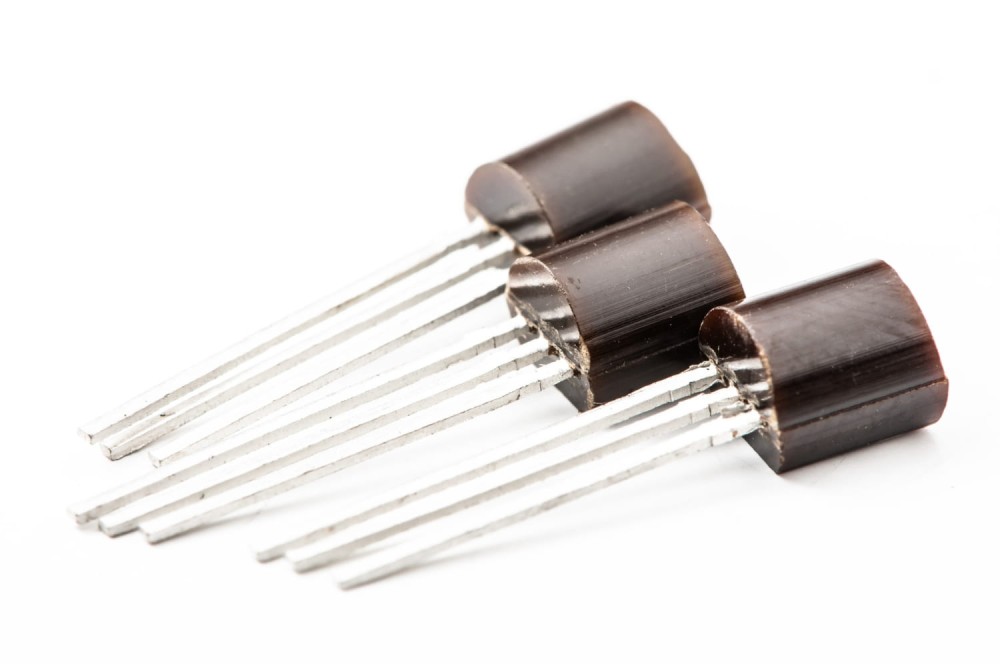
A JFET transistor controls current through a semiconductor channel using a reverse-biased PN junction at the gate. Unlike MOSFETs, JFETs are normally on: current flows freely from drain to source with zero voltage applied to the gate. Apply a negative voltage (for an N-channel device), and the depletion region widens, pinching the channel until current stops. That shutoff point is called the pinch-off voltage.
What sets JFETs apart from every other transistor on this list? Noise performance. JFETs produce less electronic noise than BJTs because they lack the junction recombination that generates shot noise in bipolar devices. That advantage makes them the first pick for audio preamplifiers in guitar amps, condenser microphone circuits, and precision measurement gear where even microvolts of noise contamination matter.
Input impedance runs around 10⁹ ohms. Not quite MOSFET territory, but far above any BJT. That high impedance, paired with simple biasing requirements and solid thermal stability, keeps JFETs relevant in oscilloscope front ends, op-amp input stages, and high-impedance buffer circuits.
N-channel JFETs are the more common variety, offering lower impedance than their P-channel counterparts. Availability has narrowed over the years compared to MOSFETs and BJTs, but for low-noise analog work, nothing else matches them at the price. Dyethin stocks JFETs for these specialized roles.
IGBT (Insulated Gate Bipolar Transistor)
An IGBT transistor merges two transistor architectures into one device. Its input stage works like a MOSFET: a voltage-controlled gate that draws almost no current. Its output stage works like a BJT: a bipolar collector-to-emitter structure that handles heavy current with low conduction losses. Three terminals total, four semiconductor layers underneath.
Why does the IGBT exist? MOSFETs switch fast but struggle with efficiency above roughly 200V because on-resistance climbs with voltage rating. BJTs handle high voltage well but switch too slowly for modern power conversion. The IGBT fills that gap, operating at voltages from 600V to 6,500V while switching at speeds adequate for most power applications.
The trade-off is frequency. IGBTs top out around 50 kHz, so MOSFETs still own anything above that threshold. Below it, though, IGBTs run the world's heaviest electrical systems:
Electric vehicles — traction motor inverters in most EVs and hybrids (Tesla's early Model S ran IGBTs before migrating to SiC)
Solar inverters — converting DC from panels into grid-compatible AC
Industrial motor drives — variable-frequency drives (VFDs) powering factory automation
Rail transport — traction systems in trains and metro cars worldwide
UPS, welding, induction heating — anywhere high voltage meets moderate switching speed
Infineon, one of the largest IGBT manufacturers, offers discrete devices from 600V to 1,600V across these markets. For prototyping or production sourcing, single IGBT components are also available through Dyethin.
Specialty Transistor Types
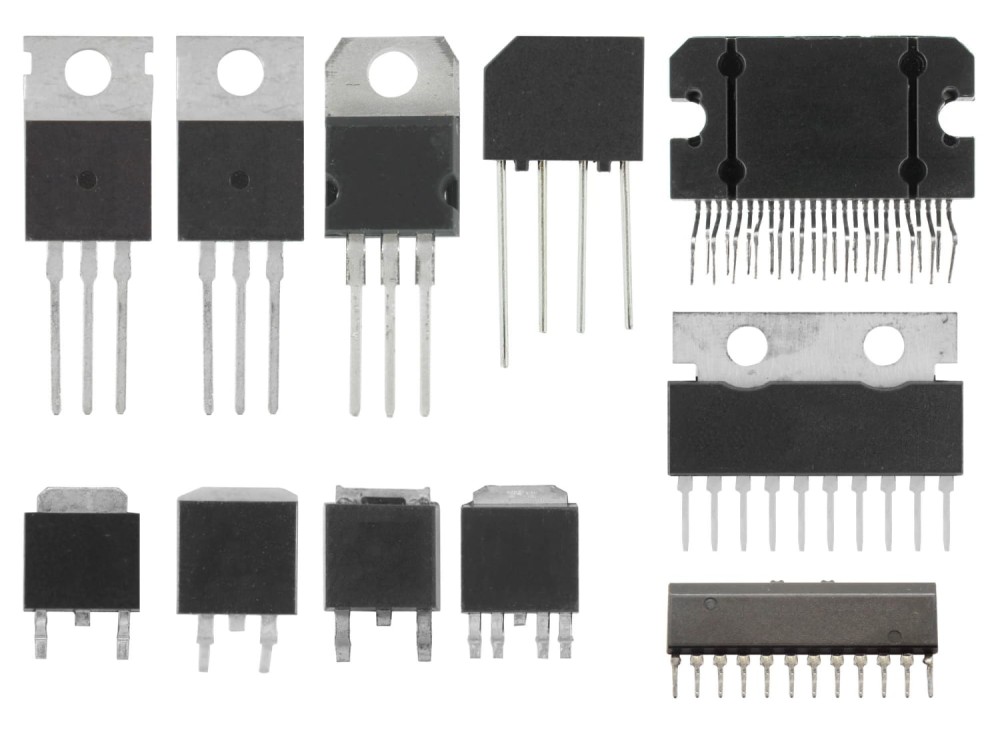
The four types above handle most circuit designs. But several specialty transistors fill roles that standard BJTs, MOSFETs, JFETs, and IGBTs weren't built for.
A Darlington transistor cascades two BJTs inside a single package, with the emitter of the first feeding the base of the second. Total current gain equals the product of both transistors' individual gains, often exceeding 1,000. The ULN2003, a widely used Darlington array IC, drives relays, stepper motors, and LED strips straight from microcontroller output pins.
A phototransistor replaces the base current of a BJT with light. Photons striking the base region generate electron-hole pairs that trigger the same amplification process as an electrical signal would. Optocouplers, barcode readers, ambient light sensors, and proximity detectors all use phototransistors. The Vishay BPW17N is a common off-the-shelf example.
The unijunction transistor (UJT) works exclusively as a switch, not an amplifier. It fires when emitter voltage crosses a set threshold, which made it a staple of timing circuits, oscillators, and SCR/TRIAC trigger stages for decades. ICs like the 555 timer have largely taken over those jobs, but UJTs still show up in legacy industrial control systems.
Wide-Bandgap Transistors: SiC and GaN
Silicon has run transistor manufacturing for decades. It's now hitting physical limits in high-power and high-frequency applications, and two newer semiconductor materials are taking over those roles.
Silicon carbide (SiC) MOSFETs tolerate higher voltages and temperatures than silicon devices. GE Aerospace's 4th-generation SiC MOSFET, demonstrated in late 2025, reaches 1,200V with 11 mΩ on-resistance and a maximum operating temperature of 200°C. Mitsubishi Electric reported that full-SiC power modules cut power loss by 79% compared to silicon IGBT modules in the same package size. EVs, solar inverters, and data center power supplies are the primary adoption targets.
Gallium nitride (GaN) FETs own the high-frequency end. GaN devices currently dominate below 200V, with 650V parts gaining ground fast in EV chargers and server power supplies. Where SiC targets raw power and voltage, GaN targets switching speed.
Both technologies are displacing silicon IGBTs and MOSFETs in designs where efficiency and thermal performance justify a higher component cost.
Types of Transistors Compared
When it's time to pick a transistor for a circuit, these parameters decide the choice.
| Parameter | BJT | MOSFET | JFET | IGBT |
| Control method | Current (base) | Voltage (gate) | Voltage (gate) | Voltage (gate) |
| Input impedance | Low (~kΩ) | Very high (>10¹⁴ Ω) | Very high (~10⁹ Ω) | Very high |
| Switching speed | Moderate | Fast | Moderate | Slow to moderate |
| Power handling | Low to medium | Low to high | Low | High (600V–6,500V) |
| Noise | Moderate | Low | Lowest | Moderate |
| Default state | OFF | OFF (enhancement) or ON (depletion) | ON | OFF |
| Best for | Amplifiers, discrete switching | Digital ICs, power conversion | Audio preamps, sensors | EVs, solar, motor drives |
Related articles

FAQs
Articles you may also like
Characteristics of CPU, GPU, and FPGA
Silicon controlled rectifier (SCR) and switch control circuit explained
Accurately measure resistor value using ADC
The difference between RAM ROM FLASH

-
-
-
-
maxim-integrated
I2C, 2-Wire Serial Real-Time Clock IC with Battery-Backed SRAM and EEPROM
-
-
-
-
-