














- Home
- Featured Products
- Omron
- Omron G7SA-2A2B-DC24 Safety Relay,24V DC Force-Guided Relay
Omron G7SA-2A2B-DC24 Safety Relay,24V DC Force-Guided Relay
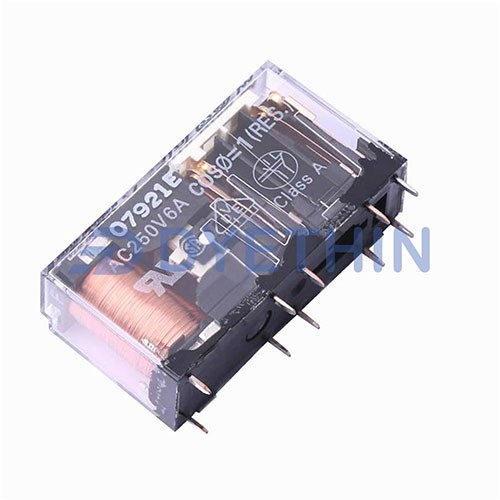
In safety-critical automation systems, the choice of relays can directly impact the reliability and compliance of the overall design. The Omron G7SA-2A2B-DC24 is engineered for applications requiring fail-safe logic, offering force-guided contact mechanisms and robust electrical ratings tailored for industrial environments.
Electrical Characteristics and Switching Performance
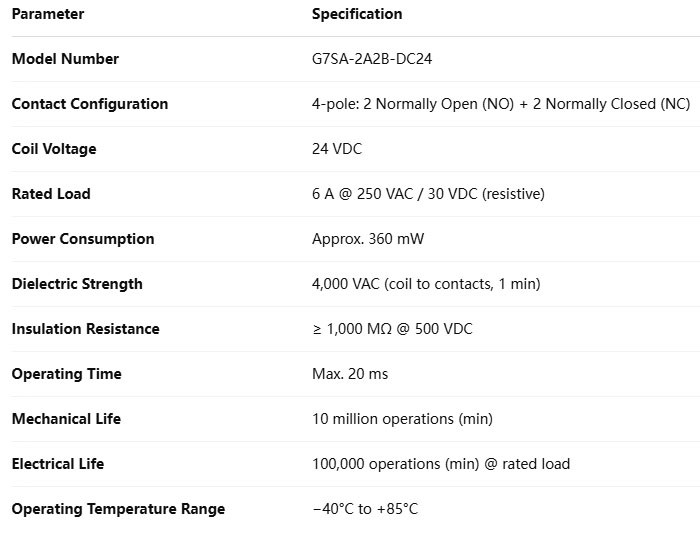
The G7SA-2A2B-DC24 handles 6A resistive loads at up to 250VAC or 30VDC, suitable for actuator control, interlock status, and logic-level switching. Its contact resistance is rated at a maximum of 100 mΩ, with a mechanical life exceeding 10 million operations and an electrical life of at least 100,000 operations under rated load. This ensures reliable operation in systems with high switching frequency or critical uptime requirements.
Application Positioning and Relay Classification
The G7SA-2A2B-DC24 is a 4-pole safety relay designed for use in safety interlock systems, emergency stop chains, and redundant control logic in machinery. Unlike general-purpose power relays, this device is part of a specialized class that supports machine safety relay standards, incorporating structural mechanisms to meet EN 50205 Class A requirements. With its 2NO + 2NC configuration, it's ideal for dual-channel safety circuits in manufacturing and robotic cells.
Force-Guided Contact Architecture Explained
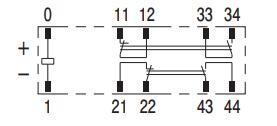
Internal Connection Diagram(Bottom View)
At the core of this relay is Omron's force-guided contact system, a design that synchronizes the movement of NO and NC contacts. If an NO contact becomes welded, the NC contacts remain open, ensuring that the system recognizes failure and prevents reactivation. This architecture is critical in redundant safety circuits, providing mechanical feedback that standard relays cannot offer. The G7SA series complies with the EN 50205 standard, ensuring structural integrity during abnormal events.
Coil Parameters and Drive Conditions
Designed for a 24V DC coil, the G7SA-2A2B consumes approximately 15mA and dissipates 360mW in steady-state operation. It operates with a must-operate voltage of 75% max and a must-release voltage of 10% min. These parameters are compatible with most 24V control systems, including PLC digital outputs. Engineers should note the presence of a built-in diode when using the ND-type socket, which affects coil release timing.
Isolation and Dielectric Strength
To ensure signal integrity and system protection, the relay is built with reinforced insulation. The dielectric strength between coil and contact is 4,000VAC for 1 minute. Between contacts of different polarity, it maintains 2,500VAC, and 1,500VAC between same-polarity contacts. This makes the G7SA-2A2B suitable for mixed-voltage systems and enhances noise immunity in densely packed panels.
Mounting Options and Socket Selection
The G7SA-2A2B is compatible with the P7SA-10F-ND-PU socket, offering push-in terminals, front mounting, and LED operation indicators. For installations requiring soldering or screw terminals, variants like P7SA-10F-ND and P7SA-10P provide flexible alternatives. The DIN rail mountable design simplifies cabinet integration, and the compact footprint saves space in high-density safety modules.
PCB Footprint and Mechanical Dimensions
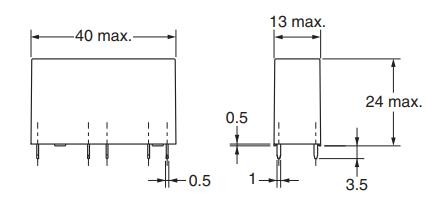
Mechanical dimensions
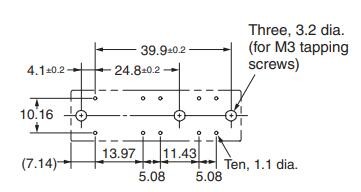
Mounting Hole Placement (Bottom View)
Measuring approximately 40 x 13 x 24 mm, the G7SA relay supports compact PCB layouts. Pin assignments follow a logical layout that simplifies routing for NO and NC contacts. The standard Omron PCB footprint is detailed in the datasheet, allowing designers to import it directly into PCB design software. This facilitates seamless integration into modular safety controller boards.
Environmental Resistance and Long-Term Stability
The G7SA-2A2B-DC24 operates in a temperature range from −40°C to +85°C, with humidity tolerance from 5% to 85% RH. It's rated for vibration resistance (10 to 55 Hz, 0.75 mm double amplitude) and shock resistance up to 1,000 m/s². These specifications make it a strong candidate for heavy-duty applications including conveyor systems, automated production lines, and outdoor control panels.
Certification and Standards Compliance
The relay meets certifications from UL, CSA, TÜV, and complies with EN 61810-1, EN 50205, and IEC 60947-5-1. It also carries CQC and S-mark approvals, making it compliant for use in North America, Europe, and Asia. Compliance with these standards ensures the relay can be deployed in machinery falling under OSHA and CE directives.
Practical Wiring Tips and Failure Prevention
Correct wiring is critical. The coil has defined polarity, and reversing it will result in inoperability. Use ferrules with the recommended push-in terminal sockets and verify all wire insertions are fully seated. When using the ND-type socket with LED and diode, account for delayed release time in your logic design. Avoid inserting multiple wires into one terminal hole, and respect torque specs for screw-type sockets.
Conclusion
The Omron G7SA-2A2B-DC24 safety relay combines compact design with robust electrical performance, international compliance, and fail-safe contact logic. For engineers tasked with designing or maintaining redundant safety circuits, it offers a practical, reliable, and certifiably safe relay solution. Whether used in a packaging line or a robotic safety controller, the G7SA-2A2B proves to be a critical link in your safety chain.
Related articles
CR2430 Battery Replacements, Equivalents, and Applications
CR2025 Battery: Equivalent, Specifications and Replacements
SMD Resistor Size Chart
SMD Capacitor Code Calculator

FAQs
Articles you may also like

-
-
-
-
-
-
-
-
-
stmicroelectronics
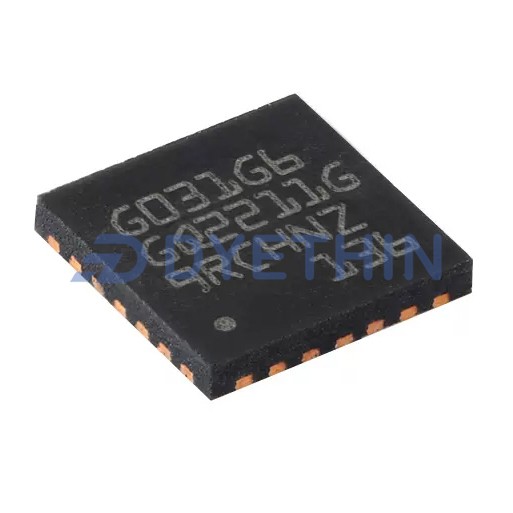
ARM® Cortex®-M0+ STM32G0 Microcontroller IC 32-Bit Single-Core 64MHz 32KB (32K x 8) FLASH 28-UFQFPN (4x4)