













- Home
- Featured Products
- Renesas
- Segger R5F100GEAFB: A Comprehensive Guide to Programming and Features
Segger R5F100GEAFB: A Comprehensive Guide to Programming and Features
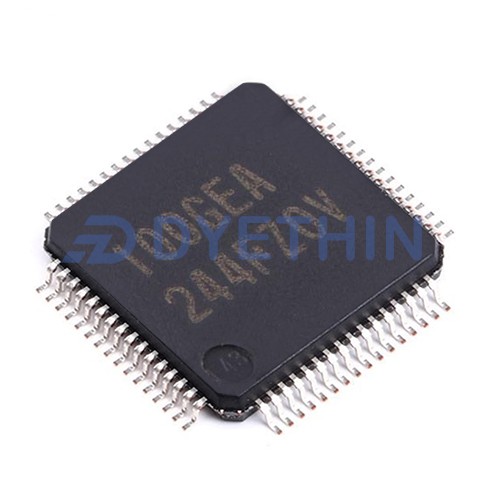
The R5F100GEAFB belongs to the Renesas Electronics RL78/G13 family, an IC with versatility and energy-efficient microcontroller features for a variety of embedded applications. From consumer electronics to industrial automation, the R5F100GEAFB is known for its reliability and energy-efficient features. In this article, we will look at the main features of this microcontroller, the technical details and the best way to program it efficiently.
Features of R5F100GEAFB
Supply Voltage: Single supply voltage range 1.6V to 5.5V.
Clock System: Supports up to 32MHz high speed internal oscillator with ±1.0% accuracy.
Operating Temperature Range: Industrial grade product with an operating temperature range of -40°C to +85°C.
Memory: 16 to 512Kbyte code flash and 4KB to 8KB data flash.
I/O Ports: Provides 16 to 120 I/O ports, including N-ch open-drain I/O and N-ch open-drain I/O (withstanding 6V).
Communication Interface: Includes Simplified SPI (CSI), UART/UART (LIN-bus support), and I2C/Simplified I2C communication interfaces.
Timer: including 16-bit timer, 12-bit interval timer, real-time clock and watchdog timer.
A/D converter: 8/10-bit resolution A/D converter with 6 to 26 analog input channels.
Other Functions: Includes BCD correction circuits, multiplier and divider, DMA controller and more.
Ultra-Low Power Consumption
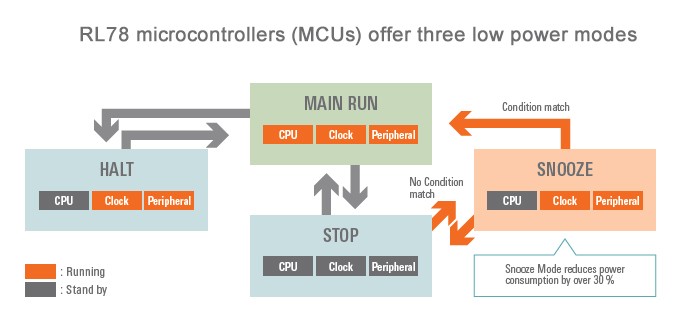
Power consumption is as low as 0.57μA in RTC and LVD only operation.
Multiple low-power modes are supported, including HALT mode, STOP mode, and SNOOZE mode.
HALT mode: The CPU clock is stopped and peripheral functions such as timers and interrupts continue to run, effectively reducing power consumption without completely stopping the microcontroller.
STOP mode: The CPU and peripheral clocks are stopped to achieve the lowest power consumption, putting the microcontroller to sleep until an external interrupt or reset occurs.
SNOOZE mode: Allows the CPU to remain inactive while specific peripherals, such as A/D converters or UARTs, remain active and can trigger a wake-up operation, striking a balance between power savings and functional responsiveness.
Processing Capabilities
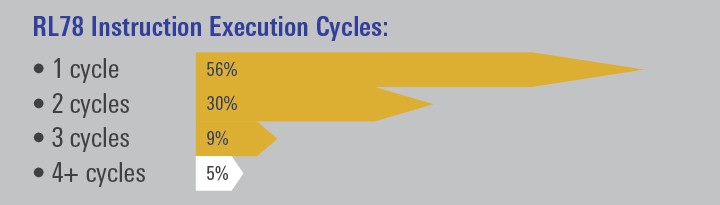
The R5F100GEAFB utilizes the RL78 CPU core, which features a CISC (Complex Instruction Set Computing) architecture. This design includes a three-stage pipeline to enhance efficiency. It supports a range of clock speeds—from 32 MHz for high-speed applications down to 32.768 kHz for ultra-low-speed operations—making it versatile for different project requirements.
R5F100GEAFB Series Common Model Comparison
| Feature | R5F100GEAFB#10 | R5F100GEAFB#30 | R5F100GEAFB#V0 |
| Package | LQFP-48 | LQFP-48 | LQFP-48 |
| Pin Count | 48 pins | 48 pins | 48 pins |
| Package Size | 12 x 12 mm (LQFP), 0.65-mm pitch | 12 x 12 mm (LQFP), 0.65-mm pitch | 12 x 12 mm (LQFP), 0.65-mm pitch |
| Application Type | Consumer and Industrial | Consumer and Industrial | Consumer and Industrial |
| Operating Temperature | -40°C to +85°C | -40°C to +85°C | -40°C to +85°C |
| Packaging Code | A, D, G | A, D, G | A, D, G |
| Usage Notes | Mounted and Not mounted options | Mounted and Not mounted options | Mounted and Not mounted options |
Applications of R5F100GEAFB
Consumer and Industrial Use Cases
Household appliance control
Industrial automation equipment
Medical equipment
Sensor Networks
Security Systems
Intelligent Building Control Systems
Thanks to its diverse range of features, the R5F100GEAFB finds applications in both consumer and industrial environments. For consumer products, it can be used in home appliances and personal care gadgets due to its low power and efficiency. In the industrial sector, it's ideal for motor control, sensor integration, and real-time monitoring tasks, where reliability and longevity are key.
R5F100GEAFB Programmation Techniques
Self-Programming via Data Flash
The R5F100GEAFB supports self-programming, which allows you to update or modify firmware without removing the microcontroller from the circuit. This is facilitated by features like the boot swap function and flash shield window, which ensure secure and uninterrupted updates.
Debugging Tools
The on-chip debugging capabilities of R5F100GEAFB, along with external tools like Segger J-Link, provide a powerful environment for monitoring and fine-tuning your application during the development process. The on-chip debugging eliminates the need for external debugging tools, simplifying development.
R5F100GEAFB Power Management
On-chip Power-on-Reset and Voltage Detector
The R5F100GEAFB features an integrated Power-on-Reset (POR) circuit and a voltage detector (LVD) that provides stable startup and monitors power supply levels, ensuring the microcontroller can function reliably under different conditions.
Packaging and Pin Configuration
Different Packaging Options
The R5F100GEAFB is available in various packages, such as LFQFP with 48 pins, allowing flexibility in choosing the right fit for your application based on space and pin count requirements.
Pin Functions and Configuration
Each pin on the R5F100GEAFB has multiple functions, which can be configured based on the needs of the application. Understanding the pin configuration is crucial for efficient interfacing with other devices.
R5F100GEAFB Development Tools
Integrated Development Environment
For development, the R5F100GEAFB is compatible with popular IDEs such as e2 studio from Renesas and IAR Embedded Workbench. These IDEs offer complete environments with support for compiling, debugging, and flashing code onto the microcontroller.
Segger Programmer Overview
Using Segger's programming tools, such as the J-Link debugger, simplifies the process of flashing and debugging the R5F100GEAFB. The seamless integration with different IDEs makes the development cycle quicker and more efficient.
Programming Example for R5F100GEAFB
Basic GPIO Example
To get started with the R5F100GEAFB, let's take a look at a basic GPIO example. Below is a step-by-step guide on how to toggle an LED connected to one of the GPIO pins:
Step 1: Configure the relevant GPIO pin as an output.
Step 2: Write logic in your program to change the pin state periodically.
Step 3: Use the HALT or STOP mode to manage power while the LED is off.
This example showcases the simplicity of controlling GPIOs with the R5F100GEAFB, which is perfect for beginners.
Common Challenges and Solutions in Programming
Memory Access and Debugging Issues
Programming the R5F100GEAFB can sometimes pose challenges, especially regarding memory access and debugging. Always ensure you utilize the debugging features available in the IDE, and use memory-safe operations to avoid overwriting critical sections of the flash.
Detailed Comparison with Other Microcontroller Families
Comparison with STM32, PIC32, and MSP430
To provide a more granular comparison, let’s look at how the R5F100GEAFB stands against the STM32, PIC32, and MSP430 families, which are widely used across different industries:
STM32 Series (STMicroelectronics)
Strengths: STM32 microcontrollers are known for their high performance, featuring Cortex-M cores that are suitable for applications needing advanced processing power, such as digital signal processing (DSP).
Weaknesses: Compared to the R5F100GEAFB, the STM32 family typically consumes more power. It lacks some of the ultra-low-power modes that are present in the RL78 family, making the R5F100GEAFB more suited for power-sensitive applications.
Use Case Fit: STM32 is often used for applications where performance outweighs the need for low power, such as graphical displays or complex sensor processing. However, for projects that require long battery life, the R5F100GEAFB has a distinct advantage.
PIC32 Series (Microchip Technology)
Strengths: PIC32 microcontrollers provide an extensive range of peripherals and have high-speed processing, making them well-suited for applications involving multiple sensors and communications protocols.
Weaknesses: Despite the high processing power, PIC32 tends to have limited power-saving capabilities when compared to R5F100GEAFB. The PIC32 is better suited for applications where continuous high-speed operation is critical.
Use Case Fit: PIC32 is a good choice for devices requiring multiple, simultaneous interface options. On the other hand, the R5F100GEAFB is advantageous for devices needing both a mix of features and extended battery operation.
MSP430 Series (Texas Instruments)
Strengths: The MSP430 family is another contender in the ultra-low power domain. It offers effective power-saving modes, which puts it on par with R5F100GEAFB for battery-powered applications.
Weaknesses: While MSP430 is known for power efficiency, it has limited flash memory and peripheral options compared to the R5F100GEAFB. This makes the R5F100GEAFB more suitable for applications requiring a combination of extended features and more memory.
Use Case Fit: For very basic, low-energy projects like temperature monitoring or wearable devices, MSP430 may suffice. However, R5F100GEAFB offers a more balanced feature set, allowing for additional computational capabilities and integration options.
Which Should You Choose? Selection Factors Explained
Selecting the right microcontroller for your application involves considering multiple factors. Here are detailed factors to help you decide:
Performance and Processing Requirements
If you need a microcontroller that balances performance and efficiency, the R5F100GEAFB's RL78 core offers a versatile clock speed ranging from high to ultra-low, suitable for both performance-heavy and battery-friendly applications.
If your application requires significant computational power (such as motor control with complex algorithms), STM32 or PIC32 could be a better fit.
Power Consumption
For battery-operated devices, the R5F100GEAFB is well-designed with ultra-low power consumption modes like HALT, STOP, and SNOOZE. This makes it more efficient than STM32 and comparable to MSP430.
MSP430 is an alternative for applications focusing solely on extreme low power, but with trade-offs in processing capabilities.
Peripherals and Interfaces
The PIC32 series provides rich peripheral options and is an excellent choice for applications requiring multiple interface protocols, including UART, I2C, SPI, and CAN.
However, the R5F100GEAFB also provides a comprehensive selection of serial interfaces and has the advantage of built-in peripherals for efficient power management.
Memory and Storage
If your application requires larger firmware storage, the R5F100GEAFB’s up to 512 KB of code flash memory gives it an edge over alternatives like the MSP430, which typically offers less.
The PIC32 series provides similar levels of flash memory, but often at the cost of higher power consumption.
Cost Efficiency
When considering cost, the R5F100GEAFB is priced competitively compared to similar microcontrollers, making it an ideal candidate for applications that need both efficiency and cost-effectiveness without compromising on features.
Development and Debugging Tools
The availability of easy-to-use debugging tools such as Segger J-Link and compatibility with popular IDEs like e2 studio makes the R5F100GEAFB very developer-friendly.
The STM32 and PIC32 also have robust development ecosystems, but they tend to be more complex for beginners compared to the R5F100GEAFB.
Packaging and Pin Configuration
The R5F100GEAFB provides flexibility in packaging, with options like LFQFP with multiple pin counts, suitable for various PCB designs and project requirements. This flexibility is advantageous when you need to select a package with a specific footprint or pin configuration.
Example Use Cases for Different Microcontrollers
Best Applications for R5F100GEAFB
Battery-Operated Devices: Thanks to its ultra-low power consumption, the R5F100GEAFB is ideal for applications like remote sensors or wearable health monitors, where extending battery life is critical.
Home Appliances: The built-in power management features make it ideal for consumer products like thermostats, smart switches, or household monitoring devices.
Best Applications for STM32 and PIC32
STM32: Typically used in applications requiring more computational power, such as drones, robotics, or digital signal processing, where higher processing throughput is a must.
PIC32: Often found in automotive and industrial control systems, especially where multiple protocols are needed simultaneously, and robust peripheral interfacing is crucial.
H2: Final Thoughts on Microcontroller Selection
Choosing the right microcontroller is about finding the right balance between power efficiency, cost, performance, and feature set. The R5F100GEAFB microcontroller offers a compelling balance between ultra-low power consumption, sufficient computational power, and versatile interfacing options that make it well-suited for a broad range of applications.
In comparison with STM32 and PIC32, the R5F100GEAFB shines where low power and reliable performance are the primary requirements. For applications that require more horsepower and less concern over energy consumption, STM32 or PIC32 might be a better choice.
The MSP430 can also compete in ultra-low power usage scenarios but lacks the advanced feature set of the R5F100GEAFB. Thus, for projects needing more capabilities and where some power usage is acceptable, the R5F100GEAFB is the more versatile and capable choice.
Conclusion
The R5F100GEAFB is a robust microcontroller well-suited for both industrial and consumer applications due to its extensive features, ultra-low power consumption, and versatile interfacing options. Whether you are updating firmware using self-programming or using its multiple timers and interfaces, the R5F100GEAFB proves to be a powerful component for your next project.
FAQs
Articles you may also like
Inventory Quantity: 3,105