













Parallel resistance calculator
Enter the resistance value of a single resistor::
R1
R2
R3
R4
recovery
calculate
result:
R
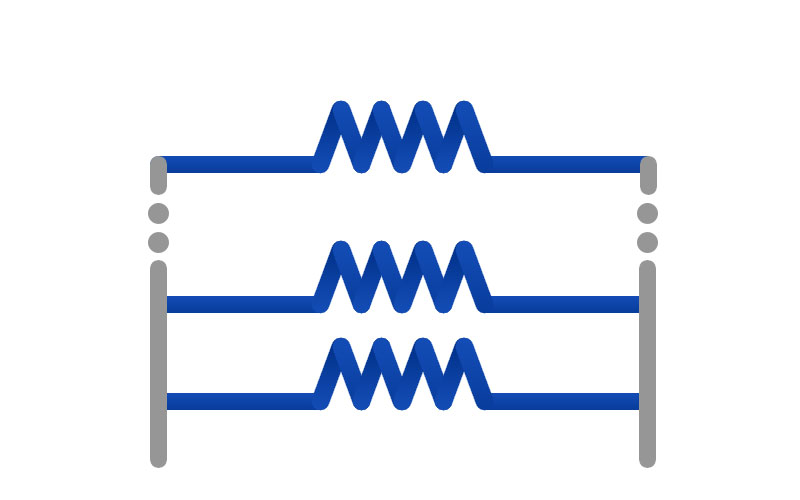
The formula for calculating the resistance of the parallel resistance is: 1/R and=1/R1+1/R2+1/R3+...1/Rn
E.g:
The resistance value R after the parallel connection of the four resistors of 10Ω, 10Ω, 100Ω, and 100Ω is:
1/R =1/10+1/10+1/100+1/100
1/R = 22/100
R ≈ 4.5Ω
Another example: the resistance R after the parallel connection of two resistors of 820Ω and 1.5kΩ is:
1/R = 1/820+1/1500
1/R = 116/61500
R ≈530.2Ω
Two typical applications of parallel resistors:
1. There is no suitable resistor: When a resistor with a suitable resistance cannot be found, it can be obtained by connecting multiple resistors in parallel.
2. The resistance power cannot meet the requirements: For example, if a 1W 25Ω resistor is needed in the circuit and there is no one on hand, it can be replaced by four 1/2W 100Ω resistors in parallel. Considering that the power is evenly distributed, the resistance values of the four resistors should be as consistent as possible.